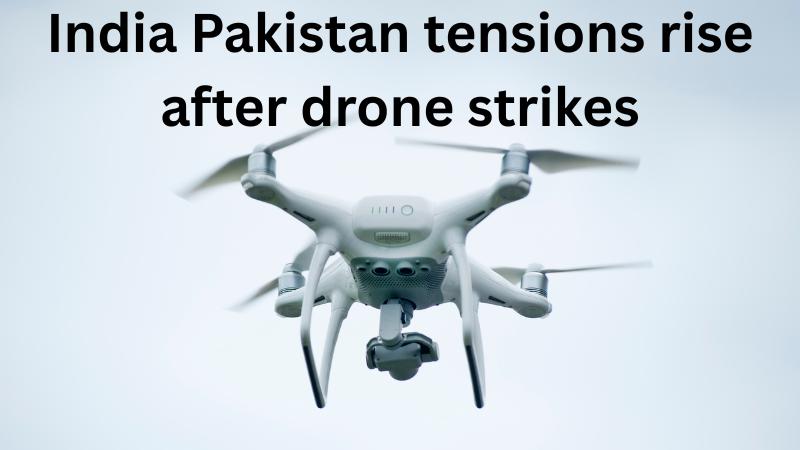
Pakistan has, for the first time, publicly acknowledged that Indian drone strikes caused damage at the strategically sensitive Nur Khan airbase in Rawalpindi during Operation Sindoor, marking a significant shift from its earlier attempts to downplay or deny the impact of the attacks. The admission came during a year-end press briefing on December 27, when Pakistan’s Deputy Prime Minister and Foreign Minister Ishaq Dar outlined the scale of the drone operation carried out by India in May.
According to Dar, India launched more than 80 drones over a 36-hour period, targeting key Pakistani military infrastructure. He claimed that Pakistani air defence systems intercepted 79 of the drones, but conceded that one drone managed to strike a military installation at the Nur Khan airbase, resulting in damage to facilities and injuries to personnel. While Dar described the overall impact as limited, his statement confirmed that the airbase, one of the most sensitive installations of the Pakistan Air Force, was indeed hit.
The Nur Khan airbase, located in Rawalpindi’s Chaklala area, lies close to Pakistan’s military headquarters and near the capital, Islamabad. Because of its location and operational importance, any strike on the base carries serious strategic implications. Dar’s comments marked a departure from Pakistan’s earlier public position, which had largely dismissed reports of significant damage following the Indian operation.
India launched Operation Sindoor in the early hours of May 7 in response to the April 22 terror attack in Pahalgam, Jammu and Kashmir, which killed 26 civilians. The operation initially involved coordinated strikes on nine terror camps in Pakistan and Pakistan-occupied Kashmir. As the situation escalated, Indian forces expanded the scope of the operation to include Pakistani military installations.
Indian assessments later indicated that at least 11 Pakistani air bases were targeted during the operation, including facilities in Sargodha, Rafiqui, Jacobabad, Muridke, and Nur Khan. Dar revealed that Pakistan’s civil and military leadership, led by Prime Minister Shehbaz Sharif, convened an emergency meeting on the night of May 9 to assess the unfolding situation and authorise response measures. He described India’s strike on Nur Khan in the early hours of May 10 as a serious and sensitive incident.
Reacting to Pakistan’s claims of minimal damage, Indian Army veteran Lieutenant General KJS Dhillon questioned the credibility of Islamabad’s narrative. Referring to Pakistani media reports, he pointed out that the announcement of 138 posthumous gallantry awards suggested far higher casualties than officially acknowledged. According to him, this discrepancy raised doubts about Pakistan’s assertion that only minor injuries were sustained. Videos circulating on social media, purportedly filmed by civilians, appeared to show parts of the Nur Khan base engulfed in flames, further fuelling questions over the true extent of the damage.
Pakistan’s leadership has previously hinted at the seriousness of the strikes. Prime Minister Shehbaz Sharif had earlier stated that Army Chief General Asim Munir informed him of the Nur Khan attack during the night of May 9–10. In July, Sharif’s adviser Rana Sanaullah disclosed that Pakistan had a narrow window of just 30 to 45 seconds to assess whether a missile heading towards Nur Khan carried a nuclear warhead, highlighting the extreme escalation risks involved.
Dar also claimed that Pakistan did not seek external mediation during the conflict, but said that US Secretary of State Marco Rubio and Saudi Foreign Minister Prince Faisal bin Farhan contacted Islamabad and later played a role in facilitating the May 10 ceasefire. The four-day confrontation eventually ended with an understanding to halt military action, underscoring how close the region came to a wider crisis.
Pakistan’s public admission of damage at Nur Khan airbase represents a notable moment in the ongoing India-Pakistan rivalry. It not only confirms the reach and precision of India’s drone capabilities but also highlights how modern warfare, driven by unmanned systems, is reshaping conflict dynamics in South Asia.