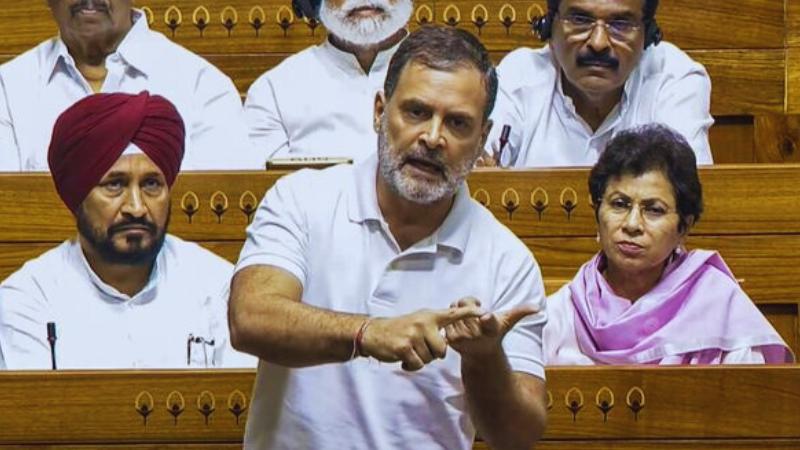
The Lok Sabha session on Tuesday was thrown into chaos after Rahul Gandhi, Leader of the Opposition, attempted to refer to an article based on former Army chief M M Naravane’s unpublished memoir. The reference ignited a fierce confrontation between the opposition Congress and the ruling BJP, which ultimately led to the adjournment of the proceedings. The tension arose when Gandhi, speaking on the Motion of Thanks to the President’s address, insisted on citing an article he claimed was linked to national security, drawing sharp objections from BJP MPs.
Gandhi, while addressing the House, declared, “I have authenticated it,” referring to the article in question. Under parliamentary rules, a member must authenticate a document by submitting a signed copy affirming its accuracy, but the Chair, Krishna Prasad Tenneti, intervened and asked Gandhi to table the document for examination. Despite this, Gandhi persisted, demanding to speak about the article, which he argued was crucial to national security, specifically concerning India’s relations with China and Pakistan.
The ruling BJP voiced strong objections, interrupting Gandhi repeatedly, while Congress MPs protested by tearing papers and throwing them toward the Speaker's chair. This led to the suspension of eight MPs and the adjournment of the session. Gandhi later criticized the ruling party, accusing them of deliberately silencing him and alleged that the government was trying to suppress his voice, particularly regarding the trade deal finalized between India and the US. He questioned why he was being prevented from speaking on an issue linked to national security, as he pointed to the India-China conflict and the deaths of soldiers in Eastern Ladakh.
In his address outside Parliament, Gandhi launched a scathing attack on Prime Minister Narendra Modi, accusing him of being under immense pressure due to the recent trade deal and other political pressures, including ongoing legal matters surrounding business tycoon Adani. He also alleged that the deal was detrimental to Indian farmers, claiming that Modi had “sold out” their hard work.
Kiren Rijiju, the Parliamentary Affairs Minister, defended the actions of the Chair, stating that Rahul Gandhi had tried to quote from a document that had not been permitted under parliamentary rules. He emphasized that the matter discussed by Gandhi was not part of the authorized debate on the President’s address and that Gandhi’s insistence on referencing the memoir led to disruptions, preventing other MPs from speaking.
This incident underscores the ongoing political tension within the Lok Sabha, with repeated disruptions over parliamentary procedures and sensitive national issues, including the Prime Minister’s policies and India’s diplomatic relations. The standoff has left many questioning the impact of such disruptions on the functioning of the legislature and the broader implications for governance in the country.