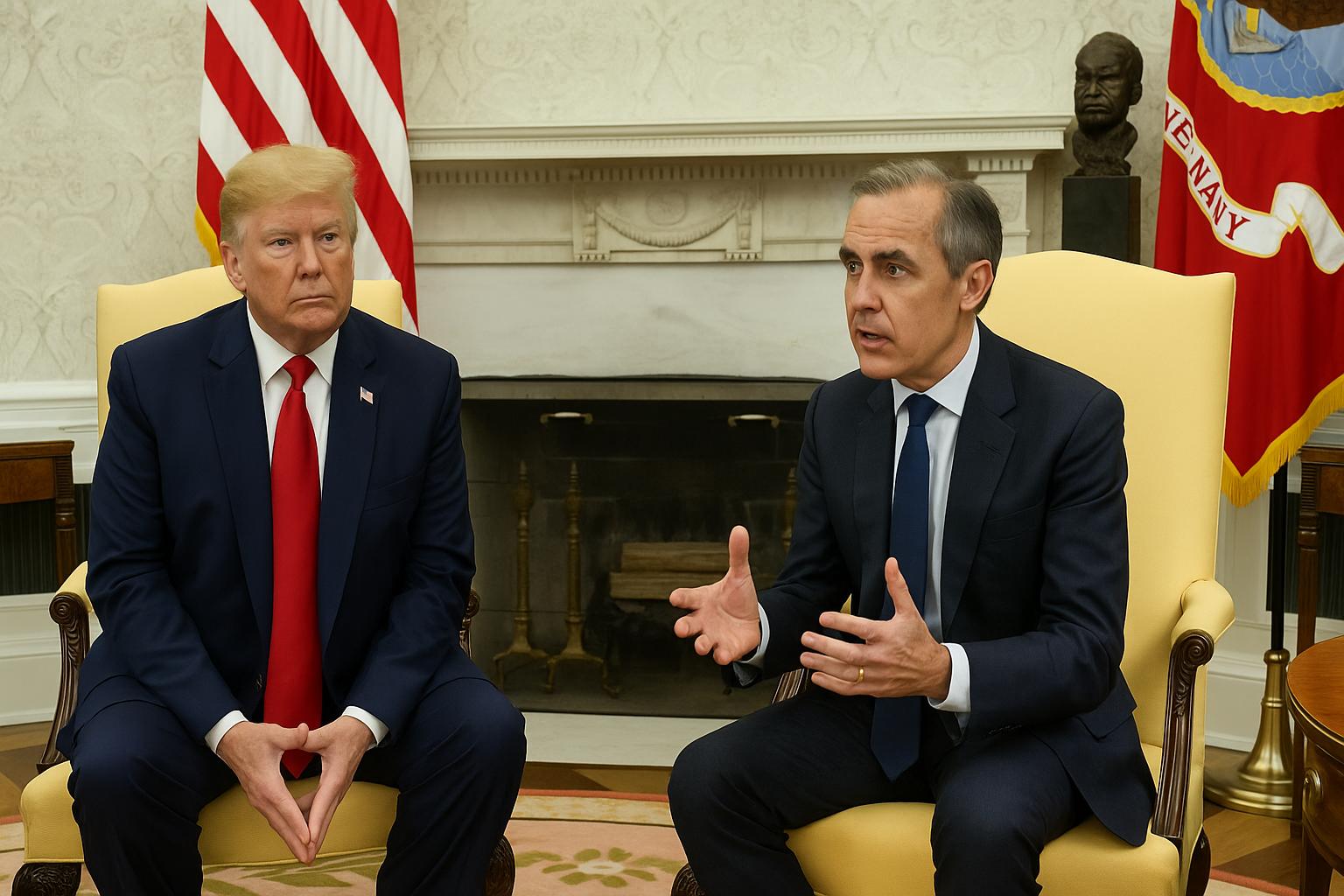
US President Donald Trump met with Canadian Prime Minister Mark Carney at the White House on Tuesday, October 7, for a high-level bilateral discussion focusing on economic cooperation and global security challenges. The meeting underscored the two nations’ long-standing partnership while also revealing areas of disagreement over trade priorities and international conflicts.
According to officials familiar with the discussions, President Trump and Prime Minister Carney covered a wide range of topics, including trade relations between the United States and Canada, the ongoing conflict in Gaza, and the Russia-Ukraine war. Both leaders emphasized the need for continued dialogue and cooperation amid global uncertainty. The meeting took place in the Oval Office and was described as cordial but direct, reflecting the pragmatic nature of their working relationship.
In his remarks following the meeting, President Trump said the United States and Canada share a deep economic bond but also face what he termed a “natural business conflict” due to their intertwined markets. “Canada will get the right deal,” Trump said, referring to future trade negotiations aimed at addressing long-standing disputes over tariffs, energy exports, and agricultural goods. The comment hinted at Trump’s intention to pursue what he views as a fairer trade balance while maintaining strong diplomatic ties.
Prime Minister Carney, who assumed office earlier this year, reiterated Canada’s commitment to strengthening bilateral cooperation with Washington, particularly in areas of trade, climate policy, and defense. He acknowledged differences in approach but said both nations are committed to ensuring stability in North America. “Our countries have a shared responsibility to protect the values we stand for—prosperity, peace, and fairness,” Carney said during a joint appearance with the US President.
The Gaza conflict and the ongoing war in Ukraine were also central to the talks. Trump expressed concern over the escalating violence in the Middle East and reaffirmed America’s support for efforts aimed at achieving a lasting ceasefire. On Ukraine, he said his administration continues to back diplomatic efforts to end hostilities and restore regional security. Carney voiced Canada’s alignment with these positions, calling for renewed international unity in response to humanitarian crises.
The discussions also touched on economic recovery measures in the aftermath of global disruptions. Both leaders acknowledged the importance of safeguarding supply chains and enhancing cooperation in energy production, technology, and manufacturing. Trump highlighted his administration’s goal of securing American industry while promoting balanced trade with Canada, the country’s largest trading partner.
The meeting comes at a time when the global economy faces multiple pressures from geopolitical conflicts and shifting alliances. For Washington, Canada remains a critical partner not only in trade but also in addressing broader issues such as border security, migration, and global health preparedness. Analysts view this engagement as a sign that both governments are seeking to reinforce their strategic partnership amid international uncertainty.
Observers noted that Trump’s characterization of the relationship as a “natural business conflict” reflects his long-standing approach to trade negotiations—assertive yet open to compromise. His administration’s trade strategy has focused on revisiting older agreements and creating new frameworks that prioritize domestic interests while sustaining key alliances.
As the meeting concluded, both Trump and Carney reaffirmed their intention to maintain regular dialogue on pressing international matters. While no formal agreements were announced, officials from both sides described the talks as productive and forward-looking. The leaders agreed to convene again in the coming months to further discussions on trade and foreign policy coordination.
The White House meeting highlighted the continued importance of US-Canada relations in an evolving global landscape. Despite differences over economic policies and international conflicts, both leaders projected a willingness to work together in pursuit of shared goals—strengthening North American trade, promoting peace, and addressing global challenges through diplomacy.