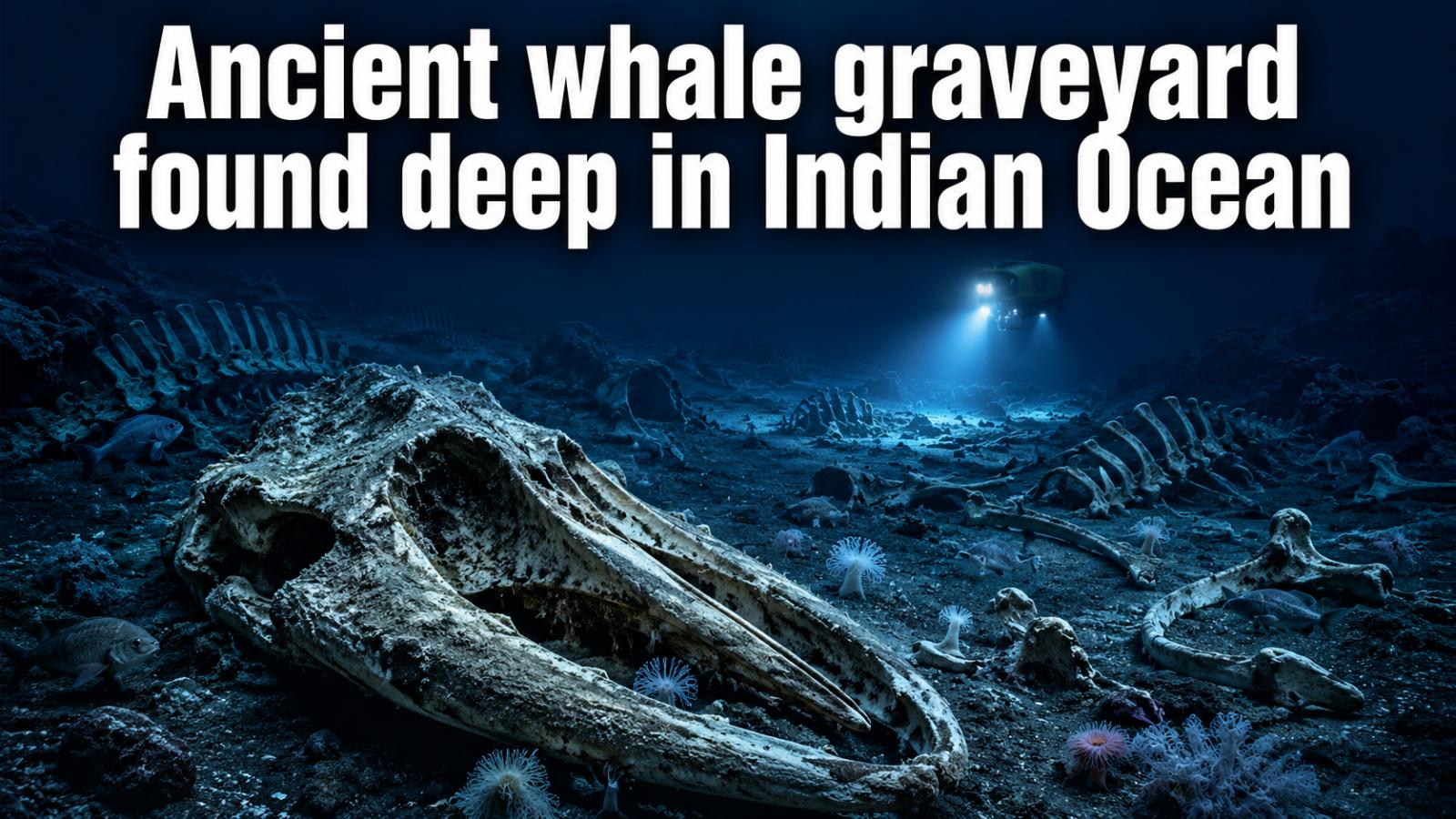
Scientists have found a remarkable whale graveyard more than seven kilometres below the surface of the south-eastern Indian Ocean. The discovery includes hundreds of ancient whale fossil sites as well as modern whale falls that continue to support life in one of the darkest and most extreme parts of the planet. Researchers say the site offers fresh clues about extinct whales, deep-sea biodiversity and how marine life survives far below sunlight.
The remains were found in the Diamantina Fracture Zone, a vast stretch of trenches and ridges on the ocean floor. This underwater region was shaped millions of years ago as Australia and Antarctica separated. Using a deep-sea submersible, researchers explored a long section of seabed and recorded an unusually large concentration of whale bones, fossils and carcass remains.
Whale falls create life in darkness
Researchers identified 485 fossil whale sites and five modern whale falls across nearly 1,200 kilometres of ocean floor. A whale fall forms when a dead whale sinks to the seabed, where its body becomes a major source of food and shelter for deep-sea creatures. These ecosystems can support life for years, especially in places where normal food sources are limited.
Most whale fall ecosystems have been recorded at depths below 4,000 metres, but this discovery goes far deeper. At more than 7,000 metres, the Indian Ocean whale graveyard is now considered one of the deepest known whale-fall ecosystems. The finding challenges the idea that the deepest ocean floor is empty and inactive.
Ancient fossils and new species
Among the ancient whale remains, scientists found fossils from extinct species. One major discovery was a skull believed to be about 5.3 million years old and linked to an ancient beaked whale. Researchers also identified a previously unknown species and named it Pterocetus diamantinae, after the Diamantina Fracture Zone where it was found.
The modern whale carcasses were also rich with life. Scientists observed crustaceans, molluscs, brittle stars and bone-eating worms living on or around the remains. Some of these organisms may be new to science, making the discovery important not only for fossil research but also for marine biology and the study of extreme ecosystems.
Why the discovery matters
The deep ocean whale graveyard shows how dead whales can become natural food stations in places where survival is difficult. In the deep sea, where sunlight never reaches and pressure is intense, whale remains provide rare nutrients that help many species live and reproduce.
For scientists, the discovery opens a new window into the history of whales and the hidden life of the ocean floor. It also shows that large parts of the deep ocean remain unexplored. The Indian Ocean site may help researchers better understand ancient marine migration, extinct whale species and the complex ecosystems that exist in the deepest parts of the sea.