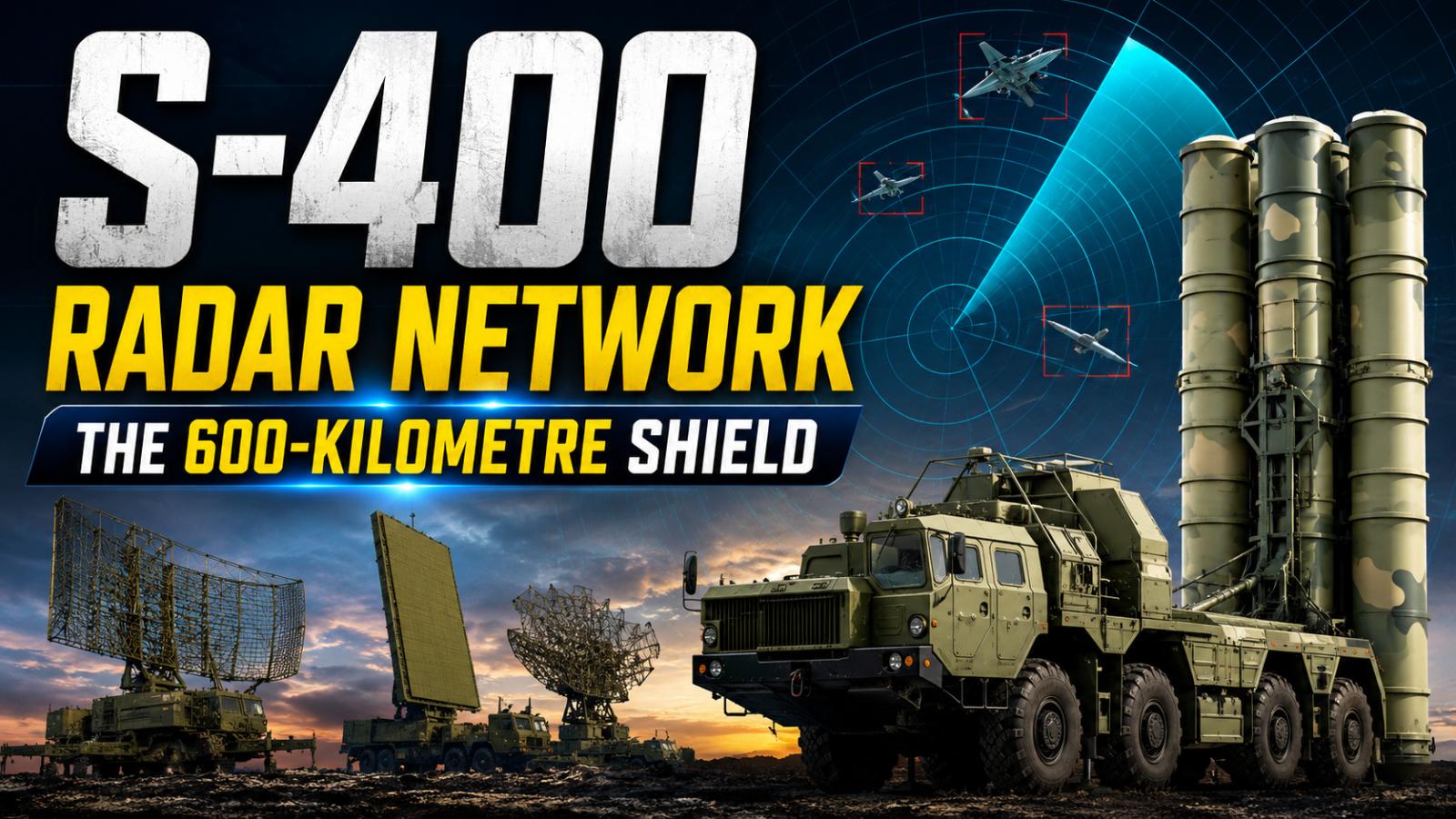
The S-400 radar network uses multiple advanced radar systems, including Big Bird, 96L6E, Nebo-M and 92N6E, to detect, track and engage aircraft, drones and missiles. This article explains how these sensors work together to create one of the world's most advanced layered air defence systems.
S-400 radar network creates layered surveillance
The S-400 Triumf does not depend on a single radar to detect and engage every type of aerial threat. Instead, it connects several sensors and command vehicles that perform different roles, from broad-area surveillance to precision target tracking.
At the centre of this structure is the 91N6E surveillance radar, commonly associated with the NATO reporting name Big Bird. The radar scans a wide area, gathers information about approaching objects and sends the data to the system’s command network. Published specifications commonly associate it with long-range detection and the ability to monitor hundreds of objects, although actual performance depends on altitude, terrain, electronic interference and target characteristics.
The S-400’s missile engagement range should not be confused with its radar detection range. Rosoboronexport lists a maximum engagement range of up to 380 kilometres against aerodynamic targets and up to 60 kilometres against ballistic targets for the export configuration.
Big Bird radar and command processing
Information collected by Big Bird is transmitted to the 55K6E mobile command post. The command vehicle processes radar returns, identifies possible threats and decides which targets require immediate attention. It can also coordinate information from supporting radars and distribute targets among connected missile units.
This digital command structure reduces the time between detection and engagement. Rather than allowing every launcher to operate independently, the network creates a shared operational picture and assigns resources according to the speed, direction, altitude and perceived danger of each target.
The system can also exchange information with other air-defence assets when deployed within a wider integrated network. This makes the command element just as important as the missile launchers because effective air defence depends on detecting, classifying and prioritising threats before weapons are fired.
96L6E and Nebo-M improve threat detection
Low-flying cruise missiles and drones present a difficult challenge because terrain and the curvature of the Earth can hide them from distant radar coverage. The 96L6E all-altitude radar supports the S-400 radar network by improving surveillance at different heights and providing additional target data.
Operators may also connect the S-400 with external systems such as the Nebo-M radar complex. Nebo-M uses radars operating across different frequency bands to improve the detection and classification of varied aerial objects. Lower-frequency radars may provide useful warning against aircraft designed to reduce their radar signature, while higher-frequency sensors can provide more precise tracking information.
However, describing any radar as capable of automatically “exposing” every stealth fighter would be misleading. Stealth technology reduces detection and tracking opportunities rather than making an aircraft completely invisible. Radar performance still depends on distance, angle, frequency, weather, electronic warfare and the target’s design.
92N6E radar guides interceptor missiles
After the command network selects a target, the 92N6E engagement radar performs the precision tracking needed for interception. Often referred to by the NATO name Grave Stone, it follows assigned targets and provides guidance data to interceptor missiles during an engagement.
The number of targets and missiles handled varies by configuration. Rosoboronexport currently states that a full S-400 air-defence missile system can engage up to 80 targets while guiding as many as 160 missiles. It lists up to 10 targets and 20 guided missiles for a single air-defence division.
These official figures differ from the frequently repeated claim that every S-400 configuration can engage exactly 36 targets while guiding 72 missiles. Such numbers may refer to particular arrangements or earlier published configurations and should not be presented as universal capabilities.
The S-400’s real strength lies in its layered design. Surveillance radars search for threats, specialised sensors improve coverage, the command post prioritises targets and the engagement radar guides missiles. That coordination allows the Triumf system to respond to aircraft, drones, cruise missiles and some ballistic threats, while its actual effectiveness remains shaped by deployment conditions, crew training, radar coverage and enemy countermeasures.