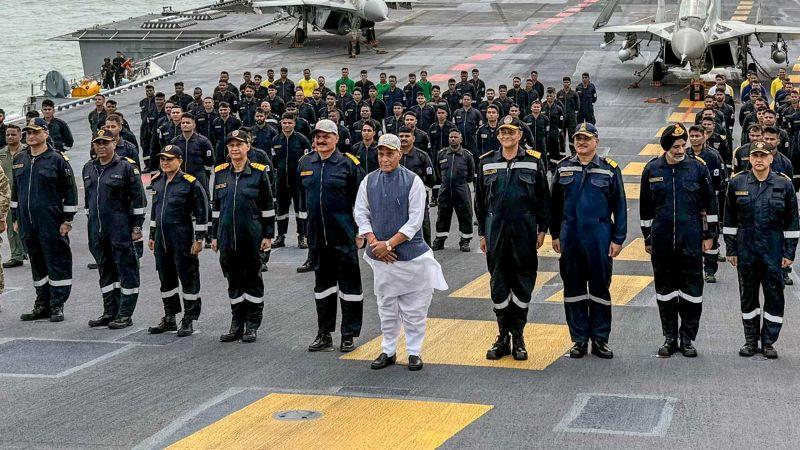
During a high-level visit aboard INS Vikrant, India’s first indigenously built aircraft carrier, Defence Minister Rajnath Singh issued a powerful statement underscoring the unmatched capabilities of the Indian Navy. Speaking from the Arabian Sea, Singh remarked that if the Indian Navy had joined active combat during Operation Sindoor, Pakistan could have faced consequences far more severe than in 1971, potentially splitting into four parts.
Referring to the Navy’s role in the recent Operation Sindoor, Singh said the force maintained strategic dominance and confined Pakistan’s naval assets to their own shores. Without even firing a shot, the Navy's aggressive deployment and preparedness were enough to demoralize the adversary. The Defence Minister emphasized how the presence of the Carrier Battle Group, led by INS Vikrant, played a critical deterrent role, keeping Pakistani forces in a defensive posture.
According to the official statement, the Navy launched precision strikes from both surface and air platforms within 96 hours of the terror attack that prompted Operation Sindoor. Singh highlighted that the Navy’s maritime awareness, surveillance, and dominance prevented Pakistani air and naval operations, ensuring control over the Arabian Sea. Naval pilots conducted day and night sorties, displaying India's strategic readiness.
Rajnath Singh cautioned that the current phase was only a warm-up, and warned Pakistan that future provocations would face full naval retaliation. He also praised the Navy’s ability to bottle up enemy forces, making clear that India’s maritime force is prepared for any future conflict. The Navy is also set to grow stronger with the addition of Rafale Marine fighter jets, boosting the capabilities of INS Vikrant and enhancing India's goal of a self-reliant defence system.