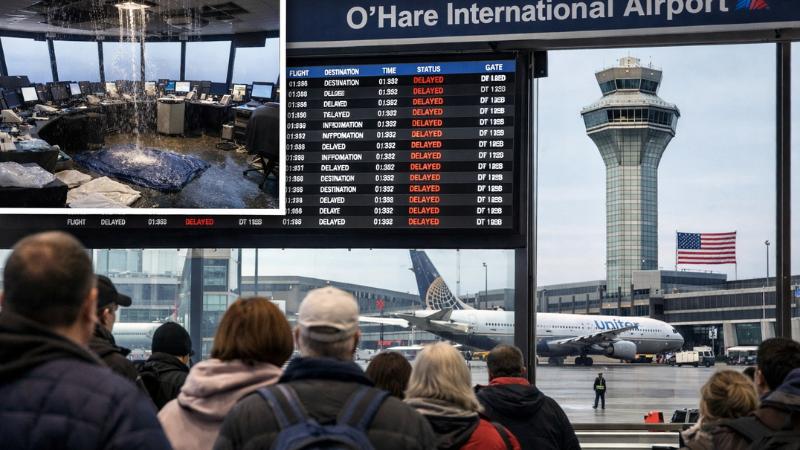
Operations at Chicago’s O’Hare International Airport were significantly disrupted Tuesday after a burst water pipe forced the evacuation of the airport’s primary air traffic control tower, triggering a prolonged ground delay program and affecting hundreds of flights throughout the day. Federal aviation officials confirmed the incident occurred during the early morning hours and continued to impact air traffic well into the evening.
The situation began at approximately 1:10 a.m. when a water pipe failed inside the main air traffic control tower. The incident prompted the immediate evacuation of air traffic controllers working in the facility as a safety precaution. Controllers were temporarily relocated to the airport’s south control tower, where they resumed operations under adjusted procedures to maintain essential flight management functions.
Shortly after the evacuation, the Federal Aviation Administration implemented a ground delay program for O’Hare. The measure was designed to manage air traffic flow while staffing and operational capacity were reduced. As of mid-morning, the FAA indicated that the ground delay program remained in effect and was expected to continue for much of the day, with projected delays extending into the evening hours.
Flight tracking data showed widespread disruption across the airport, one of the busiest aviation hubs in the United States. More than 400 flights were reported delayed by Tuesday morning, with many experiencing wait times exceeding 45 minutes. The delays affected both arriving and departing flights, creating a ripple effect across domestic and international travel schedules.
FAA officials confirmed that the main air traffic control tower remained closed as crews assessed the extent of the damage caused by the water intrusion. The full impact on equipment and infrastructure had not yet been determined, and officials said it was too early to estimate when normal operations would be fully restored. An investigation was launched to determine the cause of the pipe failure and to evaluate any structural or maintenance issues that may have contributed to the incident.
Airport authorities worked alongside federal officials to manage passenger flow and minimize congestion within terminals. Travelers were advised to check directly with airlines for updated flight information and to allow extra time when traveling to or from the airport. Airlines adjusted schedules and staffing as they worked to accommodate delayed passengers and reposition aircraft.
Despite the disruption, officials emphasized that safety remained the top priority and that the relocation of controllers allowed critical air traffic services to continue. The incident underscored the complexity of airport operations and the cascading impact that infrastructure issues can have on air travel, particularly at major hubs such as O’Hare.
As repair efforts and inspections continued, officials said updates would be provided as more information became available. The FAA noted that restoring full capacity would depend on the outcome of the damage assessment and the completion of necessary repairs, while reiterating its commitment to maintaining safe and efficient air travel operations.


 Joyful
0%
Joyful
0%
 Cool
0%
Cool
0%
 Thrilled
0%
Thrilled
0%
 Upset
0%
Upset
0%
 Unhappy
0%
Unhappy
0%