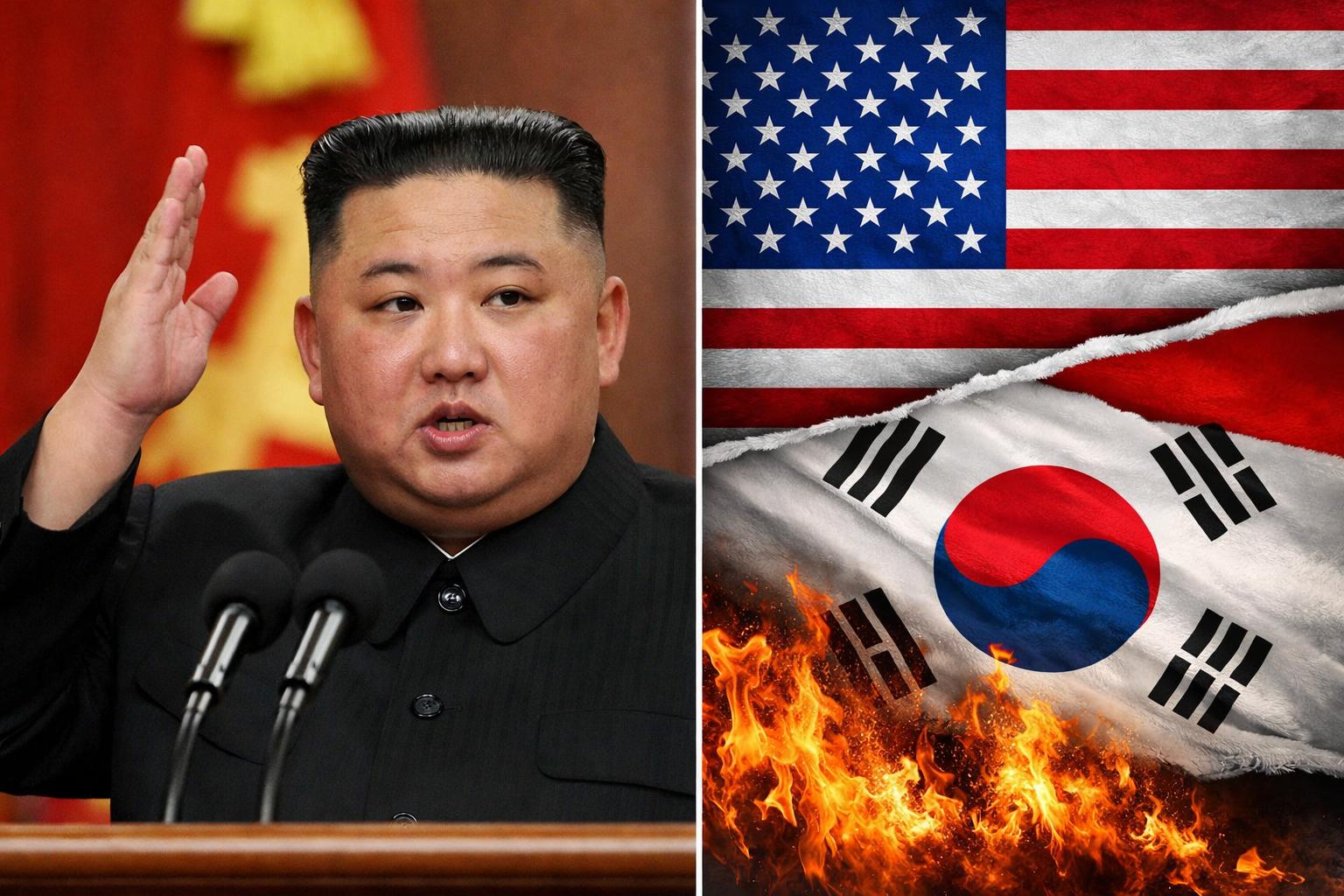
North Korean leader Kim Jong Un has concluded a rare party congress with a pointed message to the United States, stating that Pyongyang could improve relations with Washington if it is recognised as a nuclear power. At the same time, he hardened his stance toward South Korea, describing it as the country’s “most hostile” enemy and ruling out further engagement.
According to state media reports released on February 26, Kim said there was “no reason” North Korea and the United States could not “get along” provided Washington respects Pyongyang’s constitutional status as a nuclear-armed state and abandons what he characterised as a hostile policy. He emphasised that if the United States acknowledges North Korea’s current position and withdraws its adversarial approach, the path would be open for improved ties between the two countries.
The remarks come amid speculation that former US President Donald Trump could seek renewed diplomatic engagement with Kim, potentially including a meeting during a reported visit to China in April. Although no summit has been officially confirmed, Trump has previously indicated he would be “100 per cent” open to talks with North Korea. He has also described the country as “sort of a nuclear power,” language that marked a departure from longstanding US policy that avoids recognising Pyongyang’s nuclear status.
A renewed meeting would represent a significant shift after diplomatic efforts stalled following the failed 2019 Hanoi summit. That meeting ended without agreement as negotiations over sanctions relief and denuclearisation broke down. Since then, dialogue between the two sides has remained largely frozen, with tensions persisting over North Korea’s weapons programmes and regional security concerns.
While Kim signalled conditional flexibility toward the United States, his comments on South Korea were markedly uncompromising. He declared that Pyongyang would “permanently exclude” Seoul as one of its compatriots and labelled it the North’s “most hostile” entity. Kim asserted that North Korea had “absolutely no business dealing” with the South, dismissing recent overtures from Seoul as deceptive.
The rhetoric follows a constitutional revision in 2024 that formally defined South Korea as a “hostile state,” a significant departure from decades of official language that framed inter-Korean relations around eventual reunification. The change underscored a deepening divide on the Korean Peninsula and signalled a strategic recalibration in Pyongyang’s approach to inter-Korean relations.
Analysts say the contrasting messages reflect a calculated diplomatic posture. By leaving the door open to Washington while closing it to Seoul, North Korea appears to be seeking leverage in any potential future negotiations with the United States. The developments highlight the continuing volatility in regional security dynamics and raise fresh questions about the prospects for denuclearisation and long-term stability on the Korean Peninsula.