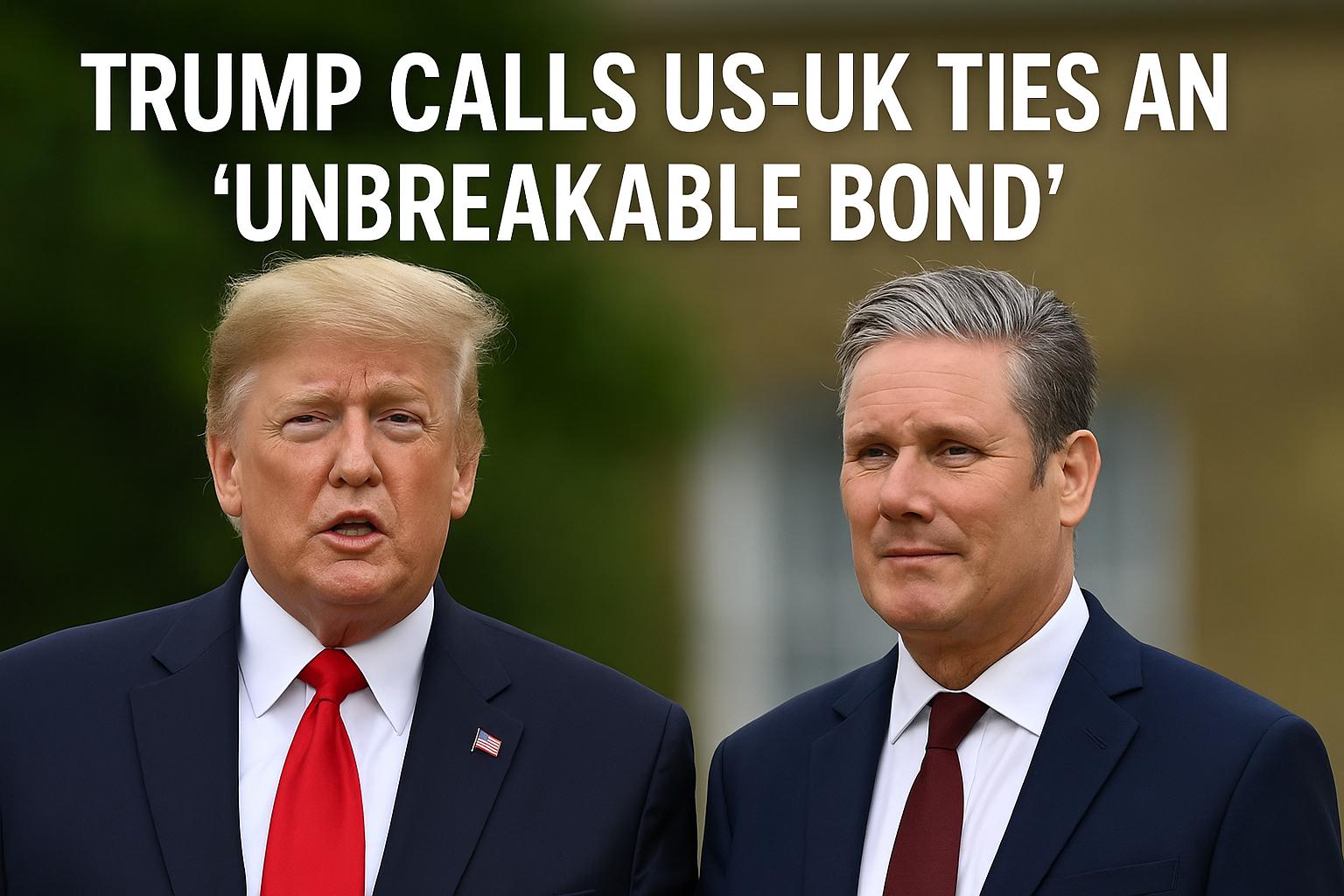
US President Donald Trump has described the relationship between the United States and the United Kingdom as an “unbreakable bond,” highlighting both its historical significance and present-day strength. Speaking at a business roundtable alongside British Prime Minister Sir Keir Starmer, Trump emphasized that the bilateral partnership is not only rooted in history but also evolving with unprecedented trade and investment initiatives. He called the ties between the two nations “a beautiful inheritance” that has become stronger with every passing decade, suggesting that the relationship is so deeply ingrained that it will remain intact regardless of current political shifts.
Prime Minister Starmer echoed Trump’s words, describing the relationship as “the very foundation of our security, our freedom and our prosperity.” He stressed that the transatlantic connection between Washington and London is essential not only for the economic well-being of both countries but also for maintaining global security at a time of mounting international crises.
The highlight of Trump’s state visit to the UK was the signing of the “Tech Prosperity Deal,” which Trump and Starmer announced as a landmark in the history of bilateral economic relations. Under this agreement, American technology companies pledged investments of nearly $42 billion into the UK economy. Coupled with additional trade and cooperation packages, the total value of cross-Atlantic deals reached an estimated $340 billion. Starmer described the announcements as “breaking all records” in British history for foreign investment inflows, emphasizing that these commitments represent both economic opportunity and a reinforcement of mutual trust between the two nations.
“What a day — £250 billion or $340 billion flowing both ways across the Atlantic. It is the biggest investment package of its kind in British history,” Starmer told business leaders, praising the United States for its role in strengthening prosperity. He argued that the size and scope of these deals were a testament to the strength of the special relationship, which has continued to flourish despite changing global dynamics.
Beyond economic cooperation, the visit carried heavy diplomatic weight. Starmer and Trump reportedly discussed pressing geopolitical issues, including Russia’s continued war in Ukraine and the Israeli-Palestinian conflict in Gaza. Reports suggested that Starmer sought to push Trump to take a stronger stance against Russia, particularly after Moscow escalated attacks beyond Ukraine by launching aerial incursions into the airspaces of NATO members Poland and Romania. For Britain, ensuring that the United States remains firmly committed to European security is essential, and Starmer is said to have urged Trump to go beyond his current measures to press Moscow into serious peace talks.
Trump has recently won approval in Europe for acknowledging Russia as the aggressor and authorizing the first arms package under a NATO-led procurement system, signaling renewed support for European allies. Yet, the two leaders may face significant differences over the Gaza conflict. Starmer has pledged support for a two-state solution and is reportedly preparing to formally recognize Palestinian statehood as early as this weekend, a move that reflects mounting pressure from within his party and constituents.
In contrast, Trump has aligned himself closely with Israeli Prime Minister Benjamin Netanyahu and has proposed controversial policies that critics argue eliminate any possibility of a two-state resolution. Trump’s position on Gaza has been to support Israeli security efforts unconditionally, framing recognition of Palestinian statehood as rewarding terrorism. This stark divergence could pose challenges in what has otherwise been a broadly cooperative meeting.
Still, Trump’s warm words and Starmer’s reaffirmation of the special relationship underline the durability of the partnership between the two nations. Despite ongoing differences in foreign policy, the combination of unprecedented trade agreements, long-standing defense ties, and cultural and historical bonds continue to sustain what both leaders have described as an “unbreakable bond.”
The United States and the United Kingdom now face the task of not only implementing the vast new trade deals but also navigating their differences on global conflicts. With both nations under pressure to act decisively in response to Russia’s war in Ukraine and the humanitarian crisis in Gaza, their ability to cooperate on security and diplomacy will prove just as critical as their historic economic alliance.
At a time when the global order faces mounting strains, the Trump-Starmer partnership and the record-breaking $340 billion in cross-Atlantic agreements stand as a powerful signal that the transatlantic alliance remains resilient. For both Trump and Starmer, the special relationship continues to be not only a matter of history but also a cornerstone of future strategy, security, and prosperity.