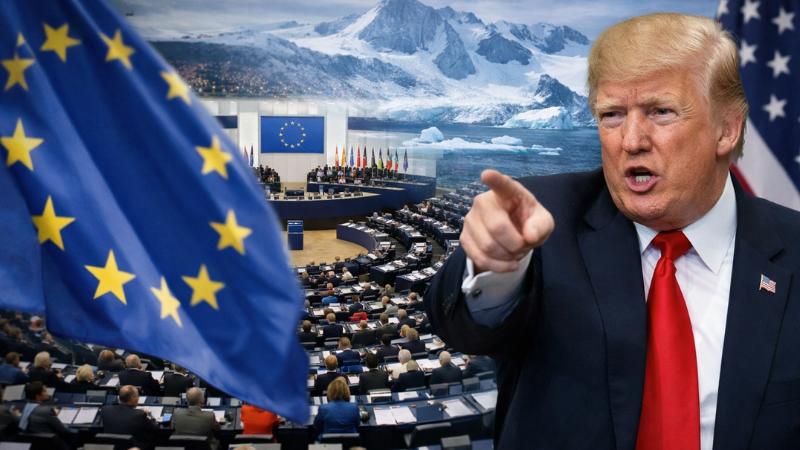
The European Parliament has suspended its work on a proposed trade agreement between the European Union and the United States, citing escalating political pressure from US President Donald Trump. The decision follows Trump’s renewed push to acquire Greenland and his warnings of punitive tariffs against European countries that resist the plan, developments that lawmakers say have undermined the basis of the deal.
Members of parliament had been reviewing draft legislation aimed at cutting a broad range of EU import duties on American goods. Those proposals formed a central pillar of the political agreement reached in Turnberry, Scotland, at the end of July. Lawmakers were also considering extending zero-tariff access for US lobster imports, an arrangement first agreed in 2020. Both measures require formal approval from the parliament and from EU member states before they can take effect.
Although the proposed agreement has drawn criticism within the legislature for being skewed in Washington’s favor, a majority of lawmakers had appeared willing to advance it under strict conditions. Critics pointed to the fact that the EU would eliminate most of its import duties while the United States would retain a general tariff of around 15 percent on European goods. To address those concerns, parliamentarians had sought safeguards, including an 18-month sunset clause and mechanisms to limit market disruption in the event of a surge in US imports.
The European Parliament’s trade committee had been expected to finalize its position during votes scheduled for January 26 and 27. Those votes have now been postponed indefinitely. Committee chair Bernd Lange told reporters that Trump’s latest tariff threats had effectively dismantled the political understanding reached in Turnberry, leaving the legislative process without a viable foundation.
Freezing the agreement carries the risk of retaliation from Washington and could lead to higher US tariffs on European exports. The Trump administration has signaled that it will not consider concessions, such as lowering duties on European spirits or steel, until the trade deal is formally approved and implemented.
Trump has warned that several EU member states could be targeted if they oppose his stance on Greenland, an autonomous territory of Denmark. Among those cited are major economies such as France and Germany, raising concerns in European capitals about the broader implications for transatlantic trade relations.
EU leaders are due to meet in Brussels for an emergency summit to discuss the situation and assess possible responses. Options under consideration include formally shelving last year’s trade agreement and reactivating a package of retaliatory tariffs worth up to 93 billion euros. That package was approved during the peak of last year’s EU-US trade dispute but was temporarily suspended until February 6 in an effort to prevent a full-scale trade war.
Separately, Emmanuel Macron has urged the EU to prepare to activate its anti-coercion trade instrument if the United States proceeds with its threats. The tool would allow the bloc to respond more forcefully to what it considers economic intimidation, underscoring the growing strain on economic and political ties between the two sides of the Atlantic.