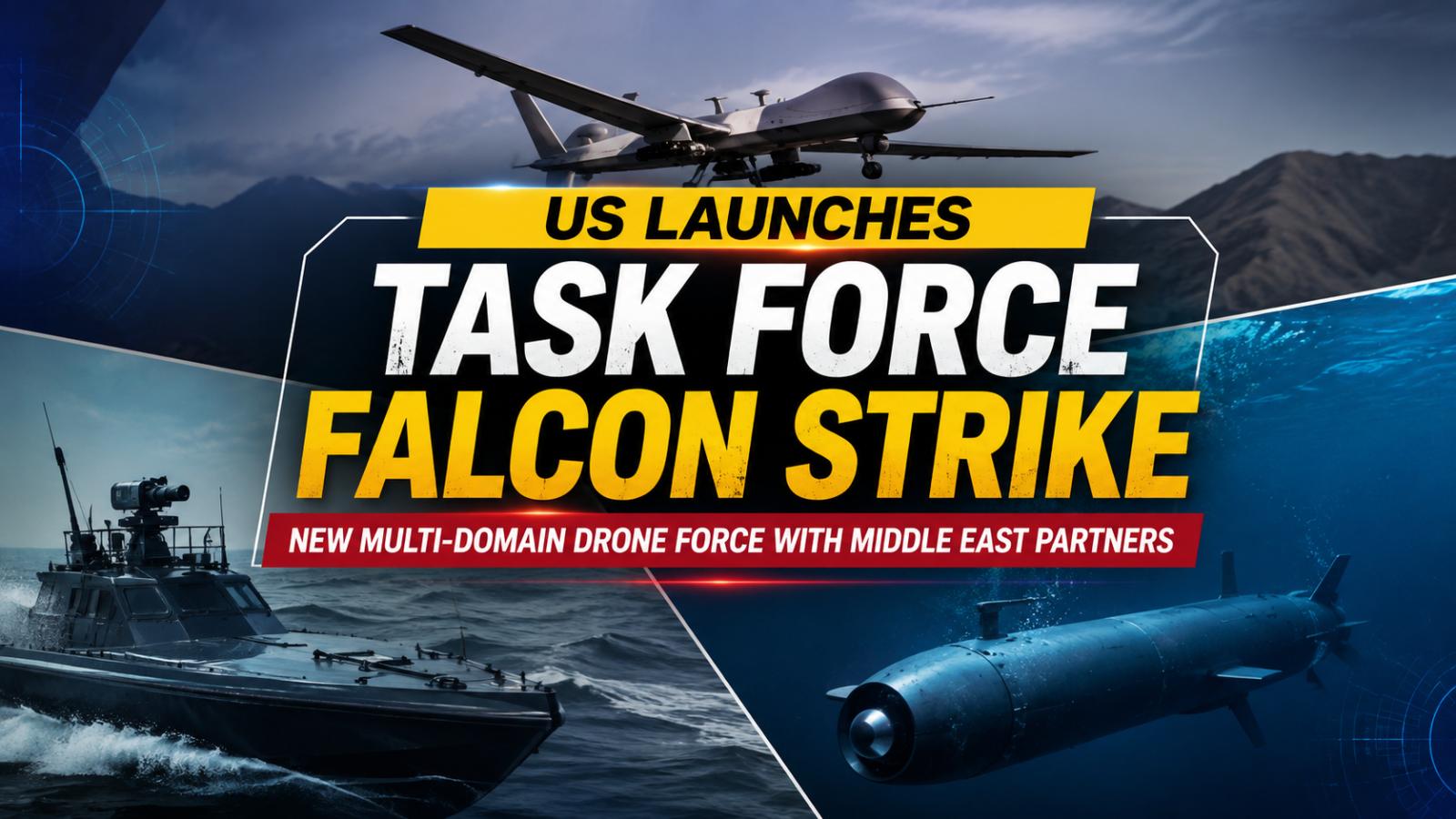
The United States has launched Task Force Falcon Strike, a new multinational attack drone initiative designed to operate unmanned systems above, on and below the sea. CENTCOM says the force will combine US capabilities with regional partners as Washington expands drone warfare across the Middle East.
Attack drone force expands across multiple domains
U.S. Central Command announced Task Force Falcon Strike on August 13, describing it as the first multi-domain, multinational attack drone task force of its kind. The force will use one-way attack drones and other unmanned systems operating from the air, surface of the sea and below the water.
Military personnel from the United States and participating regional partners will operate and support the systems. CENTCOM has not yet identified which countries will join the initiative. Instead, the command said consultations have begun and regional governments are being formally invited to participate.
That distinction is important. Falcon Strike is being established as a multinational structure, but its final membership and operational footprint have not yet been publicly disclosed.
Scorpion Strike laid foundation for new drone force
Task Force Falcon Strike builds on Task Force Scorpion Strike, which CENTCOM established in December 2025 as the US military's first dedicated one-way attack drone squadron based in the Middle East.
Scorpion Strike initially fielded Low-cost Unmanned Combat Attack System, or LUCAS, drones. CENTCOM said the systems were designed for long-range autonomous operations and could launch through several methods, including catapults, rocket-assisted takeoff and mobile platforms.
Since then, the unit has expanded beyond its initial aerial role. CENTCOM says Scorpion Strike achieved the first launch of an aerial attack drone from a US Navy warship in December 2025. It also deployed one-way aerial systems during Operation Epic Fury and unmanned attack vessels during strikes on Iranian port facilities in July 2026.
CENTCOM drones move toward regional integration
Adm. Brad Cooper, commander of US Central Command, said Falcon Strike would build on the progress made by Scorpion Strike while taking advantage of innovation among US allies and regional partners.
The larger goal is to connect separate unmanned capabilities into one coordinated deterrence network. CENTCOM said Falcon Strike will eventually scale attack drone capabilities across the region into a unified multi-domain and multinational force as partner nations formally join.
That approach reflects a wider shift in modern warfare. Low-cost unmanned systems can provide surveillance and strike options while reducing the need to place crews directly in contested environments. Combining air, surface and undersea platforms could also make drone operations harder for an adversary to counter from a single defensive layer.
SOCCENT will lead Task Force Falcon Strike
Personnel from U.S. Special Operations Command Central, or SOCCENT, will lead Falcon Strike's staff alongside representatives from regional partners. SOCCENT previously led the development of Scorpion Strike and operates across CENTCOM's 21-country area of responsibility.
The command is headquartered at MacDill Air Force Base in Tampa, Florida, and plans special operations across the Middle East, Central Asia and South Asia.
Falcon Strike therefore represents more than the creation of another drone squadron. It signals an effort to build a regional network in which allied forces develop, operate and integrate unmanned strike systems together. How significant that force becomes will depend on which countries join, what systems they contribute and how quickly CENTCOM can turn the multinational concept into operational capability.