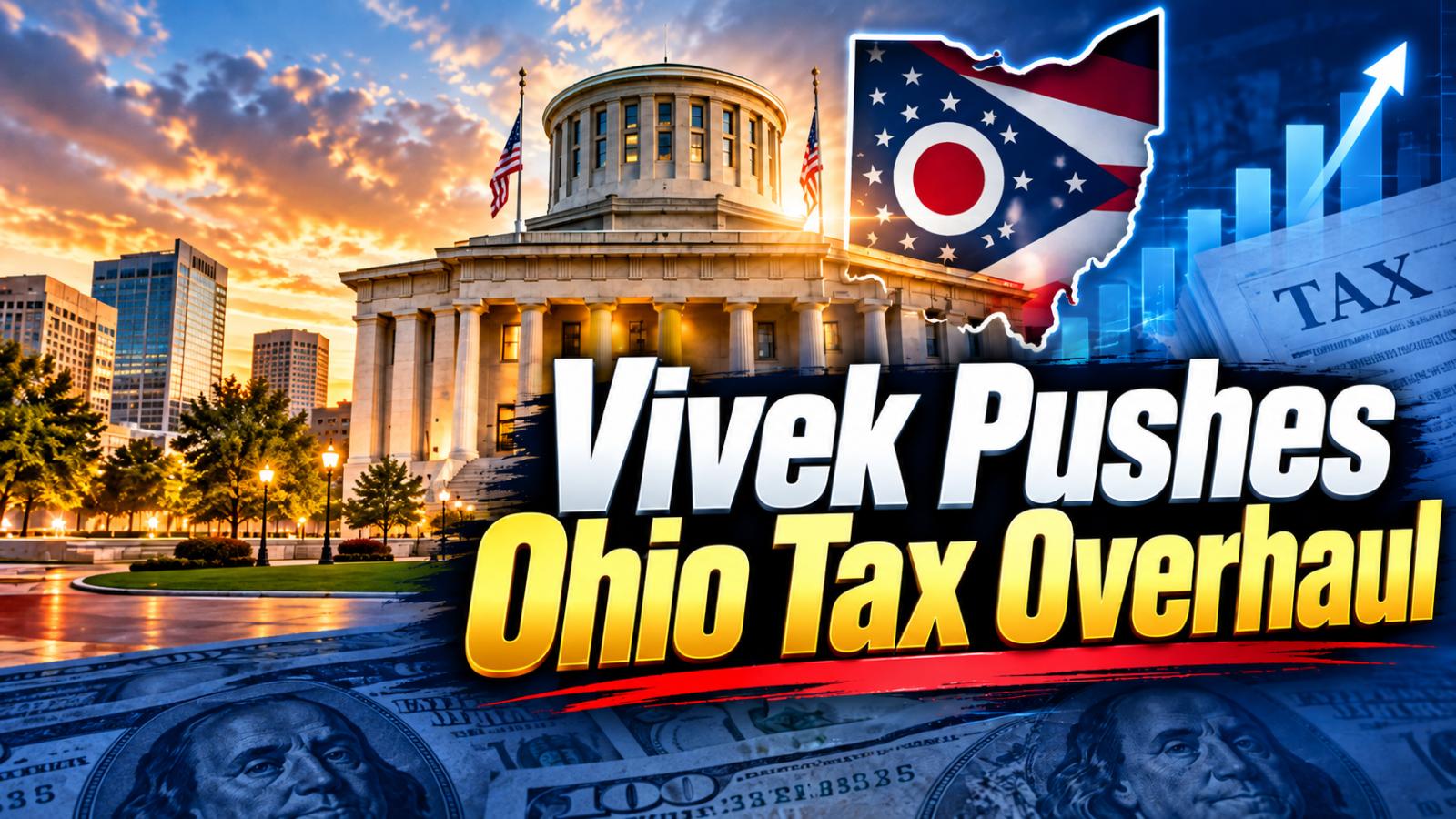
Vivek Ramaswamy’s Ohio tax plan is becoming a central issue in the race for governor, with proposals to phase out income tax, reduce property tax burdens and intensify Medicaid fraud enforcement as he competes against Democrat Amy Acton ahead of the November 3 election.
Income Tax
Republican nominee Vivek Ramaswamy has pledged to make Ohio a zero-income-tax state if elected governor. His plan would phase out the individual income tax over roughly eight to 10 years, beginning with the elimination of taxes on capital gains.
Ohio already moved to a 2.75% flat individual income tax in 2026, but Ramaswamy argues that eliminating the tax entirely would make the state more attractive to businesses, investors and workers. He has said stronger economic growth and reductions in government bureaucracy could help offset lost revenue.
The proposal also faces questions over how Ohio would replace billions of dollars in revenue. Gov. Mike DeWine has urged the next administration not to pursue further income-tax reductions, arguing that businesses are more focused on workforce quality and infrastructure than state income-tax rates.
Property Tax
Ramaswamy has also shifted his position on property taxes. Earlier in the campaign, he discussed eliminating them entirely, but he now proposes rolling property taxes back toward 2020 levels and limiting future increases.
The issue has gained urgency as higher property valuations have pushed up tax bills for many homeowners. Ramaswamy says the rollback could provide immediate relief without harming schools, police or fire departments. Critics argue that local governments depend heavily on property-tax revenue and warn that deep reductions would require replacement funding or spending cuts.
Medicaid Fraud
Medicaid reform forms the third major part of Ramaswamy’s economic agenda. His campaign has proposed simplifying the program’s administration, improving coordination between state and federal authorities and making Medicaid fraud prosecution a statewide enforcement priority.
More than 3 million Ohioans receive Medicaid coverage, and state officials say the program now costs more than $40 billion annually. Ramaswamy argues that fraudulent providers increase costs for taxpayers and divert resources from people who legitimately depend on the program.
Acton Race
Ramaswamy is running against Democratic nominee Amy Acton, with Libertarian Don Kissick also appearing on the official November 3 ballot. Acton has taken a different approach to affordability, emphasizing greater state support for schools and expanded property-tax relief rather than large reductions in state revenue.
The contrast gives Ohio voters a clear policy choice: Ramaswamy is betting that lower taxes, smaller government and tougher fraud enforcement will accelerate growth, while Acton argues that stronger public investment is necessary to reduce pressure on local taxpayers.
Fraud Enforcement
The Medicaid issue is not theoretical. Ohio’s Attorney General has announced several fraud prosecutions in 2026, including a September case involving 18 providers accused of stealing more than $355,000 and a June case alleging a $12 million Medicaid scheme.
These cases strengthen Ramaswamy’s argument that enforcement deserves greater attention, but they do not by themselves prove that fraud savings would be large enough to finance his broader tax agenda. That remains one of the central fiscal questions facing his campaign.