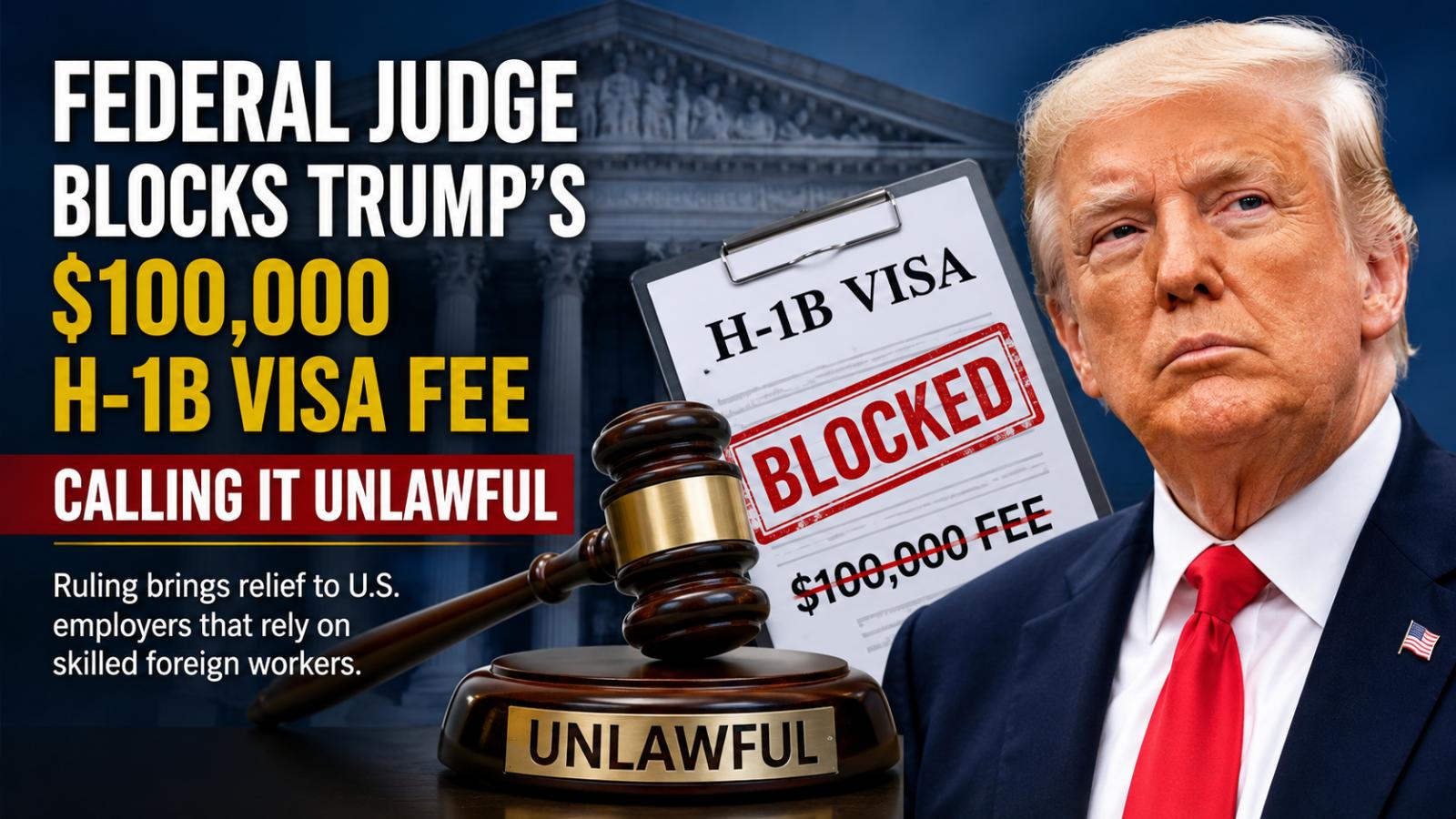
A federal judge in Boston blocked President Donald Trump’s $100,000 H-1B visa fee on Monday, June 8, 2026, ruling that the charge was unlawful and must be vacated.
The H-1B visa fee ruling gives immediate relief to U.S. employers that depend on skilled foreign workers in technology, engineering and other specialized fields.
H-1B Visa Fee Ruling Deals Setback to Trump Administration
U.S. District Judge Leo T. Sorokin ruled in Massachusetts that the administration exceeded its authority by imposing the $100,000 fee on new H-1B visa applications. The lawsuit was brought by 20 Democratic state attorneys general, who argued that the president could not create such a large charge without approval from Congress.
Sorokin found that the fee functioned more like an unlawful tax than a normal immigration processing fee. His ruling means the $100,000 charge cannot be enforced under the order reviewed by the court unless a higher court later changes the outcome.
Why the $100,000 H-1B Fee Mattered to Employers
The H-1B visa program allows U.S. employers to hire foreign workers for specialized jobs, including roles in technology and other skilled industries. The proposed $100,000 fee would have sharply increased the upfront cost of each new application.
Employers and states challenging the fee said the policy could disrupt hiring plans, especially for companies and institutions that rely on hard-to-fill specialized roles. The Trump administration argued the measure was part of a broader effort to protect American workers and encourage companies to hire domestically.
Immigration Debate Continues After Court Ruling
The ruling does not end the larger political debate over H-1B visas. Supporters say the program helps U.S. employers fill critical talent gaps, while critics argue it can reduce opportunities or wages for American workers.
For now, the decision removes a major cost barrier for employers seeking skilled foreign talent. It also raises a broader question over how far a president can go in reshaping legal immigration policy without direct congressional approval.