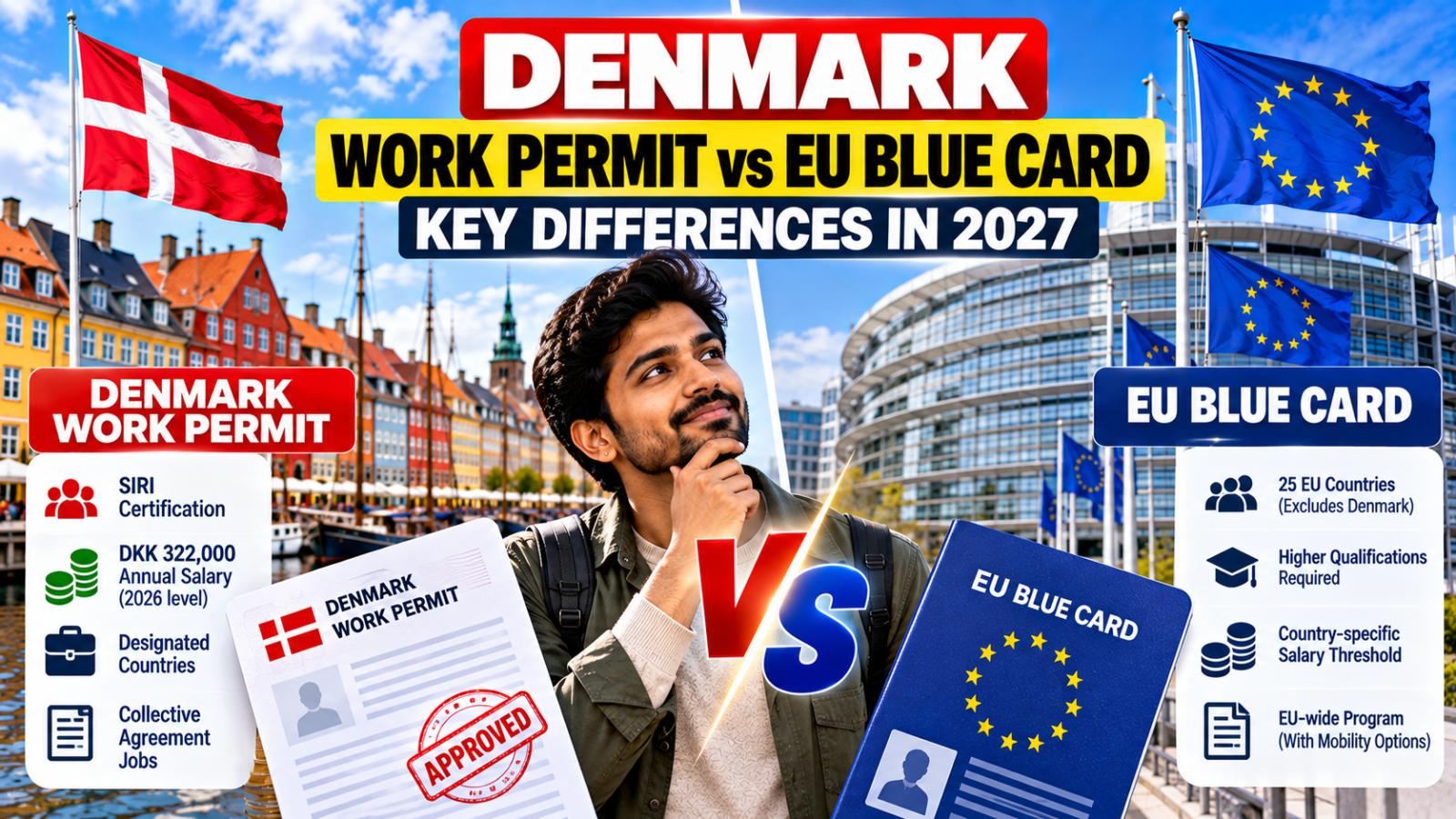
Denmark work permit vs EU Blue Card rules differ significantly. Denmark does not participate in the EU Blue Card system, despite being an EU member. Its new Collective Agreement Scheme begins January 1, 2027, with separate nationality, employer certification and salary requirements for foreign workers.
Denmark will introduce a new work permit scheme on January 1, 2027, offering eligible foreign workers another route into the country's labor market. However, the program differs significantly from the European Union's Blue Card system.
Although Denmark is an EU member, it does not participate in the EU Blue Card program. Foreign professionals seeking employment in Denmark must therefore follow Danish immigration rules rather than apply for a Danish EU Blue Card.
Does Denmark offer an EU Blue Card?
No. The EU Blue Card program operates in 25 of the EU's 27 member states, excluding Denmark and Ireland.
The Blue Card is designed for highly qualified workers from outside the EU who meet professional qualification, employment contract and salary requirements.
Denmark maintains its own employment-based residence and work permit schemes, administered by the Danish Agency for International Recruitment and Integration (SIRI).
Denmark work permit 2027 requirements
Denmark's new Collective Agreement Scheme will take effect on January 1, 2027.
The program requires applicants to hold citizenship from one of 16 designated countries and obtain a qualifying full-time employment offer.
The employer must be SIRI-certified, and the position must be covered by a relevant collective agreement.
The minimum annual salary is DKK 322,000 at the 2026 level, subject to adjustment for 2027.
EU Blue Card eligibility and salary rules
The EU Blue Card requires a qualifying employment contract or binding job offer lasting at least six months.
Applicants must demonstrate the higher professional qualifications or skills required under the participating country's rules.
Salary thresholds differ between participating countries. Unlike Denmark's new scheme, the EU Blue Card does not operate under one common salary amount across the EU.
Applicants must satisfy the requirements of the country where they intend to work.
Denmark work permit vs EU Blue Card: Main differences
The most important distinction is where each immigration route applies.
Denmark's Collective Agreement Scheme provides a national pathway for eligible employment within Denmark.
The EU Blue Card provides residence and employment authorization in a participating EU country, with certain mobility provisions under EU law.
An EU Blue Card issued by another member state does not automatically authorize someone to work in Denmark.
Denmark Pay Limit Scheme offers another option
Denmark also operates an existing Pay Limit Scheme for foreign workers offered qualifying high-salary employment.
Its minimum salary is DKK 552,000 annually at the 2026 level, compared with DKK 322,000 under the upcoming Collective Agreement Scheme.
Unlike the new route, the Pay Limit Scheme does not require a specific educational background or occupation.
For Indian, American and other foreign professionals considering European employment, the appropriate pathway depends on the destination country, job offer and applicable immigration requirements. Workers targeting Denmark must obtain authorization through a Danish scheme, while the EU Blue Card remains an option in participating member states.