EB-2 and EB-3 are major employment-based green card categories used by Indian professionals. Eligibility standards differ, while priority dates, labor certification and monthly Visa Bulletin cutoffs determine when applicants may move toward permanent residence.
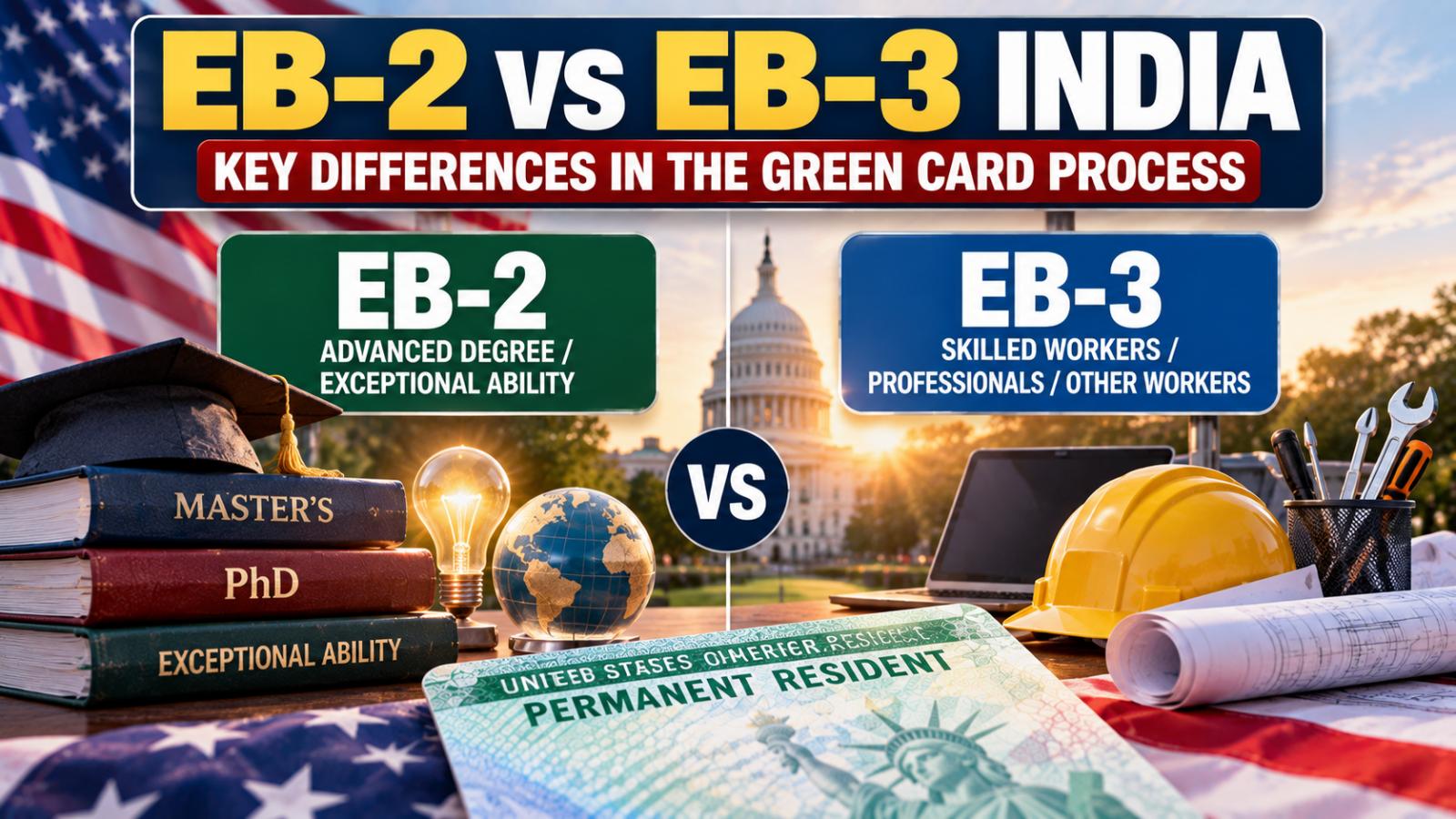
EB-2 vs EB-3 India is an important comparison for employment-based green card applicants because the two categories have different eligibility standards and can have different Visa Bulletin cut-off dates.
Both routes can lead to permanent residence, but qualifying for one category does not automatically mean an applicant qualifies for the other.
Who qualifies for EB-2?
EB-2 generally covers members of professions holding an advanced degree and individuals with exceptional ability in the sciences, arts or business.
For the advanced-degree route, USCIS generally recognizes a degree above the bachelor’s level or a bachelor’s degree followed by at least five years of progressive post-baccalaureate experience in the specialty.
Certain EB-2 applicants may also qualify for a National Interest Waiver, which can waive the normal job-offer and labor-certification requirements if USCIS determines the applicable standards are met.
Who qualifies for EB-3?
EB-3 includes skilled workers, professionals and other workers.
Professionals generally require at least a U.S. bachelor’s degree or foreign equivalent for the occupation. Skilled workers generally perform jobs requiring at least two years of training or experience, while the Other Workers category covers qualifying jobs requiring less than two years of training or experience.
Unlike a National Interest Waiver case under EB-2, EB-3 cases generally involve employer sponsorship and labor certification before the employer files Form I-140.
PERM and Form I-140 in the green card process
For many employer-sponsored EB-2 and EB-3 cases, the process begins with labor certification from the U.S. Department of Labor.
After labor certification is approved, the employer typically files Form I-140, Immigrant Petition for Alien Workers, with USCIS. In labor-certification-based cases, the priority date is generally the date the Department of Labor accepted the labor certification for processing.
The applicant may later seek an immigrant visa or adjustment of status when a visa number is available.
How EB-2 and EB-3 priority dates differ for India
Indian applicants should compare their priority dates with the applicable category in the monthly State Department Visa Bulletin.
For October 2026, India’s EB-2 Final Action Date is November 1, 2013, while EB-3 is January 1, 2014. Under the Dates for Filing chart, both EB-2 and EB-3 India are listed at January 15, 2015.
These dates can change from month to month depending on visa demand and annual numerical limits.
Why one category can move differently
EB-2 and EB-3 have separate numerical allocations and demand patterns. As a result, one category may advance, remain unchanged or retrogress while the other follows a different pattern.
India also faces substantial employment-based demand. In fiscal year 2026, the State Department announced that India had reached its available EB-2 allocation, temporarily stopping further EB-2 visa issuance until the fiscal year reset on October 1, 2026.
What Indian applicants should watch
Applicants should monitor their classification, priority date, monthly Visa Bulletin and USCIS filing guidance.
The category with the later Visa Bulletin date is not automatically the appropriate immigration path for an individual applicant. Eligibility depends on the requirements of the underlying petition and employment position, while visa availability determines when the case may move toward final approval.