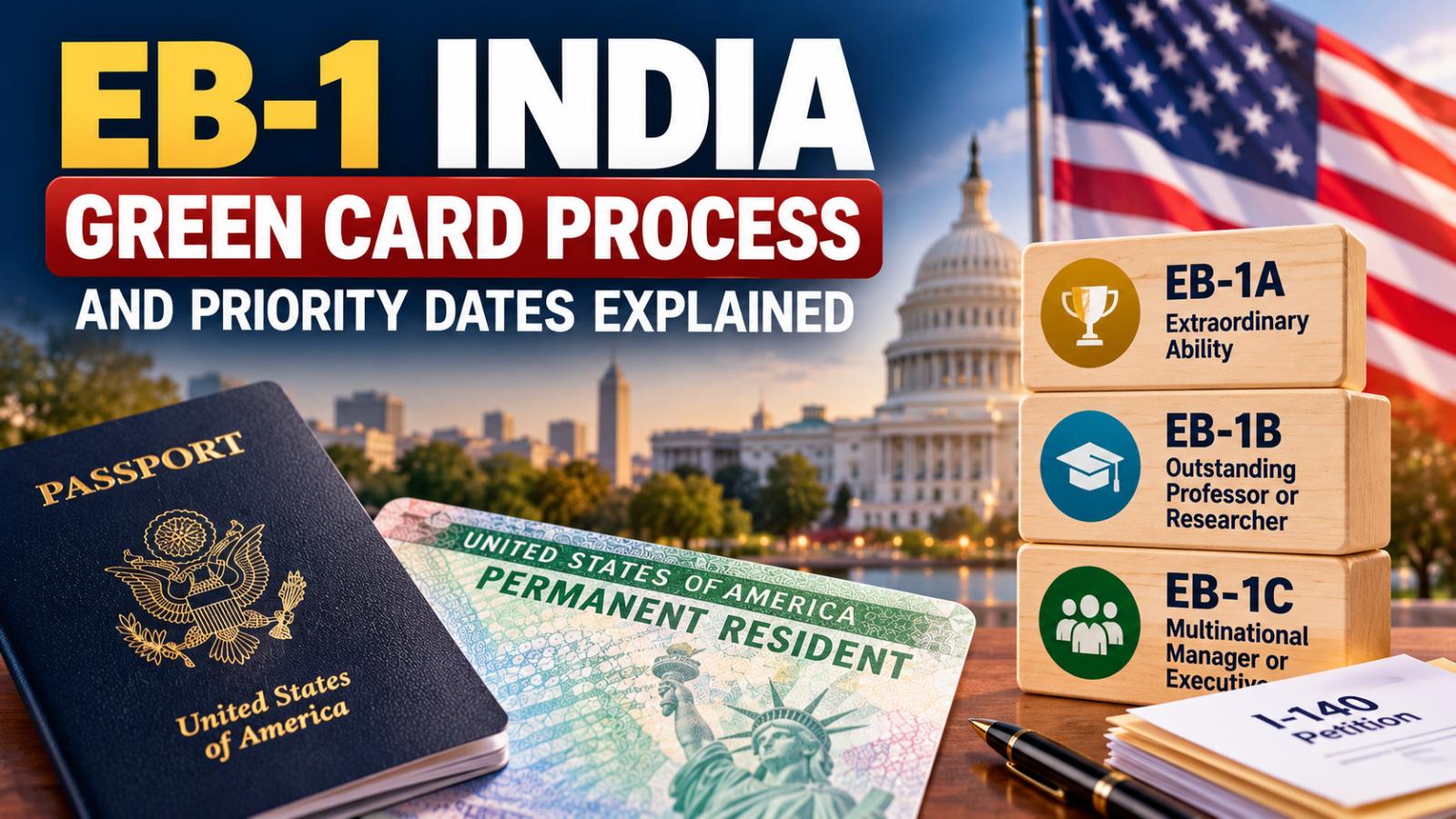
The EB-1 India green card category covers extraordinary ability workers, outstanding professors or researchers and certain multinational executives or managers. Indian applicants must also track their priority date and the monthly Visa Bulletin before final green card approval.
The EB-1 India green card route is the first preference category for certain highly qualified employment-based immigrants. USCIS divides EB-1 into three groups: people with extraordinary ability, outstanding professors or researchers, and certain multinational executives or managers.
Eligibility for EB-1 does not automatically mean a green card is immediately available. Indian applicants may also need to wait until their priority date is eligible under the U.S. Department of State’s Visa Bulletin.
Who qualifies under EB-1?
The first category, EB-1A, is for individuals who can demonstrate extraordinary ability in fields such as science, arts, education, business or athletics. USCIS states that EB-1A applicants do not need a job offer or permanent labor certification, although they must show that they intend to continue working in their area of expertise.
EB-1B covers qualifying outstanding professors and researchers. This category generally requires a qualifying offer of permanent employment from an eligible U.S. employer.
EB-1C applies to certain multinational managers or executives. The petitioning U.S. employer must meet qualifying business-relationship requirements, and the beneficiary must satisfy the applicable managerial or executive criteria.
How the EB-1 priority date works
A priority date establishes an applicant’s place in the employment-based immigrant visa queue.
For many employment-based cases, the date is connected to the filing of the immigrant petition or labor certification, depending on the category. EB-1 generally does not require labor certification, so the priority date is typically connected to the filing of Form I-140, Immigrant Petition for Alien Workers.
Indian applicants should compare their priority date with the EB-1 India dates published in the monthly Visa Bulletin.
Why the Visa Bulletin matters for India
When demand exceeds the available annual immigrant visa numbers, the State Department establishes cut-off dates.
For October 2026, the EB-1 India Final Action Date is February 1, 2023, while the Dates for Filing date is July 1, 2024. These dates can change in later bulletins as visa demand and annual numerical limits are managed.
A priority date earlier than the applicable cut-off may allow the case to move to the relevant stage, but applicants must still satisfy all other eligibility requirements.
Form I-140 and adjustment of status
Most EB-1 cases begin with Form I-140. EB-1A applicants may self-petition, while EB-1B and EB-1C generally require a qualifying U.S. employer to file the petition.
Applicants already in the United States may later seek adjustment of status through Form I-485 when permitted. USCIS determines each month whether employment-based applicants may use the Final Action Dates chart or the Dates for Filing chart.
What EB-1 India applicants should monitor
An approved I-140 does not by itself guarantee immediate green card approval. Applicants should continue checking their priority date, the monthly Visa Bulletin and USCIS filing-chart guidance.
Because India is an oversubscribed employment-based country, EB-1 dates can advance, remain unchanged or retrogress depending on demand and available visa numbers. The State Department adjusts these dates to keep visa issuance within annual limits.