Plot:
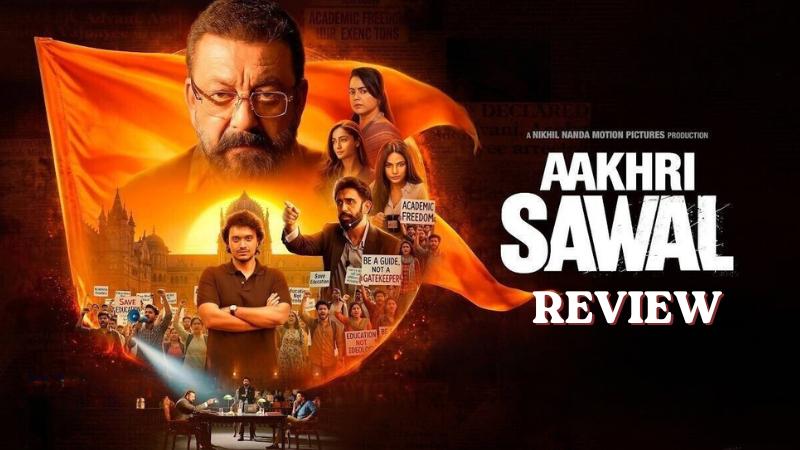
Aakhri Sawal explores the ideological clash between Professor Gopal Nadkarni (Sanjay Dutt) and his former student Vicky Hegde (Namashi Chakraborty). What begins as an academic disagreement over Vicky’s thesis on the RSS spirals into a national debate involving politicians, journalists, and social media outrage. The film interweaves campus politics, historical controversies, and RSS’s humanitarian work, highlighting the distinction between constructive Samvaad and adversarial Vivaad.
Overview:
Directed by Abhijeet Mohan Warang and written by Utkarsh Naithani, the film ambitiously tackles India’s polarised discourse. While it shines a light on RSS’s centenary contributions and attempts balanced storytelling, melodramatic sequences and caricatured characters dilute the depth of the ideological conflict.
Performances:
- Sanjay Dutt commands as Prof Nadkarni – calm yet layered, morally upright yet human.
- Namashi Chakraborty delivers fiery, intense face-offs as Vicky Hegde.
- Amit Sadh impresses as anchor Aditya Rao; Sameera Reddy provides credible left-right counterpoints.
- Tridha Choudhury and Mrinal Kulkarni add warmth and subtle emotional layers.
- Richa Chadha hints at potential in limited screen time.
Technical Aspects:
- Cinematography captures campus debates and televised confrontations effectively.
- Background score overuses melodrama, reducing tension.
- Production design convincingly represents institutional and media settings.
Music:
- Score often leans melodramatic, at times turning serious confrontations into soap-opera-style sequences.
Editing:
- Long debate sequences (nearly an hour) stretch pacing.
- Narrative jumps between student-teacher dynamics, media coverage, and historical flashbacks occasionally disrupt flow.
Positives:
- Raises constructive discussion over adversarial debate.
- Highlights lesser-known humanitarian contributions of RSS.
- Strong central performances by Dutt and Chakraborty.
- Encourages reflection on ideological balance in modern India.
Negatives:
- Over-dramatic score undercuts tension.
- Some characters verge on caricature, reducing nuanced debate.
- Pacing issues in extended debate sequences.
- Ambitious narrative layers sometimes dilute emotional core.
Analysis:
Aakhri Sawal succeeds in sparking conversation around India’s political and ideological history but falters in execution due to melodramatic excess and caricatured portrayals. It serves as a gateway to understanding ideological debates and the RSS’s legacy, though tighter direction could have amplified impact.
Bottomline: Ambitious, uneven
Rating: 2.5/10