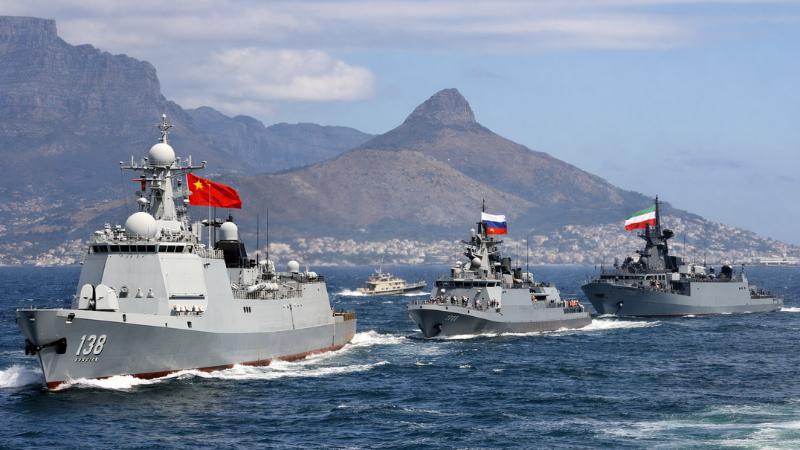
South Africa’s armed forces said the drills are intended to enhance maritime safety, improve coordination in anti-piracy operations and strengthen cooperation among participating nations. China is leading the exercise, which was organized through BRICS mechanisms established last year. South Africa, China and Russia are founding members of the bloc, while Iran formally joined in 2024 as part of the group’s expansion.
The arrival of the warships comes at a time of escalating international tensions following recent United States actions in Venezuela and the seizure of tankers transporting Venezuelan oil. While South African defense officials emphasized the technical and cooperative nature of the drills, the presence of Chinese, Russian and Iranian naval forces has attracted diplomatic attention due to the broader geopolitical context.
Naval vessels from the three countries have been observed entering and leaving the harbor at Simon’s Town, home to South Africa’s primary naval base, located south of Cape Town at the meeting point of the Atlantic and Indian Oceans. Among the Chinese vessels taking part is the 161-meter destroyer Tangshan. South Africa previously hosted Chinese and Russian warships for similar exercises in 2023, underscoring an ongoing pattern of military engagement with these partners.
Officials said participation by other BRICS members remains uncertain. A spokesperson for South Africa’s armed forces stated that details regarding additional involvement will be confirmed as the drills progress. Deputy Defence Minister Bantu Holomisa indicated that the United Arab Emirates is expected to deploy ships, while Indonesia, Ethiopia and Brazil will take part as observers. Other BRICS members include India, Egypt and Saudi Arabia.
According to the South African navy, the exercises are designed to facilitate the sharing of operational experience and best practices, with a focus on safeguarding critical shipping routes and promoting maritime stability in regional waters. The drills were originally scheduled for late November but were postponed due to South Africa hosting the G20 summit during the same period.
The naval exercise is expected to further complicate relations between South Africa and the United States. As Africa’s most industrialized economy and a key diplomatic actor on the continent, South Africa has faced criticism from Washington over its growing military and political engagement with countries viewed as strategic rivals of the US. The presence of Iranian naval forces, in particular, has drawn attention given existing international sanctions.
In February, US President Donald Trump issued an executive order accusing South Africa of supporting what he described as “bad actors on the world stage,” citing the country’s ties with Iran as one of the reasons for cutting US funding. China and Russia have frequently used BRICS forums to criticize US and Western policies, reinforcing perceptions of the bloc as a counterweight to Western influence.
South Africa has consistently maintained that it follows a nonaligned foreign policy and seeks to remain neutral in global conflicts. However, its willingness to host Russian and Iranian warships has sparked debate both internationally and domestically. In 2023, the Biden administration alleged that South Africa allowed a sanctioned Russian vessel to dock at Simon’s Town to load weapons destined for the war in Ukraine, an accusation South African authorities denied.
Domestic criticism has also emerged. The Democratic Alliance, the second-largest party in South Africa’s coalition government, said it opposed hosting military exercises involving Russia and Iran, both of which face extensive international sanctions. The party argued that labeling the drills as BRICS cooperation obscures what it described as a deliberate move toward closer military ties with controversial states.
As the “Will for Peace 2026” exercise continues, South Africa’s role in the evolving geopolitical landscape is likely to remain under close observation, with the drills highlighting the delicate balance the country seeks to maintain between strategic partnerships, economic interests and diplomatic relationships.