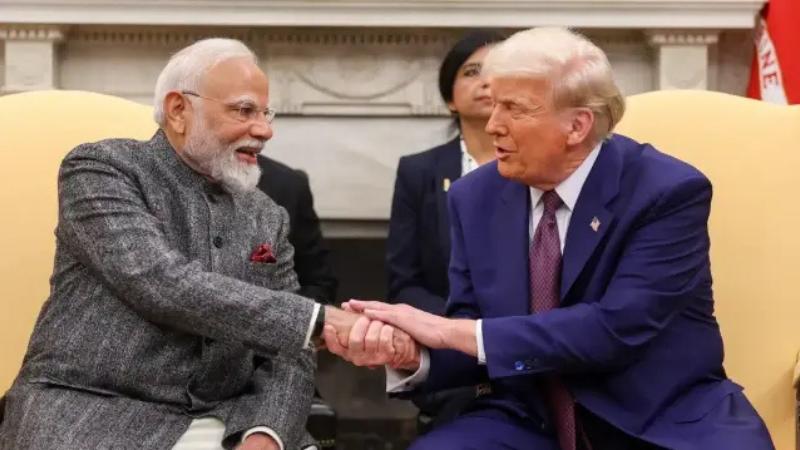
In a significant development affecting global trade and energy policy, United States President Donald Trump announced a bilateral trade agreement with Indian Prime Minister Narendra Modi following a direct telephone conversation on Monday. According to an official post shared by the US Ambassador to India on social media, the leaders discussed a range of strategic and economic issues, culminating in an accord that reduces key economic barriers between the two countries.
In his public statement, President Trump said he spoke with Prime Minister Modi early in the day, referring to Modi as “a powerful and respected leader” with whom he has a longstanding personal friendship. The conversation, Mr. Trump said, covered trade relations, efforts to influence the ongoing conflict stemming from Russia’s invasion of Ukraine, and future energy linkages between Washington and New Delhi.
Central to the announcement was the decision to lower the reciprocal tariff levied by the United States on Indian goods. Under the newly agreed terms, the tariff that had stood at 25 percent will be reduced to 18 percent, effective immediately. Mr. Trump described this step as a foundational element of the broader trade deal and suggested it would ease costly tariffs that had challenged bilateral commerce. He also indicated that India will take steps to reduce its own tariff and non-tariff barriers on US goods.
In the same announcement, President Trump said that India agreed to “stop buying Russian oil” and would instead expand purchases of energy resources from the United States and potentially from other suppliers. Tying this shift in energy sourcing to broader geopolitical goals, the US leader said reducing Russian energy dependence would contribute to ending the war in Ukraine — a conflict that continues to draw global economic repercussions and humanitarian concern.
Economic analysts have noted that the reduction in tariffs could have immediate implications for key sectors, including machinery, technology, agriculture and energy. By potentially lowering costs for exporters and importers in both markets, the accord may stimulate higher flows of goods ranging from US agricultural products to Indian manufactured items. While the long-term impacts remain to be evaluated by industry and government stakeholders, initial reactions in financial circles suggest the move could recalibrate trade balances and investment decisions across sectors.
Despite these developments, officials in New Delhi have not issued an immediate public comment on the terms of the agreement or on the diplomatic framing of the oil import commitments. Historically, India’s energy strategy has relied on a diversified portfolio of suppliers, including significant purchases of Russian crude. Policy experts caution that any substantive change to long-standing energy contracts involves complex logistical and fiscal considerations well beyond a single diplomatic exchange.
Commentators on international trade policy have also noted that the announcement occurs against the backdrop of broader shifts in global economic alignments. Recent agreements and negotiations — such as newly announced free trade frameworks between India and other major trading blocs — demonstrate that New Delhi is actively pursuing a multifaceted trade strategy while balancing national interests, supply chain security and geopolitical alignments.
President Trump’s post-call statement reiterated a theme of personal diplomacy, underscoring his assertion that both leaders “get things done.” Whether the newly outlined tariff adjustments and energy commitments will translate into sustained, measurable economic realignment remains subject to formal ratification and detailed implementation dialogues between technical trade negotiators in Washington and New Delhi.
Observers in diplomatic and economic communities will be watching closely as the two sides calibrate their approaches to tariff schedules, trade balances and energy sourcing in the months ahead. The broader implications for global trade — particularly in the context of broader geopolitical tensions involving Russia, Ukraine and major energy markets — make this development a notable chapter in early-2026 international economic policy.