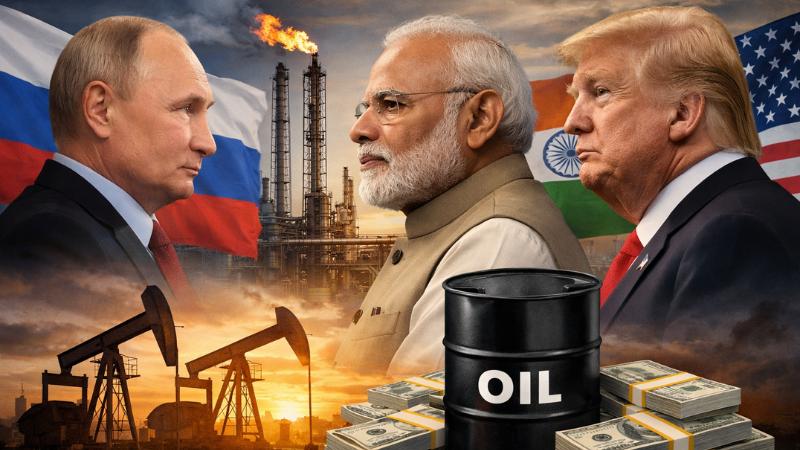
Russia has said it has not received any official confirmation from India that the country plans to halt purchases of Russian oil, a day after U.S. President Donald Trump claimed New Delhi agreed to scale back those imports as part of a new trade agreement with Washington.
Kremlin spokesperson Dmitry Peskov stated that Moscow had yet to hear directly from Indian authorities regarding any change in energy flows. While acknowledging the evolving relationship between the United States and India, he emphasized that Russia continues to place significant importance on its longstanding strategic partnership with New Delhi. According to Peskov, the development of bilateral ties between Russia and India remains a priority, particularly in energy and defense cooperation.
Russia’s Deputy Prime Minister Alexander Novak also sought to downplay concerns that India might reduce purchases of Russian crude. Speaking to reporters, he characterized recent developments as largely public statements and noted that global energy markets tend to adjust to shifts in supply and demand. Novak said Russian resources remain competitive and that demand for its exports persists across international markets.
The comments followed President Trump’s announcement that Washington and New Delhi had reached a trade agreement during a recent conversation with Indian Prime Minister Narendra Modi. Trump said the deal included India’s commitment to reduce or end purchases of Russian oil while increasing imports from the United States and potentially Venezuela. He also said the United States would lower its main tariff on Indian goods from 25 percent to 18 percent and remove an additional penalty tariff previously imposed in response to India’s Russian oil imports.
Prime Minister Modi confirmed progress on the trade front, welcoming the reduction in tariffs and highlighting opportunities for Indian exports. However, he did not directly address the issue of Russian oil purchases in his public statements, leaving uncertainty about the scope and timing of any changes to India’s energy strategy.
Analysts have expressed skepticism that India would completely abandon Russian crude in the near term. Since the start of the war in Ukraine in 2022, India has emerged as a major buyer of discounted Russian oil, which has helped lower import costs and stabilize domestic fuel prices. Experts say these economic considerations, combined with India’s historical and strategic ties to Moscow, make an abrupt halt unlikely.
Evan A. Feigenbaum of the Carnegie Endowment for International Peace noted that India has traditionally sought to maintain foreign policy autonomy and avoid overt alignment with any single power. He suggested that publicly committing to end Russian oil imports could undermine that approach and complicate domestic politics. India, he said, has deep-rooted defense and diplomatic links with Russia that would be difficult to sever quickly.
Farwa Aamer of the Asia Society Policy Institute echoed that view, describing India’s position as a delicate balancing act. While New Delhi has incentives to strengthen trade relations with the United States, it also aims to preserve steady relations with Russia. According to Aamer, India may gradually diversify its import structure but is unlikely to risk damaging a key partnership outright.
Credit ratings agency Moody’s also warned that a complete shift away from Russian oil could have broader economic consequences. As one of the world’s largest oil importers, India could face higher costs for manufacturing and transportation if alternative supplies prove more expensive. Such pressures could contribute to inflation and slow economic growth.
The situation underscores the complex intersection of trade policy, energy security, and geopolitics. As negotiations continue, India appears poised to carefully manage its relationships with both Washington and Moscow, seeking to protect its economic interests while navigating mounting international pressure.