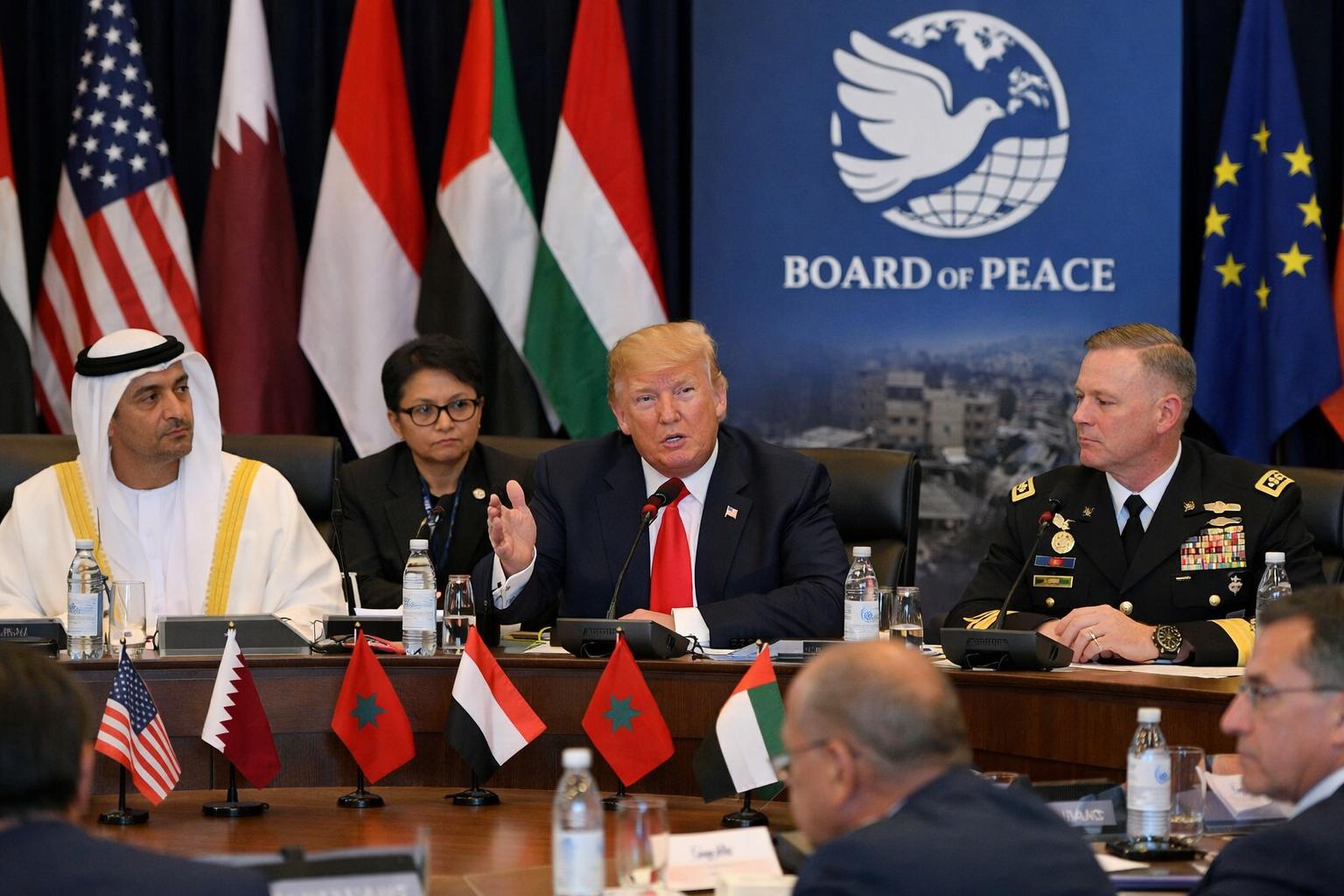
President Donald Trump on Thursday announced that the United States will contribute $10 billion to the newly formed Board of Peace, a central element of his 20-point plan aimed at stabilising and rebuilding Gaza. Speaking at the board’s inaugural meeting in Washington, Trump told representatives from nearly 50 countries that the United States intended to play a leading financial role in the initiative, though questions remain about how the funding will be sourced amid the administration’s recent reductions in foreign aid.
The president’s pledge comes as his administration continues to emphasise prioritising domestic spending, leaving observers seeking clarity on how the large commitment to Gaza will be financed. During the three-hour meeting, Trump also revealed that nine participating members have collectively pledged an additional $7 billion toward a broader Gaza relief package, signalling growing international engagement with the proposed peace framework.
Military support also emerged as a key component of the plan. Army Major General Jasper Jeffers, commander of the proposed International Stabilization Force, announced that five countries—Indonesia, Morocco, Kazakhstan, Kosovo, and Albania—have agreed to contribute troops. According to Jeffers, the ISF will initially deploy in southern Gaza’s Rafa region to help train local police forces before expanding operations sector by sector across the territory.
Additional support commitments were outlined by several countries. Indonesia reaffirmed its earlier pledge to send 8,000 troops, while Qatar committed $1 billion toward the mission. The United Arab Emirates pledged $1.2 billion for Gaza rebuilding efforts, and Morocco indicated it would provide police personnel and training support for Palestinian officers. Egypt and Jordan also agreed to assist in training Palestinian police forces, while Romania offered humanitarian assistance including medical evacuations for sick children, educational scholarships, and school refurbishment projects.
Despite the broad participation, details regarding oversight and financial transparency for the Board of Peace remain unclear. It is not yet known how contributions will be tracked or how funds will be allocated once the rebuilding phase begins. Trump suggested the board’s mandate could eventually expand beyond Gaza, hinting at a wider diplomatic role.
The meeting took place against the backdrop of rising regional tensions. Trump warned that Iran has roughly 10 days to reach an agreement on ending its nuclear programme, stating that failure to do so could lead to serious consequences. He indicated that developments would become clearer in the coming days, as the United States continues to position military assets in the region.
Long critical of the United Nations, Trump struck a more measured tone during the gathering, saying the organisation has “great potential” but has not fully delivered on its mission. He added that the newly formed peace board would play an oversight role in coordinating international efforts related to Gaza’s security and reconstruction.
The initiative marks one of the most ambitious multinational efforts tied to the Gaza crisis in recent years. However, with funding mechanisms, operational timelines, and political backing still evolving, the effectiveness of the Board of Peace will likely depend on sustained international cooperation and clarity in execution over the coming months.