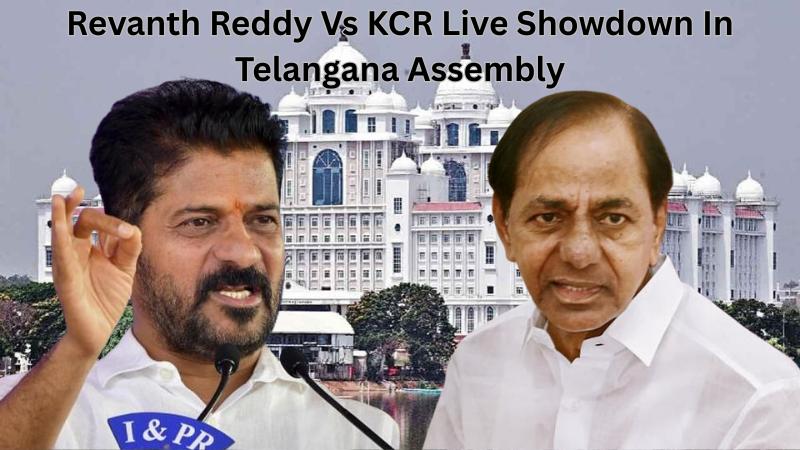
The winter session of the Telangana Legislative Assembly has begun on a dramatic and politically charged note, drawing statewide attention as Chief Minister A Revanth Reddy and former Chief Minister K Chandrashekar Rao come face to face on the Assembly floor. This moment is being closely watched as it marks KCR’s return to the House after nearly two years, following the Bharat Rashtra Samithi’s defeat in the 2023 Assembly elections. His presence has added intensity to the proceedings and raised expectations of sharp exchanges and high-voltage political debate.
From the very first day of the seventh Telangana Assembly session, the atmosphere inside the House has reflected deep political divisions. Both the ruling Congress and the opposition BRS have prepared their strategies carefully, aware that every statement made during this session could shape public perception in the months ahead. Revanth Reddy, leading the government for the first time during a full-scale winter session, is expected to defend his administration’s decisions while simultaneously questioning the legacy of the previous BRS government. On the other hand, KCR’s return signals a renewed and assertive opposition approach aimed at challenging the Congress on governance, policy implementation, and political promises.
Several critical issues are expected to dominate the Assembly proceedings over the coming days. River water sharing disputes related to the Krishna and Godavari rivers are likely to be discussed at length, given their long-standing importance to Telangana’s agriculture, drinking water needs, and regional politics. These issues have historically triggered strong political reactions, and the current session is expected to be no different, especially with both sides keen to assert their stance before the public.
Another major focus area is the Kaleshwaram Lift Irrigation Project, one of the most ambitious initiatives undertaken during the previous BRS regime. The Congress government is expected to raise questions regarding the project’s execution, costs, and outcomes, while KCR is likely to defend it as a landmark development effort. These discussions are expected to turn intense, as the project has been a symbol of political pride as well as controversy.
Apart from irrigation and water management, the Congress government’s performance since coming to power will also come under scrutiny. Issues related to administration, welfare schemes, financial management, and policy direction are likely to be debated, with both sides attempting to control the narrative. Political analysts believe this session could redefine the tone of governance versus opposition politics in Telangana, especially with KCR actively participating after a prolonged period away from legislative debates.
The political showdown between Revanth Reddy and KCR has generated enormous public interest, extending well beyond the Assembly premises. Citizens across Telangana and political observers nationwide are closely following the developments, eager to see how the two leaders engage with each other after the change of government. The session is being streamed live, allowing people to watch the debates in real time and form their own opinions on the arguments presented by both sides.
This Assembly session is not just about legislation but about political positioning, leadership styles, and the future direction of the state. KCR’s return to active Assembly politics is being seen as a critical moment for the BRS, while Revanth Reddy views the session as an opportunity to consolidate his government’s image and counter opposition criticism. As the winter session unfolds, Telangana’s Assembly is expected to remain the center of intense political action, with every debate, interruption, and response carrying significant political weight.