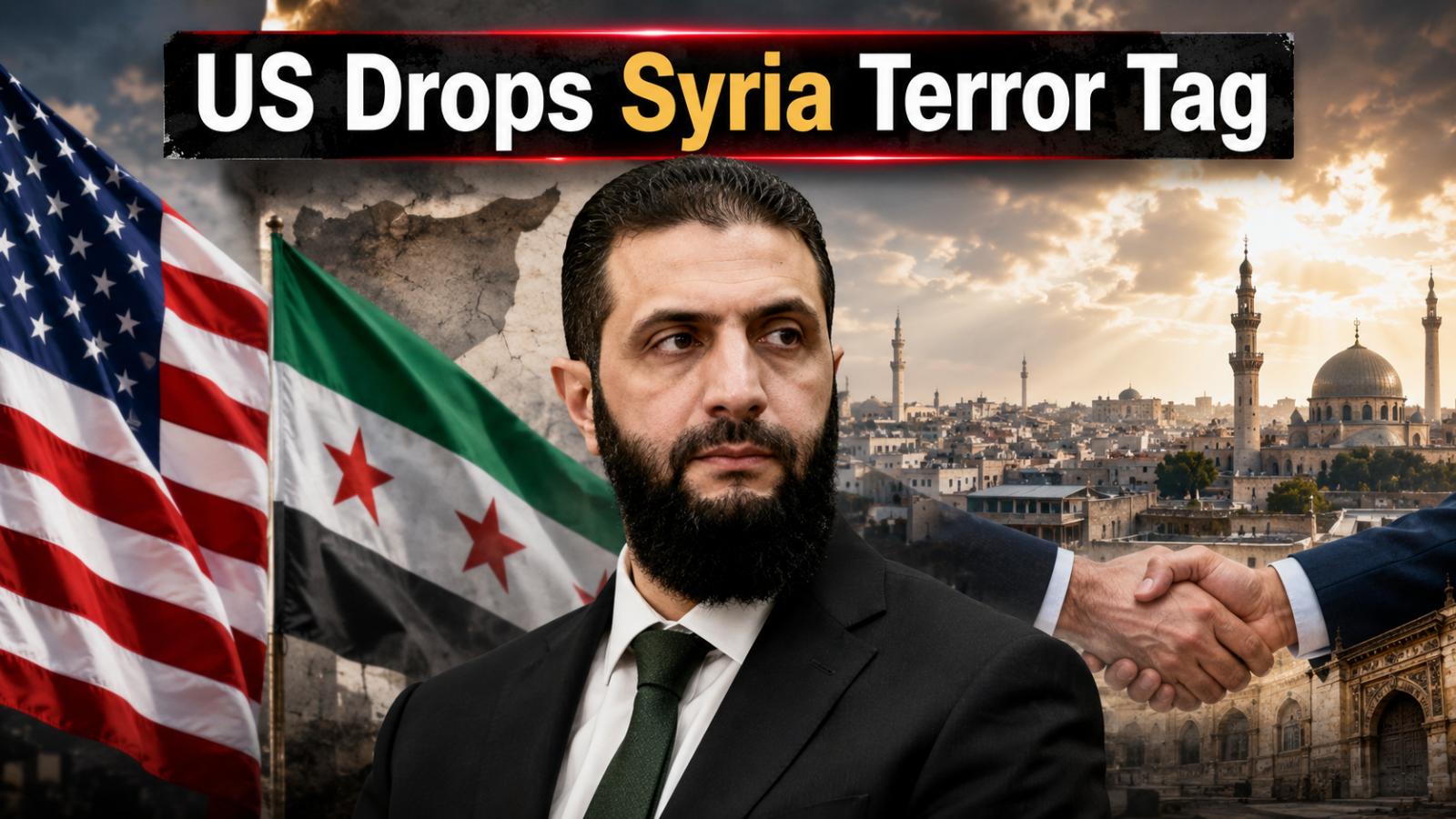
The Syria terror delisting marks one of Washington’s most dramatic policy reversals in the Middle East. The United States has formally removed Syria from its State Sponsors of Terrorism list after nearly 47 years, opening new economic opportunities while strengthening ties with President Ahmed al-Sharaa’s government.
Syria terror delisting ends a 47-year designation
Secretary of State Marco Rubio formally rescinded Syria’s designation on August 24 after the required 45-day congressional notification period. Syria had remained on the US State Sponsors of Terrorism list since 1979, when Washington accused the government of Hafez al-Assad of supporting militant organisations.
Rubio said the decision recognised steps taken by the government of Ahmed al-Sharaa to distance Syria from international terrorism. Washington has cited Damascus’s cooperation against ISIS, al-Qaeda-linked networks, Hezbollah and Iran-aligned groups as part of its changing assessment.
The shift is especially striking because al-Sharaa, formerly known as Abu Mohammed al-Jolani, once carried a US reward of up to $10 million. Washington confirmed in December 2024 that it would stop pursuing that reward as it opened direct engagement with Syria’s new leadership.
Sanctions relief could revive Syria economy
The designation had imposed restrictions involving US assistance, defence exports and financial transactions, creating a major obstacle for banks and international investors considering Syria. Its removal therefore matters far beyond diplomatic symbolism.
The Treasury Department said the move is intended to encourage investment and economic stability. Syria needs enormous amounts of capital to rebuild infrastructure, housing and public services after years of civil war. Damascus hopes the decision will reconnect its banking system with global financial markets and encourage companies that had avoided Syria because of sanctions risk.
Washington had already begun dismantling broader Syria sanctions in 2025. President Trump’s executive order revoked major economic restrictions and ordered a review of both Syria’s terrorism designation and sanctions related to al-Sharaa and Hay’at Tahrir al-Sham.
US Syria reset also changes HTS status
Alongside Syria’s removal from the state sponsor list, Washington revoked HTS’s designation as a Specially Designated Global Terrorist organisation. The United States had already removed HTS from its Foreign Terrorist Organization list in July 2025.
The policy reflects Washington’s judgment that cooperation with the post-Assad government can advance regional security. Al-Sharaa’s administration has moved against Iranian-linked networks and disrupted some of the routes that once helped supply Hezbollah through Syrian territory.
That places Damascus on a very different strategic path from the Assad era, when Syria maintained close relations with Tehran and Hezbollah.
Israel talks test Syria’s regional comeback
Economic reintegration does not remove Syria’s security problems. Israel continues to control the Golan Heights and has conducted military operations inside Syrian territory.
Tensions rose again after Israeli strikes hit the Abu al-Duhur airbase on August 18. US envoy Tom Barrack described the attack as an “unnecessary escalation” and urged dialogue instead of further military confrontation.
Days later, Jordan hosted Syrian and Israeli officials for talks aimed at reducing tensions and reviving security discussions. Jordan said the meeting followed the recent Israeli strikes and focused on supporting de-escalation.
Al-Sharaa now faces the harder test
Removing the terrorism designation gives Syria greater access to investment, banking and international diplomacy, but it does not guarantee recovery. Al-Sharaa still faces damaged infrastructure, political divisions, foreign military influence and unresolved tensions with Israel.
The larger test is whether the diplomatic breakthrough can produce jobs, reconstruction and lasting stability. Washington has now removed one of Syria’s biggest international barriers. What Damascus does with that opportunity will determine whether the policy reversal becomes the beginning of a durable recovery or simply another chapter in Syria’s turbulent transition.