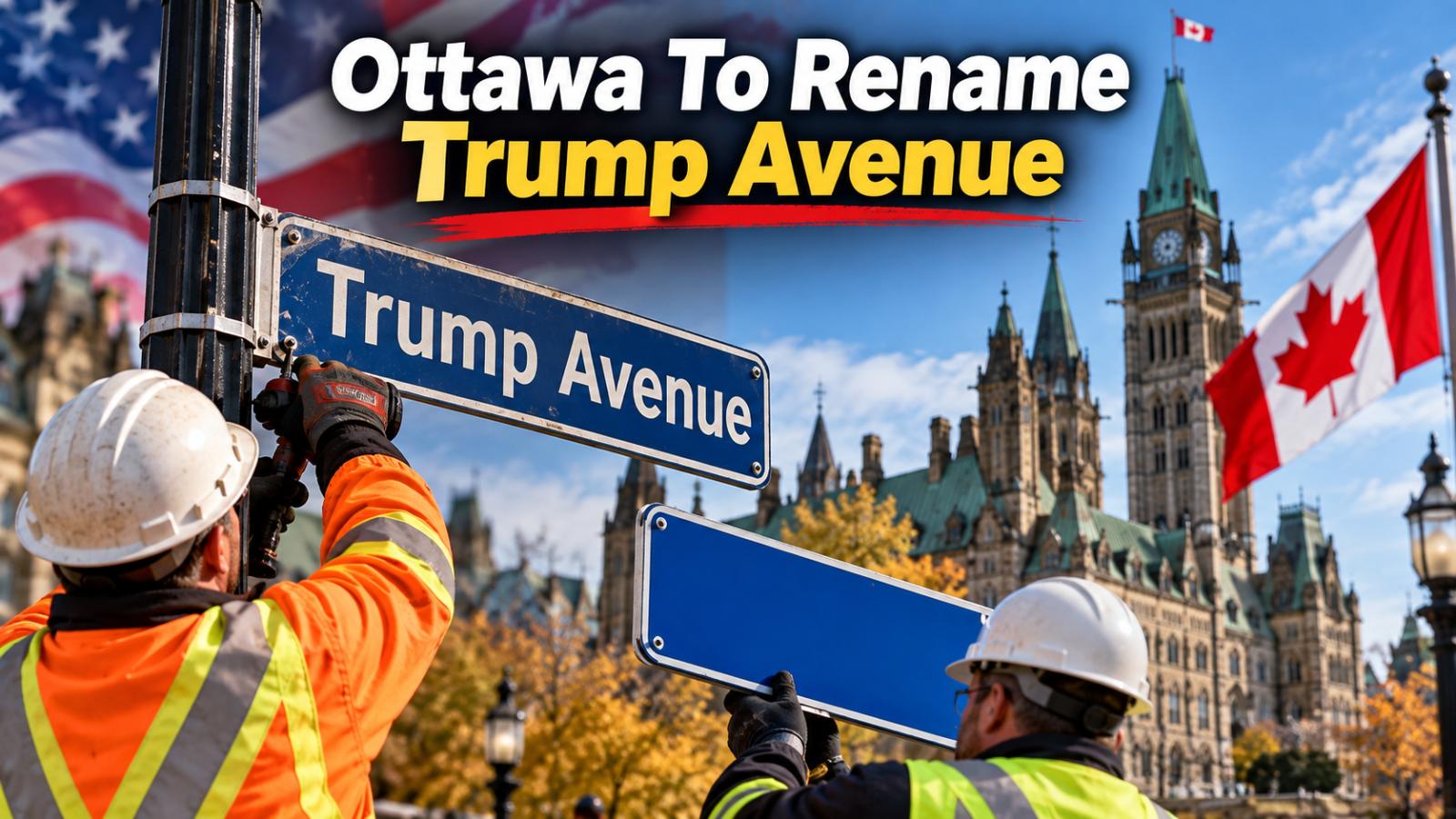
Ottawa is moving ahead with the Ottawa Trump Avenue renaming after city council unanimously backed changing the residential street’s name, adding a symbolic chapter to increasingly strained Canada-US relations. The decision comes weeks after President Donald Trump ordered US federal agencies to refer to Lake Ontario as “Lake America.”
Ottawa vote starts street renaming process
Ottawa City Council voted unanimously on September 23 to begin renaming Trump Avenue in the Central Park neighbourhood. The street has carried the name for more than 25 years and sits in an area developed around a New York City naming theme, alongside streets and parks referencing Manhattan and other New York landmarks.
The council decision does not immediately remove the existing name. Residents are expected to participate in selecting a replacement before the change is formally implemented. The motion argued that Trump Avenue would not meet Ottawa’s present-day standards for commemorative naming.
Canada-US tensions shape the debate
The renaming comes as relations between Canada and the United States face pressure from tariffs, trade disputes and repeated statements by Trump concerning Canada’s political and economic relationship with the US. Recent tensions have encouraged Canadian governments and businesses to examine ways to reduce their dependence on the US market.
Ottawa Mayor Mark Sutcliffe has publicly supported removing Trump’s name from the street, citing what he described as Trump’s hostile approach toward Canada. The street-renaming decision therefore carries symbolism beyond a routine municipal address change.
Lake America order adds another flashpoint
On August 27, Trump signed Executive Order 14422 directing the US federal government to rename Lake Ontario as “Lake America.” The order instructs the US Board on Geographic Names and federal departments to update official American maps, databases, contracts and communications with the new terminology.
The order governs US federal usage. It does not require Canada or other governments to abandon the name Lake Ontario. The shared lake borders both New York state and the Canadian province of Ontario, making the naming decision another visible point of disagreement between Washington and Ottawa.
Lake Ontario name faces US resistance too
Opposition to the change has not been limited to Canada. In New York’s Oswego County, local lawmakers unanimously rejected the “Lake America” designation and continued supporting the traditional Lake Ontario name. The disagreement shows that reactions to the federal order cut across the international border and political lines.
For communities around the Great Lakes, the dispute goes beyond maps. Lake Ontario has a long-established geographic, economic and cultural identity shared by residents in both countries.
Symbolic disputes reflect a wider relationship shift
Neither the Ottawa street decision nor the Lake America order changes the fundamental geography connecting Canada and the United States. But both have become symbols of a broader deterioration in a relationship historically built around extensive trade, travel and security cooperation.
Canada has increasingly sought stronger economic ties beyond the United States as trade tensions continue, including deeper engagement with Europe. Against that backdrop, the Ottawa Trump Avenue renaming is likely to attract attention far beyond one residential neighbourhood because it reflects how national political disputes can reach even local street signs.