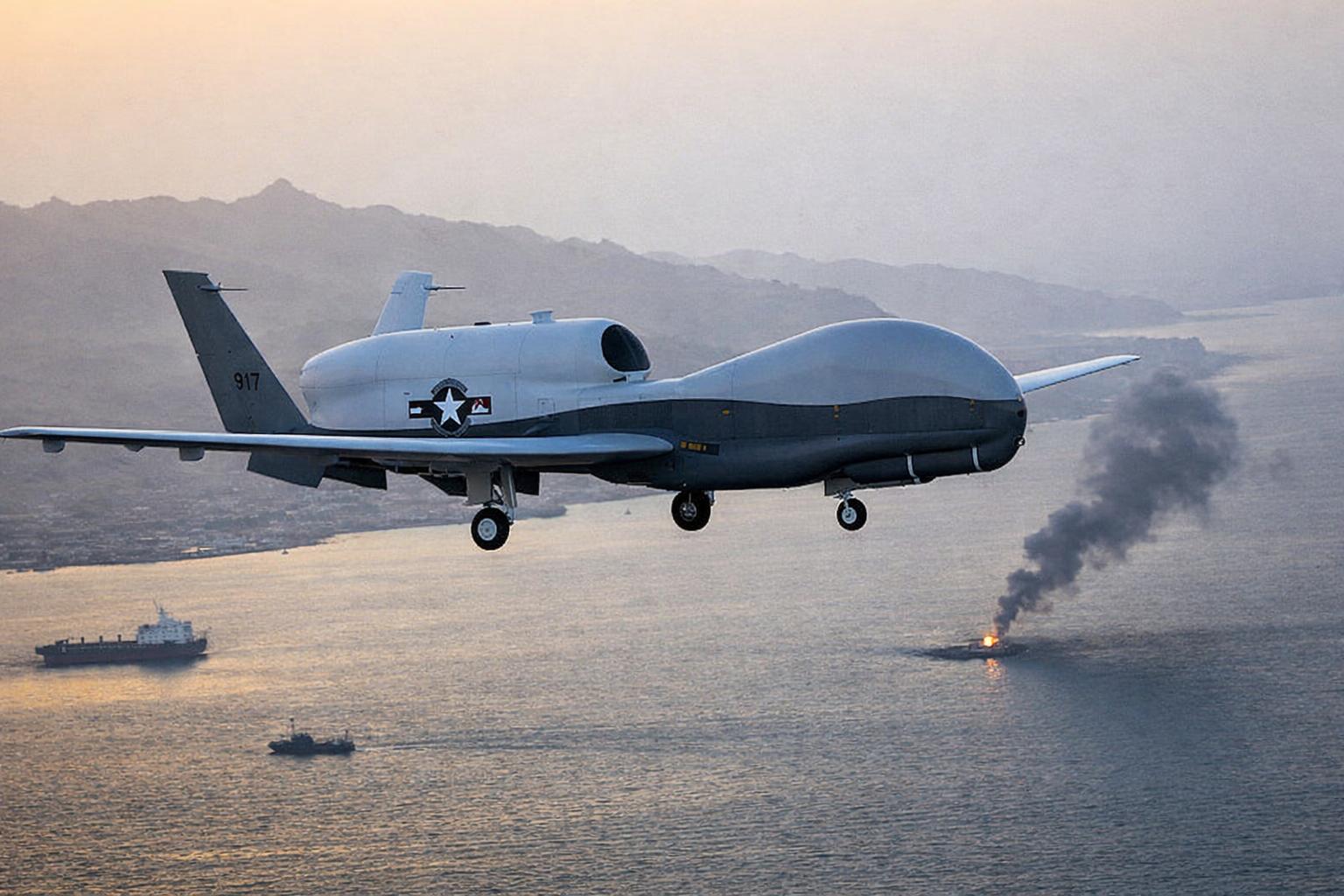
A U.S. Navy MQ-4C Triton surveillance drone disappeared over the Strait of Hormuz after declaring an in-flight emergency on Thursday, April 9, raising uncertainty about its fate amid ongoing regional tensions involving Iran and key maritime routes.
Flight tracking data from Flightradar24 indicates the unmanned aircraft had been conducting surveillance operations over the Persian Gulf for nearly three hours before beginning its return to Naval Air Station Sigonella in Italy. During its return leg, the drone reportedly altered its course slightly toward Iranian airspace. Shortly afterward, it transmitted a code 7700 emergency signal—used internationally to indicate a general emergency—and began descending from an altitude of approximately 50,000 feet.
The aircraft then disappeared from radar tracking systems. As of now, there has been no official confirmation on whether the drone crashed due to a technical malfunction or was brought down by external factors. The lack of clarity has fueled speculation, particularly given the sensitive location of the incident.
The Strait of Hormuz is one of the world’s most strategically significant maritime corridors, serving as a critical passage for global oil shipments. The incident occurred shortly after the United States and Iran agreed to a temporary two-week ceasefire and the reopening of the strait, adding further complexity to an already fragile geopolitical environment.
The MQ-4C Triton is among the most advanced unmanned aerial systems operated by the U.S. Navy. Designed for long-endurance intelligence, surveillance, and reconnaissance missions, the aircraft can operate at altitudes exceeding 50,000 feet and remain airborne for over 24 hours. Its capabilities allow it to provide real-time intelligence across vast maritime regions, making it a vital component of U.S. defense and monitoring operations.
The disappearance of such a high-value asset underscores the risks associated with military surveillance activities in contested regions and may prompt further scrutiny of aerial operations in the area.
Flight tracking data from Flightradar24 indicates the unmanned aircraft had been conducting surveillance operations over the Persian Gulf for nearly three hours before beginning its return to Naval Air Station Sigonella in Italy. During its return leg, the drone reportedly altered its course slightly toward Iranian airspace. Shortly afterward, it transmitted a code 7700 emergency signal—used internationally to indicate a general emergency—and began descending from an altitude of approximately 50,000 feet.
The aircraft then disappeared from radar tracking systems. As of now, there has been no official confirmation on whether the drone crashed due to a technical malfunction or was brought down by external factors. The lack of clarity has fueled speculation, particularly given the sensitive location of the incident.
The Strait of Hormuz is one of the world’s most strategically significant maritime corridors, serving as a critical passage for global oil shipments. The incident occurred shortly after the United States and Iran agreed to a temporary two-week ceasefire and the reopening of the strait, adding further complexity to an already fragile geopolitical environment.
The MQ-4C Triton is among the most advanced unmanned aerial systems operated by the U.S. Navy. Designed for long-endurance intelligence, surveillance, and reconnaissance missions, the aircraft can operate at altitudes exceeding 50,000 feet and remain airborne for over 24 hours. Its capabilities allow it to provide real-time intelligence across vast maritime regions, making it a vital component of U.S. defense and monitoring operations.
The disappearance of such a high-value asset underscores the risks associated with military surveillance activities in contested regions and may prompt further scrutiny of aerial operations in the area.