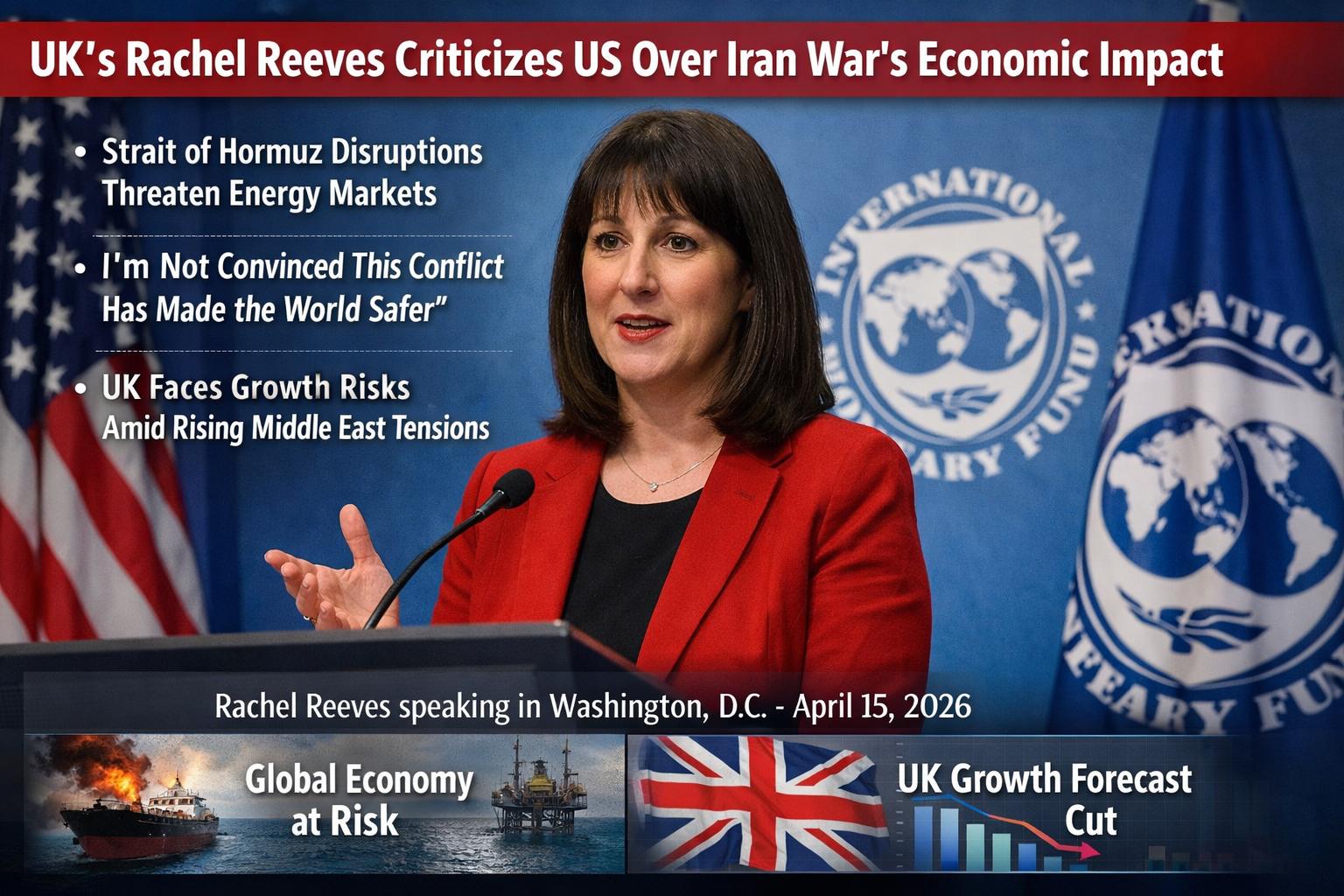
U.K. Finance Minister Rachel Reeves on Wednesday, April 15, 2026, called for immediate de-escalation of the Iran war, warning that the conflict is posing significant risks to global economic stability and expressing concern over the approach taken by the United States.
Speaking at a forum in Washington, D.C., Reeves highlighted the economic consequences of disruptions in the Strait of Hormuz, a key global energy shipping route. She warned that ongoing instability in the region is increasing pressure on oil and gas markets, with ripple effects for import-dependent economies such as the United Kingdom.
Reeves questioned the clarity of the U.S. strategy in the conflict, saying its objectives appeared to have shifted over time. “I’m not convinced this conflict has made the world a safer place,” she said, adding that it remains unclear whether the goals include regime change, regional security, or limiting Iran’s nuclear capabilities. She reaffirmed that while the U.K. maintains a strong bilateral relationship with the United States, policy differences do arise.
The finance minister also pointed to lasting damage to energy infrastructure in the Middle East, warning that the economic consequences would continue even if the conflict ended in the near term. “Even if this conflict does come to an end tomorrow, there are longer-term impacts. Damage has been done,” she said.
Her remarks came alongside international economic assessments indicating that the U.K. could face the steepest growth slowdown among advanced economies due to the ongoing crisis, largely because of its reliance on imported energy. Reeves, who is attending international financial meetings in Washington, said she remains confident that the U.K. can outperform these projections if conditions stabilize, leading to stronger growth and lower inflation.
The comments reflect growing global concern over the economic impact of the Iran war, particularly its effects on energy markets and broader financial stability.
Speaking at a forum in Washington, D.C., Reeves highlighted the economic consequences of disruptions in the Strait of Hormuz, a key global energy shipping route. She warned that ongoing instability in the region is increasing pressure on oil and gas markets, with ripple effects for import-dependent economies such as the United Kingdom.
Reeves questioned the clarity of the U.S. strategy in the conflict, saying its objectives appeared to have shifted over time. “I’m not convinced this conflict has made the world a safer place,” she said, adding that it remains unclear whether the goals include regime change, regional security, or limiting Iran’s nuclear capabilities. She reaffirmed that while the U.K. maintains a strong bilateral relationship with the United States, policy differences do arise.
The finance minister also pointed to lasting damage to energy infrastructure in the Middle East, warning that the economic consequences would continue even if the conflict ended in the near term. “Even if this conflict does come to an end tomorrow, there are longer-term impacts. Damage has been done,” she said.
Her remarks came alongside international economic assessments indicating that the U.K. could face the steepest growth slowdown among advanced economies due to the ongoing crisis, largely because of its reliance on imported energy. Reeves, who is attending international financial meetings in Washington, said she remains confident that the U.K. can outperform these projections if conditions stabilize, leading to stronger growth and lower inflation.
The comments reflect growing global concern over the economic impact of the Iran war, particularly its effects on energy markets and broader financial stability.