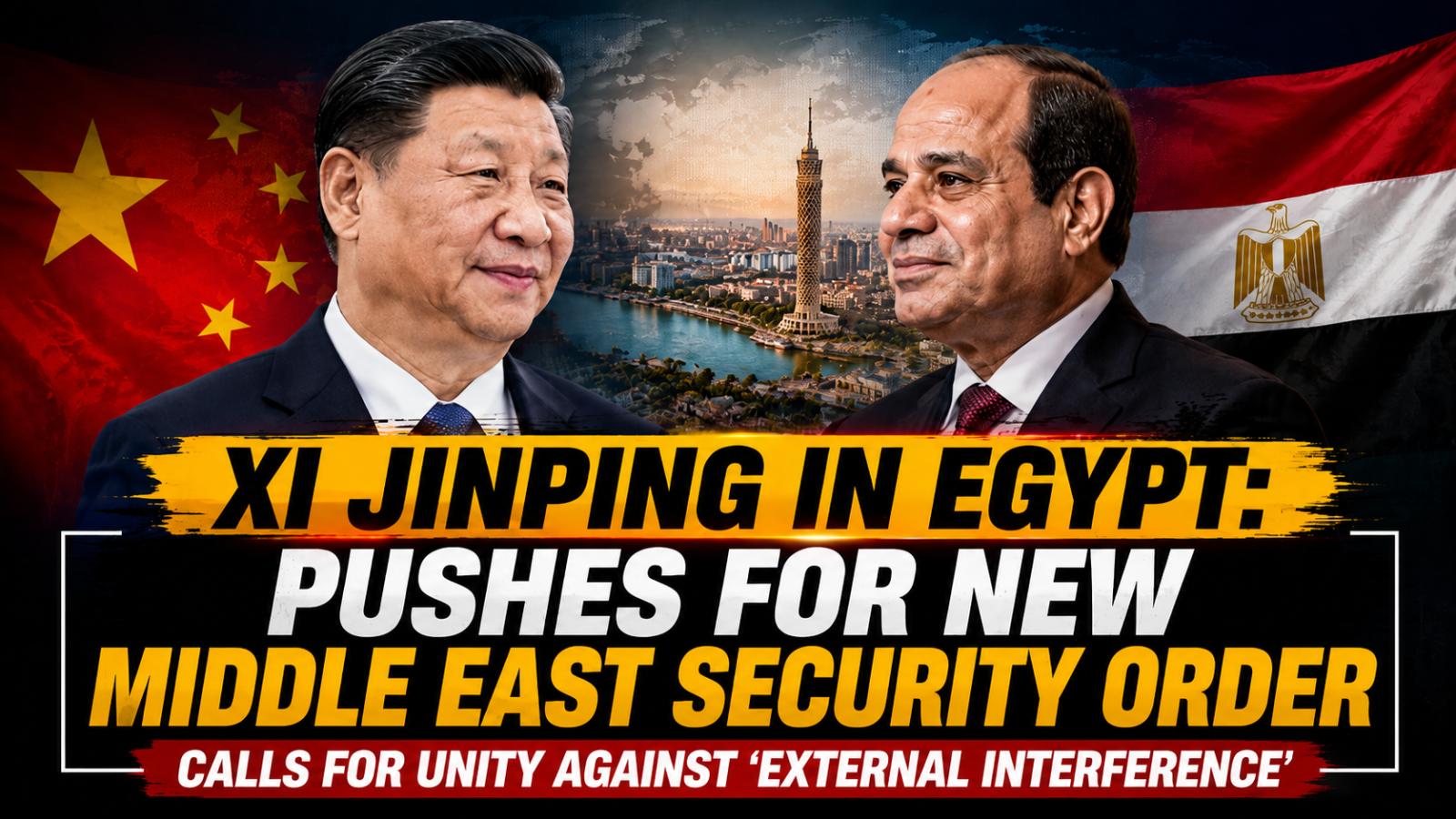
Chinese President Xi Jinping has used his state visit to Egypt to call for a new Middle East security architecture, urging regional countries to resist external interference and take greater control of their own security decisions. His visit comes as China seeks a larger diplomatic and economic role in a region unsettled by the US-Iran conflict.
Xi Jinping calls for new Middle East security order
During talks with Egyptian President Abdel Fattah El-Sisi in Cairo on September 2, Xi proposed what Chinese officials described as a four-point framework for a new regional security architecture. According to China’s state news agency Xinhua, the proposal focuses on common, comprehensive, cooperative and sustainable security.
Xi said Middle Eastern countries should remain “masters of their own affairs” and strengthen dialogue on peace and security rather than depend on external powers to shape the region’s future. He also called on China and Egypt to oppose unilateralism and what Beijing described as acts of bullying.
China-Egypt ties deepen during Cairo visit
Xi’s visit to Egypt took place on September 1 and 2 and marked 70 years of diplomatic relations between the two countries. Egypt was the first Arab and African nation to establish diplomatic ties with the People’s Republic of China in 1956, according to the joint communiqué released by Egypt’s presidency.
The two leaders agreed to deepen their comprehensive strategic partnership and witnessed the signing of cooperation documents covering the Belt and Road Initiative, artificial intelligence, trade, industrial supply chains, education, transportation and the digital economy.
China and Egypt also agreed to expand security cooperation and counterterrorism coordination while supporting greater dialogue across the Middle East.
Egypt balances US and China relationships
Egypt remains a major security partner of the United States, but Cairo has increasingly expanded its economic and military relationships with Beijing. President Sisi has described Egypt’s approach as one of strategic balance as competition among global powers intensifies.
That strategy has become more visible through stronger military engagement with China. Recent “Eagles of Civilization” exercises included Chinese and Egyptian forces and reflected a broader expansion of defence cooperation. At the same time, Egypt continues to maintain long-standing strategic and military ties with Washington.
China seeks wider influence across Middle East
For Beijing, Egypt offers both political influence and strategic geography. The country controls the Suez Canal, sits at the crossroads of Africa and the Middle East and provides access to a large regional market.
Chinese investment in Egypt has expanded into ports, manufacturing, green hydrogen, infrastructure and industrial projects. The two sides are also looking at cooperation in semiconductors, data centres, critical minerals and greater use of their own currencies in trade and investment.
Xi’s visit also comes as the US-Iran conflict disrupts regional trade and shipping routes, including the Strait of Hormuz. Against that backdrop, China is presenting itself as a partner focused on economic ties, regional dialogue and a security structure less dependent on outside powers. Whether regional governments embrace that vision will depend on how they balance relations with Beijing, Washington and their own security priorities.