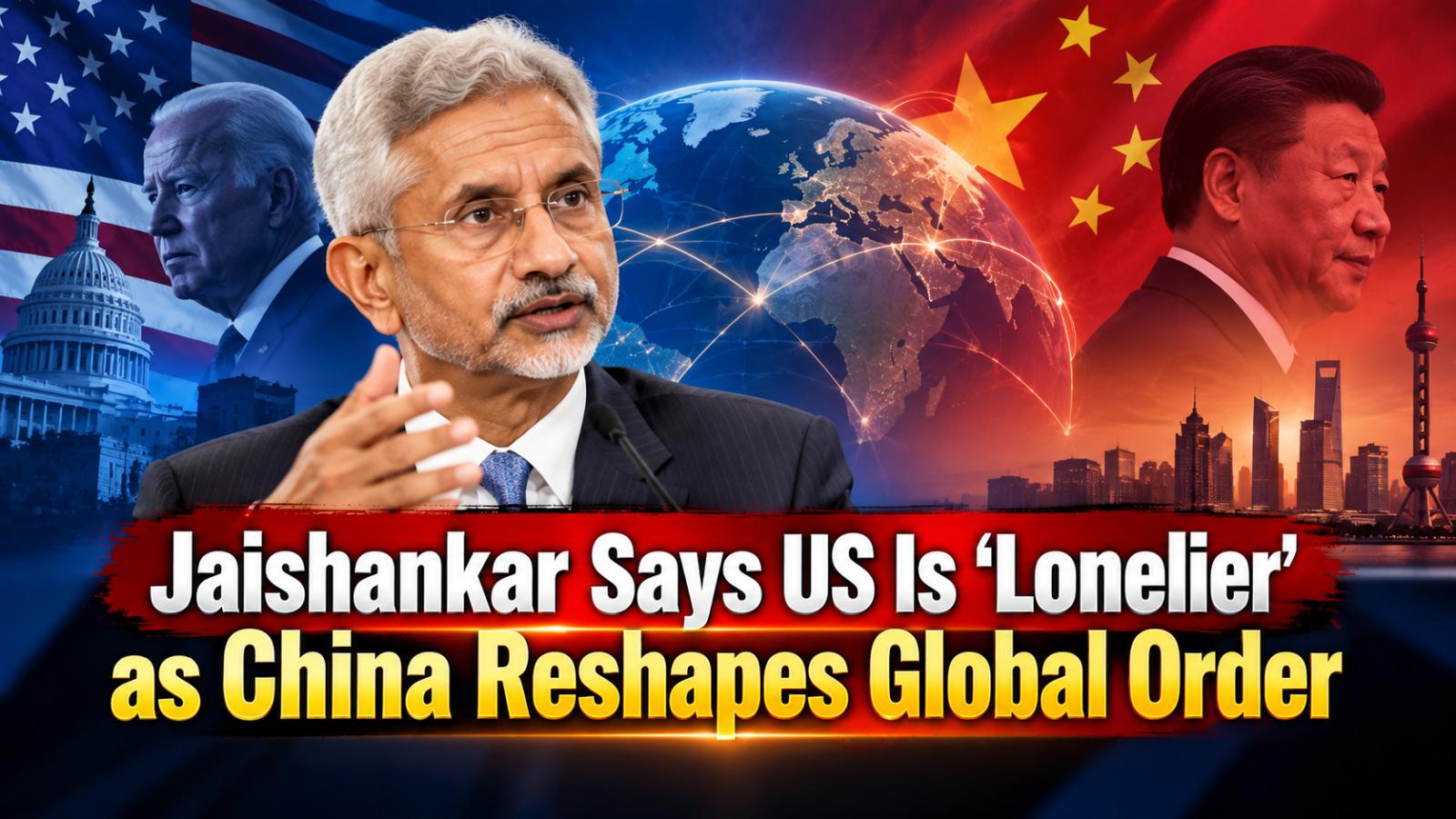
External Affairs Minister S Jaishankar has said that the United States has deliberately adopted a more isolated global posture while China’s growing economic and political influence is reshaping the international order.
Speaking at the 62nd Munich Security Conference, Jaishankar said the present global landscape is increasingly defined by strategic competition between the US and China, alongside a stronger push by emerging and middle powers to protect their interests through diversification, de-risking and flexible partnerships.
US Repositioning Changing Global Landscape
Jaishankar described the changing role of the United States as one of the most important features of the current international environment.
According to him, Washington’s repositioning is a deliberate policy choice rather than an accidental development. He said this shift has made the US a “lonelier power” while encouraging other countries to reassess their own strategies and partnerships.
The changing American approach, he suggested, is influencing how countries view security, trade, technology and diplomatic cooperation.
China’s Rise Becomes Another Major Factor
Jaishankar identified China’s growing influence as another major force shaping the world.
He highlighted China’s large share of global manufacturing and said its economic capabilities are increasingly translating into political influence.
According to Jaishankar, the growing rivalry between Washington and Beijing now extends well beyond bilateral relations. Countries across the world are increasingly being affected by competition involving trade, technology, supply chains and strategic influence.
At the same time, he noted that economic interdependence remains significant, making the US-China relationship both competitive and interconnected.
Middle Powers Focus on Self-Reliance
Jaishankar said emerging and middle powers are becoming more conscious of their national interests and increasingly focusing on self-reliance.
He referred to India’s concept of “Atmanirbhar” while explaining how countries are assessing their own economic, technological and strategic capabilities before entering new partnerships.
According to him, many countries are now looking to reduce excessive dependence on any one partner by diversifying supply chains, economic relationships and security arrangements.
Flexible Partnerships Gain Importance
Jaishankar argued that countries no longer need complete agreement on every political or strategic issue in order to cooperate.
Instead, partnerships can develop when countries have sufficient areas of shared interest. He said a reasonable level of convergence may now be enough to support cooperation between nations with otherwise different positions.
This approach, he said, is contributing to the emergence of a more flexible international system based on issue-specific partnerships.
Quad, BRICS and Connectivity Projects Cited
Jaishankar cited the Quad and BRICS as examples of countries cooperating through different strategic arrangements.
He also referred to connectivity projects including the India-Middle East-Europe Economic Corridor, the International North-South Transport Corridor and the Northern Sea Route.
According to him, BRICS demonstrates how countries can strengthen their influence by working collectively, while initiatives such as the International Solar Alliance and the Coalition for Disaster Resilient Infrastructure reflect cooperation in specific areas.
New Global Order Taking Shape
Jaishankar said the emerging global system is increasingly being shaped by countries that cooperate when their interests overlap rather than relying only on traditional alliances.
He argued that de-risking, diversification and strategic flexibility are becoming central features of international relations.
As US-China competition continues and middle powers seek greater room for independent decision-making, Jaishankar said a new global architecture is gradually emerging based on resilience, shared interests and adaptable partnerships.