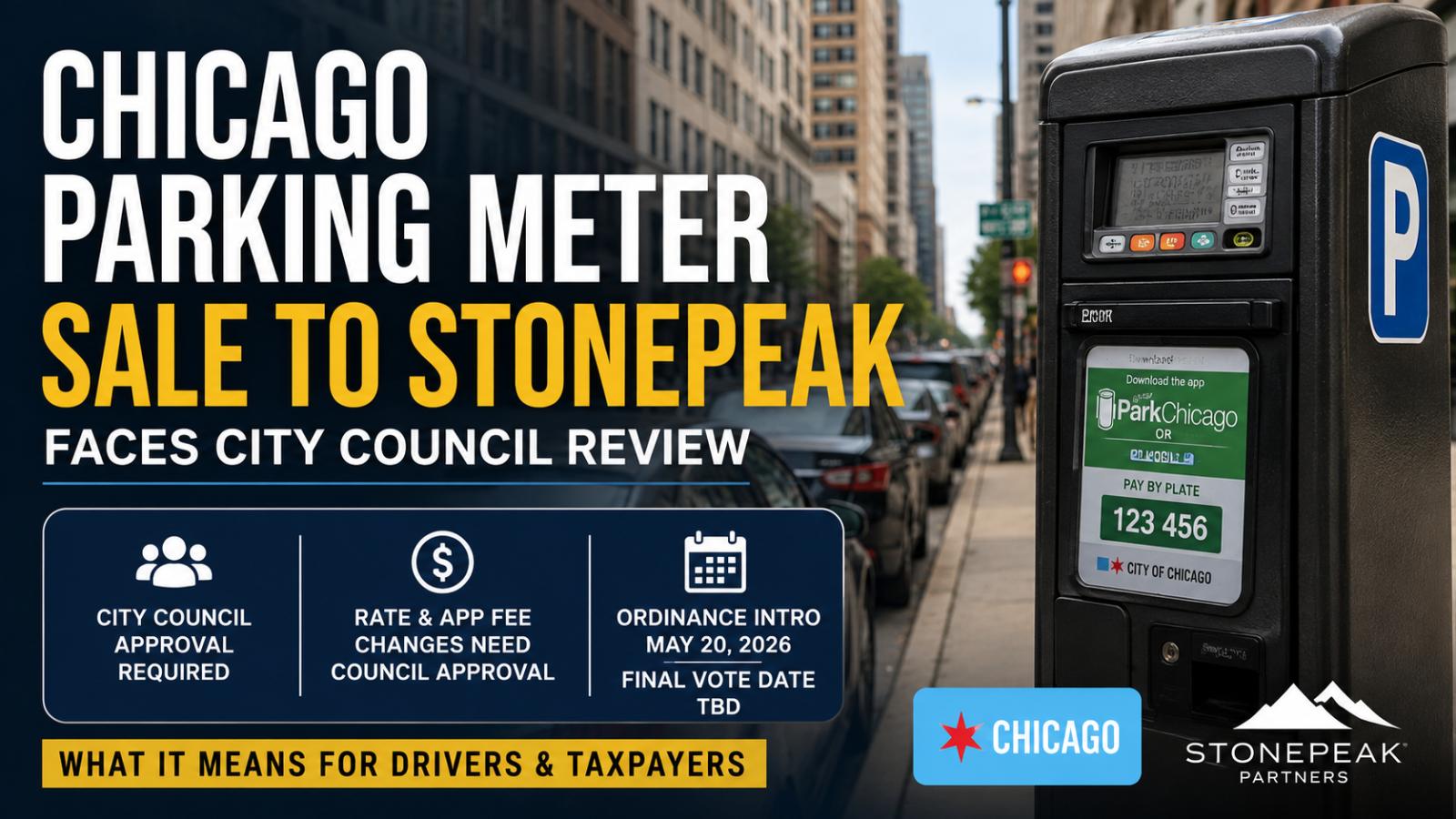
Chicago’s parking meter sale could move to a new private owner after Chicago Parking Meters LLC reached a tentative agreement to transfer its rights to New York-based Stonepeak Partners. The proposal still requires approval from the Chicago City Council, according to Mayor Brandon Johnson’s office.
Ordinance Number and Vote Timeline
An ordinance to begin the review process is expected to be introduced at the Chicago City Council meeting on Wednesday, May 20, 2026, but the exact ordinance number was not immediately available in public source material. CBS Chicago reported that the measure would start the council’s process for evaluating the proposed transfer.
A final vote date has not been publicly confirmed. FOX 32 Chicago reported that the City Council can approve or reject the sale and is expected to review the deal before any ownership transfer moves forward.
Could Parking Rates or App Fees Change?
The ownership transfer itself has not been reported to include any immediate increase in parking meter rates or ParkChicago app fees. Current meter rates are set in Chicago’s municipal code, including $7 per hour in the downtown core, $4.50 per hour in nearby central areas and $2 per hour in most other parts of the city, with annual CPI-based adjustments.
Under the parking meter concession agreement, later rate increases beyond limited inflation-linked adjustments are subject to City Council approval, according to a World Bank summary of the 2008 Chicago metered parking concession.
ParkChicago currently lists a 35-cent convenience fee for transactions under two hours. No public report has confirmed that Stonepeak’s proposed acquisition would automatically change that app fee.
Why the Deal Matters for Drivers
The proposed sale would not end Chicago’s 75-year parking meter lease, which began in 2008 when the city received about $1.15 billion in exchange for long-term private control of meter revenue. The agreement has remained one of Chicago’s most criticized privatization deals because the private operator has already generated nearly $2 billion in revenue, with decades still remaining on the lease.
For drivers, the key question is not only who owns the meter system, but whether the City Council can use the approval process to demand clearer protections on future rates, app fees, taxpayer exposure and public control over curbside parking.