







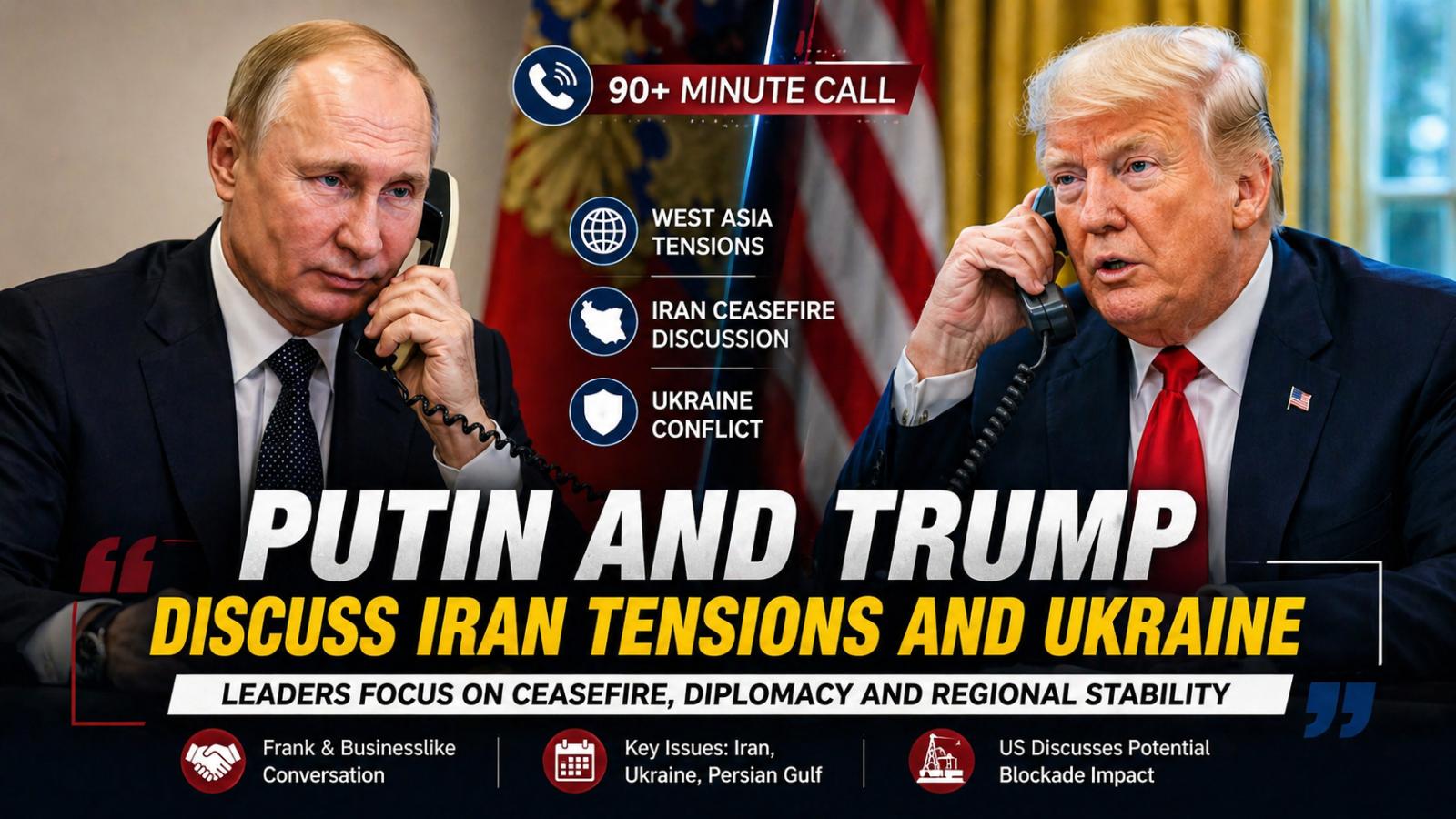
Putin and Trump discuss Iran tensions and Ukraine in lengthy phone call
Russian President Vladimir Putin and US President Donald Trump held a 90-minute call on Iran, Ukraine, and Gulf tensions, discussing ceasefire efforts, diplomacy, and possible US actions on Iranian ports. Putin and Trump discuss Iran tensions and Ukraine in lengthy phone call as Vladimir Putin held a phone conversation with Donald Trump addressing ongoing conflicts in West Asia and Ukraine, according to statements from the Kremlin. The discussion, confirmed by aide Yuri Ushakov on Wednesday, lasted more than 90 minutes and was described as both “frank” and “businesslike,” reflecting the seriousness of the geopolitical issues involved. A central topic of the conversation was the situation in Iran and the broader Persian Gulf. Putin reportedly welcomed Trump’s decision to extend a ceasefire involving Iran, emphasizing that the move could provide critical time for diplomatic negotiations and help reduce escalating tensions across the region. The call highlighted mutual concerns about stability in key global energy corridors and the potential consequences of prolonged conflict. According to a White House official, Trump also discussed strategies with U.S. oil companies to mitigate the economic and logistical impact of a possible long-term U.S. blockade targeting Iranian ports. The potential blockade, which could last for months, is part of broader efforts to pressure Tehran amid ongoing disputes over regional security and nuclear negotiations. During the conversation, Trump urged Iranian leadership to act swiftly, signaling that diplomatic opportunities remain open but limited. His remarks underscored Washington’s push for a negotiated agreement while maintaining pressure through economic and strategic measures. The exchange between the two leaders reflects continued engagement between the United States and Russia on key international crises, even amid broader tensions in bilateral relations.
Putin and Trump discuss Iran tensions and Ukraine in lengthy phone call
Russian President Vladimir Putin and US President Donald Trump held a 90-minute call on Iran, Ukraine, and Gulf tensions, discussing ceasefire efforts, diplomacy, and possible US actions on Iranian ports. Putin and Trump discuss Iran tensions and Ukraine in lengthy phone call as Vladimir Putin held a phone conversation with Donald Trump addressing ongoing conflicts in West Asia and Ukraine, according to statements from the Kremlin. The discussion, confirmed by aide Yuri Ushakov on Wednesday, lasted more than 90 minutes and was described as both “frank” and “businesslike,” reflecting the seriousness of the geopolitical issues involved. A central topic of the conversation was the situation in Iran and the broader Persian Gulf. Putin reportedly welcomed Trump’s decision to extend a ceasefire involving Iran, emphasizing that the move could provide critical time for diplomatic negotiations and help reduce escalating tensions across the region. The call highlighted mutual concerns about stability in key global energy corridors and the potential consequences of prolonged conflict. According to a White House official, Trump also discussed strategies with U.S. oil companies to mitigate the economic and logistical impact of a possible long-term U.S. blockade targeting Iranian ports. The potential blockade, which could last for months, is part of broader efforts to pressure Tehran amid ongoing disputes over regional security and nuclear negotiations. During the conversation, Trump urged Iranian leadership to act swiftly, signaling that diplomatic opportunities remain open but limited. His remarks underscored Washington’s push for a negotiated agreement while maintaining pressure through economic and strategic measures. The exchange between the two leaders reflects continued engagement between the United States and Russia on key international crises, even amid broader tensions in bilateral relations.
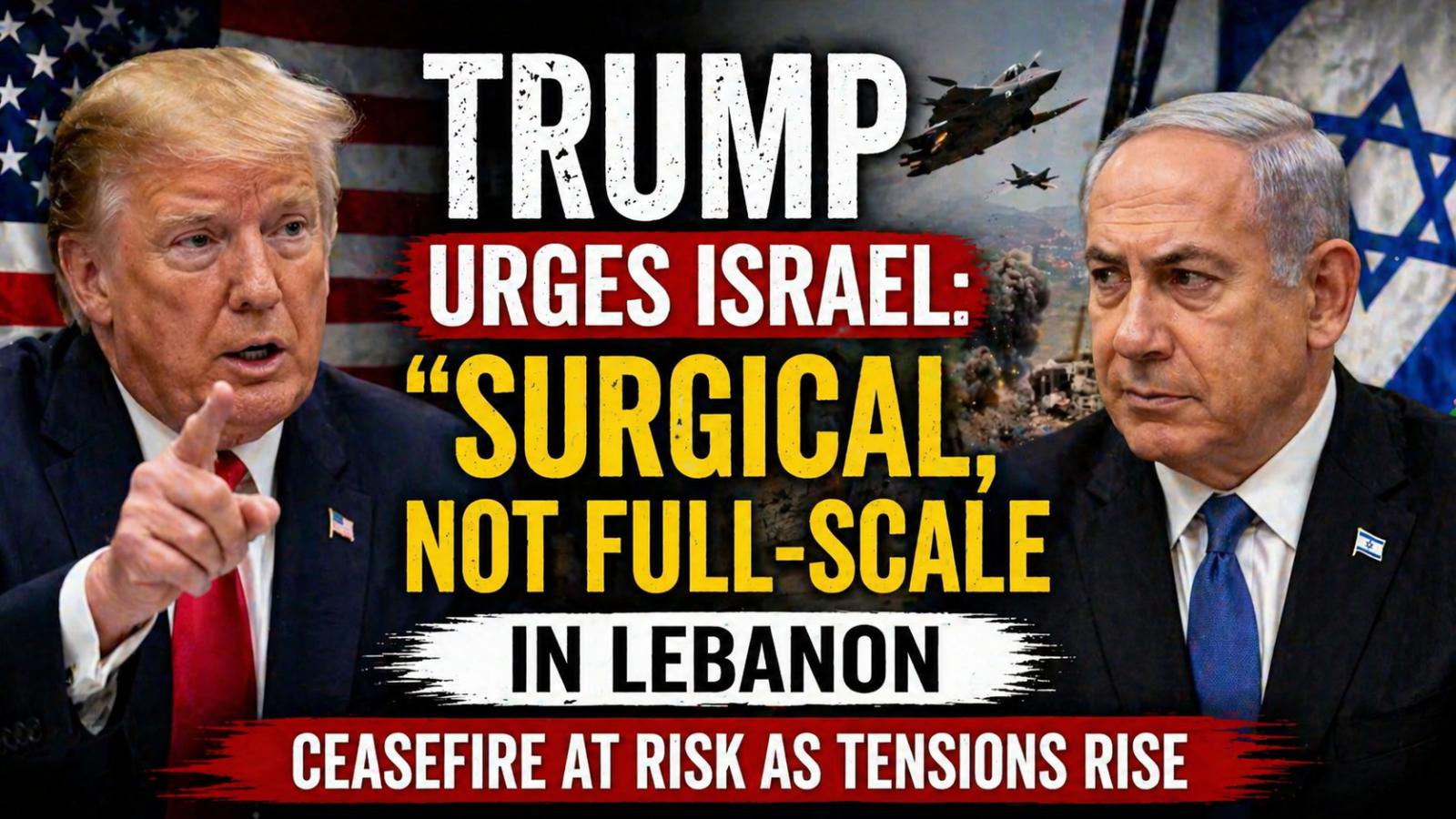
Trump Calls for “Surgical” Action as Israel-Hezbollah Conflict Intensifies
US President Donald Trump has urged Israeli Prime Minister Benjamin Netanyahu to limit military operations in Lebanon to targeted actions, emphasizing restraint as tensions with Hezbollah continue to escalate. According to remarks made during a recent interview, Trump advised against large-scale strikes, stating that extensive destruction risks undermining Israel’s international image. His comments come as a fragile ceasefire between Israel and Lebanon shows signs of weakening ahead of its expected expiration. Despite ongoing diplomatic efforts, clashes between Israeli forces and Hezbollah have persisted. Hezbollah has continued launching rockets and drones toward Israeli territory, while Israel has responded with expanded airstrikes and maintained a military presence in parts of southern Lebanon. Israeli officials have indicated the need for a stronger response, citing security concerns, while US officials have urged caution to avoid further escalation. Trump reportedly held frequent discussions with Netanyahu, during which the Israeli leader outlined the challenges of responding to continued attacks. Trump reiterated his position that military actions should remain precise and proportionate, arguing that broader strikes could complicate diplomatic efforts and regional stability. He also expressed a positive view of Lebanon’s leadership, suggesting that the country has the potential to recover despite ongoing instability. US officials have framed Hezbollah’s actions as an attempt to provoke a wider conflict and disrupt negotiations. Washington has continued to advocate for restraint while pursuing diplomatic channels aimed at reducing tensions. Efforts have included discussions involving Israeli and Lebanese representatives, although progress toward a formal agreement remains limited. The situation highlights the delicate balance between security concerns and diplomatic engagement in the region. As the ceasefire continues to erode, international pressure is mounting to prevent a broader conflict while maintaining efforts to stabilize relations between Israel and Lebanon.
Trump Calls for “Surgical” Action as Israel-Hezbollah Conflict Intensifies
US President Donald Trump has urged Israeli Prime Minister Benjamin Netanyahu to limit military operations in Lebanon to targeted actions, emphasizing restraint as tensions with Hezbollah continue to escalate. According to remarks made during a recent interview, Trump advised against large-scale strikes, stating that extensive destruction risks undermining Israel’s international image. His comments come as a fragile ceasefire between Israel and Lebanon shows signs of weakening ahead of its expected expiration. Despite ongoing diplomatic efforts, clashes between Israeli forces and Hezbollah have persisted. Hezbollah has continued launching rockets and drones toward Israeli territory, while Israel has responded with expanded airstrikes and maintained a military presence in parts of southern Lebanon. Israeli officials have indicated the need for a stronger response, citing security concerns, while US officials have urged caution to avoid further escalation. Trump reportedly held frequent discussions with Netanyahu, during which the Israeli leader outlined the challenges of responding to continued attacks. Trump reiterated his position that military actions should remain precise and proportionate, arguing that broader strikes could complicate diplomatic efforts and regional stability. He also expressed a positive view of Lebanon’s leadership, suggesting that the country has the potential to recover despite ongoing instability. US officials have framed Hezbollah’s actions as an attempt to provoke a wider conflict and disrupt negotiations. Washington has continued to advocate for restraint while pursuing diplomatic channels aimed at reducing tensions. Efforts have included discussions involving Israeli and Lebanese representatives, although progress toward a formal agreement remains limited. The situation highlights the delicate balance between security concerns and diplomatic engagement in the region. As the ceasefire continues to erode, international pressure is mounting to prevent a broader conflict while maintaining efforts to stabilize relations between Israel and Lebanon.

Does parental sacrifice build values? Consistency matters more than sacrifice
Does parental sacrifice build values? Consistency matters more than sacrifice is a question many parents reflect on when children do not respond as expected, despite years of effort and care. While sacrifice is often seen as a measure of love, young children are not equipped to understand or evaluate it in the way adults do. Children respond to patterns, not effort In early childhood, children do not think in terms of how much a parent has done for them. Th
Does parental sacrifice build values? Consistency matters more than sacrifice
Does parental sacrifice build values? Consistency matters more than sacrifice is a question many parents reflect on when children do not respond as expected, despite years of effort and care. While sacrifice is often seen as a measure of love, young children are not equipped to understand or evaluate it in the way adults do. Children respond to patterns, not effort In early childhood, children do not think in terms of how much a parent has done for them. Th

What defines JRD Tata’s legacy? A life of service over ownership
A life of service over ownership JRD Tata’s legacy offers a striking contrast to modern perceptions of wealth and leadership. As one of India’s most influential industrialists, he led the Tata Group for over five decades, yet chose to live in a rented residence rather than accumulate personal assets. His approach reflected a philosophy that prioritized responsibility, ethics, and long-term impact over visible displays of success. Leadership that expanded an industrial empire Under JRD Tata’s leadership, the Tata Group evolved into one of India’s most significant industrial conglomerates, spanning sectors such as steel, aviation, power, and chemicals. His tenure marked a period of sustained growth and modernization, contributing to the country’s economic development. Rather than focusing on personal gain, he emphasized institutional strength, innovation, and employee welfare, setting standards that influenced corporate governance across industries. Simplicity as a leadership principle JRD Tata’s personal lifestyle remained notably modest despite his professional stature. He lived in a rented bungalow in Mumbai for decades, demonstrating that leadership did not require material excess. His daily life reflected discipline and humility, reinforcing the idea that influence comes from actions and values rather than possessions. This approach continues to resonate in discussions about ethical leadership and sustainable success. Impact measured beyond wealth The scale of JRD Tata’s impact is reflected not only in business expansion but also in the opportunities created for thousands of employees and communities. His leadership helped build institutions that continue to operate globally, shaping industries and contributing to economic stability. For many observers, his legacy represents a model where success is defined by contribution rather than ownership. A lasting example for global audiences For audiences in the United States and beyond, JRD Taa’s story provides a broader perspective on leadership in a global context. His life underscores the importance of purpose-driven decision-making and challenges assumptions about the relationship between wealth and success. In an era where corporate influence is closely examined, his example remains relevant as a benchmark for integrity and long-term vision.
What defines JRD Tata’s legacy? A life of service over ownership
A life of service over ownership JRD Tata’s legacy offers a striking contrast to modern perceptions of wealth and leadership. As one of India’s most influential industrialists, he led the Tata Group for over five decades, yet chose to live in a rented residence rather than accumulate personal assets. His approach reflected a philosophy that prioritized responsibility, ethics, and long-term impact over visible displays of success. Leadership that expanded an industrial empire Under JRD Tata’s leadership, the Tata Group evolved into one of India’s most significant industrial conglomerates, spanning sectors such as steel, aviation, power, and chemicals. His tenure marked a period of sustained growth and modernization, contributing to the country’s economic development. Rather than focusing on personal gain, he emphasized institutional strength, innovation, and employee welfare, setting standards that influenced corporate governance across industries. Simplicity as a leadership principle JRD Tata’s personal lifestyle remained notably modest despite his professional stature. He lived in a rented bungalow in Mumbai for decades, demonstrating that leadership did not require material excess. His daily life reflected discipline and humility, reinforcing the idea that influence comes from actions and values rather than possessions. This approach continues to resonate in discussions about ethical leadership and sustainable success. Impact measured beyond wealth The scale of JRD Tata’s impact is reflected not only in business expansion but also in the opportunities created for thousands of employees and communities. His leadership helped build institutions that continue to operate globally, shaping industries and contributing to economic stability. For many observers, his legacy represents a model where success is defined by contribution rather than ownership. A lasting example for global audiences For audiences in the United States and beyond, JRD Taa’s story provides a broader perspective on leadership in a global context. His life underscores the importance of purpose-driven decision-making and challenges assumptions about the relationship between wealth and success. In an era where corporate influence is closely examined, his example remains relevant as a benchmark for integrity and long-term vision.
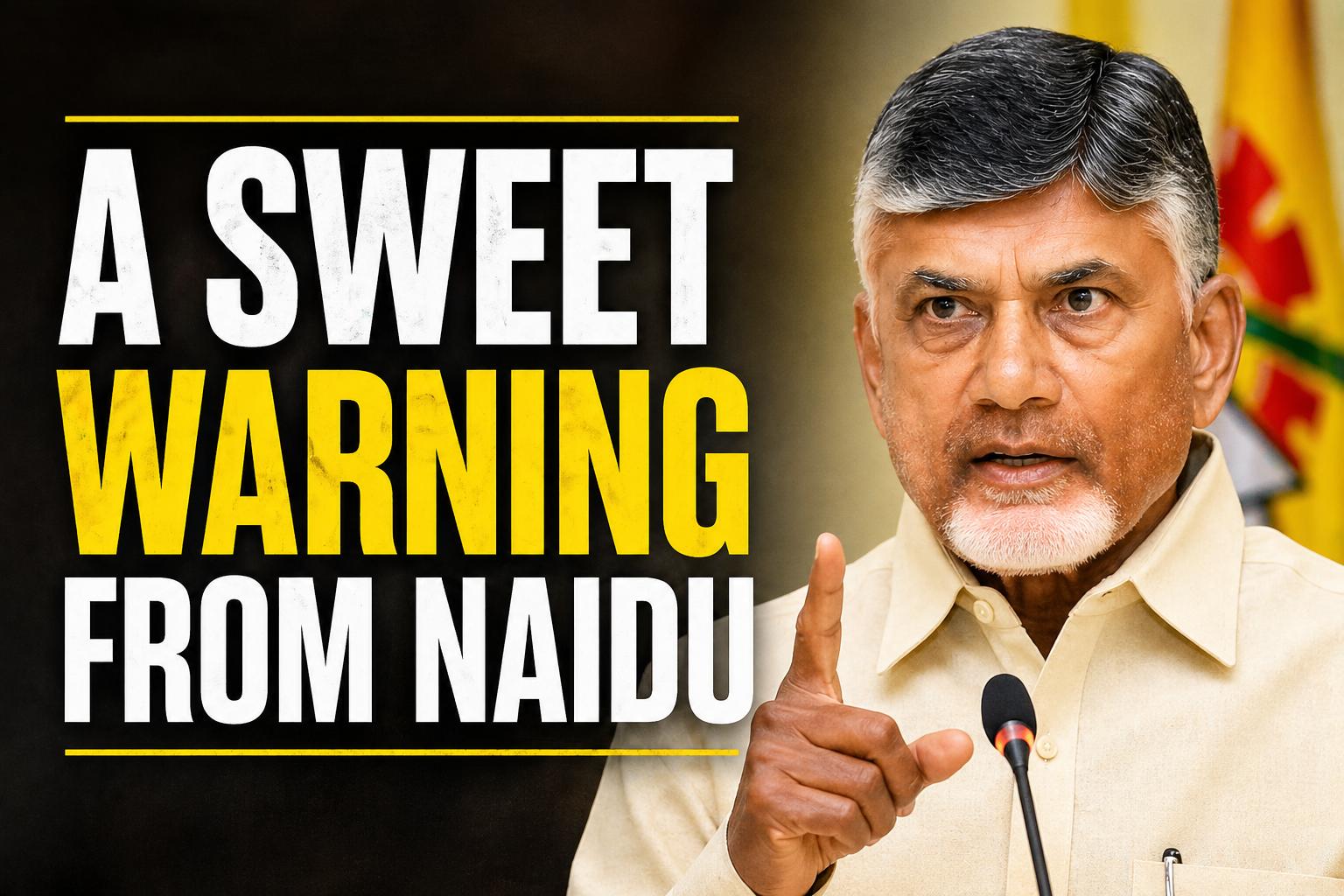
Chandrababu Naidu Warns TDP Leaders To Stay Disciplined Amid Internal Tensions
Chandrababu Naidu urged Telugu Desam Party leaders to stay disciplined and avoid internal conflicts. He warned that small issues and power-driven behavior can damage the party’s image and public trust. Chandrababu Naidu has issued a firm yet measured warning to leaders of the Telugu Desam Party, urging them to maintain discipline and avoid unnecessary internal conflicts. Speaking at a recent party event, Naidu highlighted how minor disputes over issues such as flex banners, photo placements, and seating arrangements can create a negative perception among the public and harm the party’s image. His remarks come at a time when reports of friction between TDP and Jana Sena Party leaders have surfaced, particularly in the Pithapuram constituency. Although Naidu did not mention any individual names, political observers believe his comments were directed at local leaders involved in these tensions. He emphasized that such behavior distracts from the party’s primary goal of serving the people and maintaining unity within the ranks. Naidu stressed that discipline is the backbone of any political organization and must be followed at every level, from grassroots workers to senior leadership. He reminded party members that the public is closely observing their actions, and even small missteps can quickly turn into damaging headlines. Drawing lessons from the past, Naidu pointed out that voters have already penalized leaders from YSR Congress Party for similar behavior driven by arrogance and misuse of power. He cautioned TDP leaders not to repeat those mistakes and instead focus on responsible conduct. By calling for unity, humility, and public-oriented work, Naidu reinforced the importance of protecting the party’s reputation through disciplined and respectful behavior.
Chandrababu Naidu Warns TDP Leaders To Stay Disciplined Amid Internal Tensions
Chandrababu Naidu urged Telugu Desam Party leaders to stay disciplined and avoid internal conflicts. He warned that small issues and power-driven behavior can damage the party’s image and public trust. Chandrababu Naidu has issued a firm yet measured warning to leaders of the Telugu Desam Party, urging them to maintain discipline and avoid unnecessary internal conflicts. Speaking at a recent party event, Naidu highlighted how minor disputes over issues such as flex banners, photo placements, and seating arrangements can create a negative perception among the public and harm the party’s image. His remarks come at a time when reports of friction between TDP and Jana Sena Party leaders have surfaced, particularly in the Pithapuram constituency. Although Naidu did not mention any individual names, political observers believe his comments were directed at local leaders involved in these tensions. He emphasized that such behavior distracts from the party’s primary goal of serving the people and maintaining unity within the ranks. Naidu stressed that discipline is the backbone of any political organization and must be followed at every level, from grassroots workers to senior leadership. He reminded party members that the public is closely observing their actions, and even small missteps can quickly turn into damaging headlines. Drawing lessons from the past, Naidu pointed out that voters have already penalized leaders from YSR Congress Party for similar behavior driven by arrogance and misuse of power. He cautioned TDP leaders not to repeat those mistakes and instead focus on responsible conduct. By calling for unity, humility, and public-oriented work, Naidu reinforced the importance of protecting the party’s reputation through disciplined and respectful behavior.
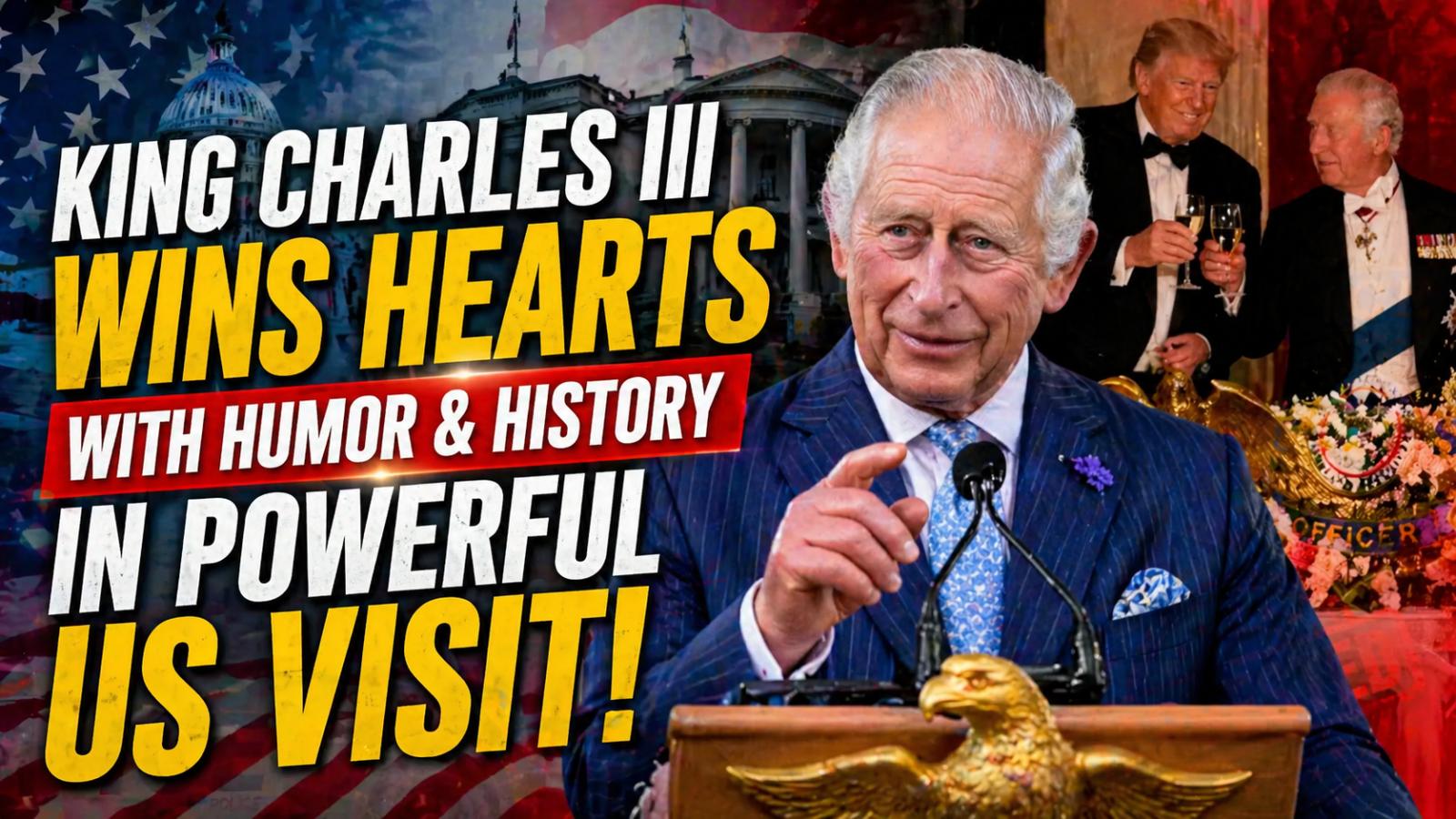
King Charles III Uses Humor to Strengthen US-UK Ties During Visit
King Charles III used a mix of humor and historical references during his recent visit to the United States, delivering speeches that balanced diplomacy with wit while reinforcing the long-standing relationship between the two nations. His appearances, including an address to Congress and remarks at a state dinner at the White House hosted by Donald Trump, drew attention for their tone and messaging. During his engagements, the King made light-hearted comments that resonated with audiences while referencing shared history. In one instance, he joked about the British army’s burning of the White House in 1814, describing it as a “small attempt at beautification,” prompting laughter while acknowledging a historic conflict. His remarks also included references to earlier global rivalries, noting that without British influence, Americans might have been speaking French, a nod to the outcome of 18th-century European conflicts. In his address to Congress, King Charles drew on literary imagery, referring to “a tale of two Georges,” linking George Washington and George III. The comment highlighted shared history while emphasizing the evolution of relations between the United Kingdom and the United States. His speech avoided direct involvement in political controversies, instead focusing on broader themes of partnership and mutual respect. The King also touched on modern geopolitical issues, including defense cooperation and the role of alliances such as NATO. He referenced the enduring collaboration between the two nations, particularly in times of crisis, while acknowledging differing perspectives on international policy matters. His remarks underscored the importance of maintaining cooperation despite disagreements. By combining humor with carefully measured commentary, King Charles demonstrated a diplomatic approach that emphasized unity without overlooking complexity. His visit highlighted both the historical depth and contemporary relevance of the US-UK relationship, presenting a message aimed at strengthening ties while navigating sensitive political dynamics.
King Charles III Uses Humor to Strengthen US-UK Ties During Visit
King Charles III used a mix of humor and historical references during his recent visit to the United States, delivering speeches that balanced diplomacy with wit while reinforcing the long-standing relationship between the two nations. His appearances, including an address to Congress and remarks at a state dinner at the White House hosted by Donald Trump, drew attention for their tone and messaging. During his engagements, the King made light-hearted comments that resonated with audiences while referencing shared history. In one instance, he joked about the British army’s burning of the White House in 1814, describing it as a “small attempt at beautification,” prompting laughter while acknowledging a historic conflict. His remarks also included references to earlier global rivalries, noting that without British influence, Americans might have been speaking French, a nod to the outcome of 18th-century European conflicts. In his address to Congress, King Charles drew on literary imagery, referring to “a tale of two Georges,” linking George Washington and George III. The comment highlighted shared history while emphasizing the evolution of relations between the United Kingdom and the United States. His speech avoided direct involvement in political controversies, instead focusing on broader themes of partnership and mutual respect. The King also touched on modern geopolitical issues, including defense cooperation and the role of alliances such as NATO. He referenced the enduring collaboration between the two nations, particularly in times of crisis, while acknowledging differing perspectives on international policy matters. His remarks underscored the importance of maintaining cooperation despite disagreements. By combining humor with carefully measured commentary, King Charles demonstrated a diplomatic approach that emphasized unity without overlooking complexity. His visit highlighted both the historical depth and contemporary relevance of the US-UK relationship, presenting a message aimed at strengthening ties while navigating sensitive political dynamics.
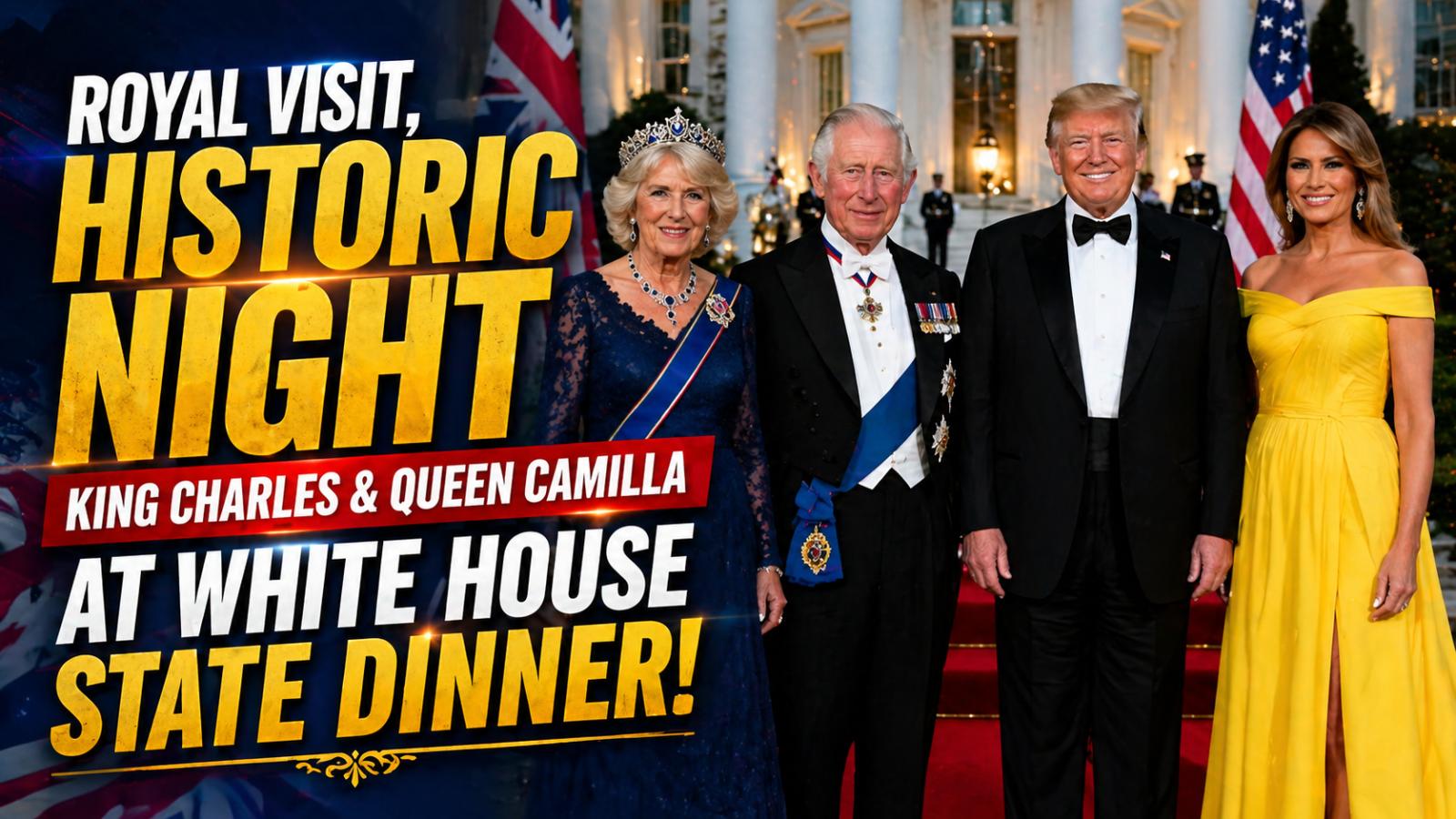
King Charles III Attends White House State Dinner Hosted by President Trump
King Charles III and Queen Camilla arrived at the White House on Tuesday evening for a formal state dinner hosted by Donald
King Charles III Attends White House State Dinner Hosted by President Trump
King Charles III and Queen Camilla arrived at the White House on Tuesday evening for a formal state dinner hosted by Donald
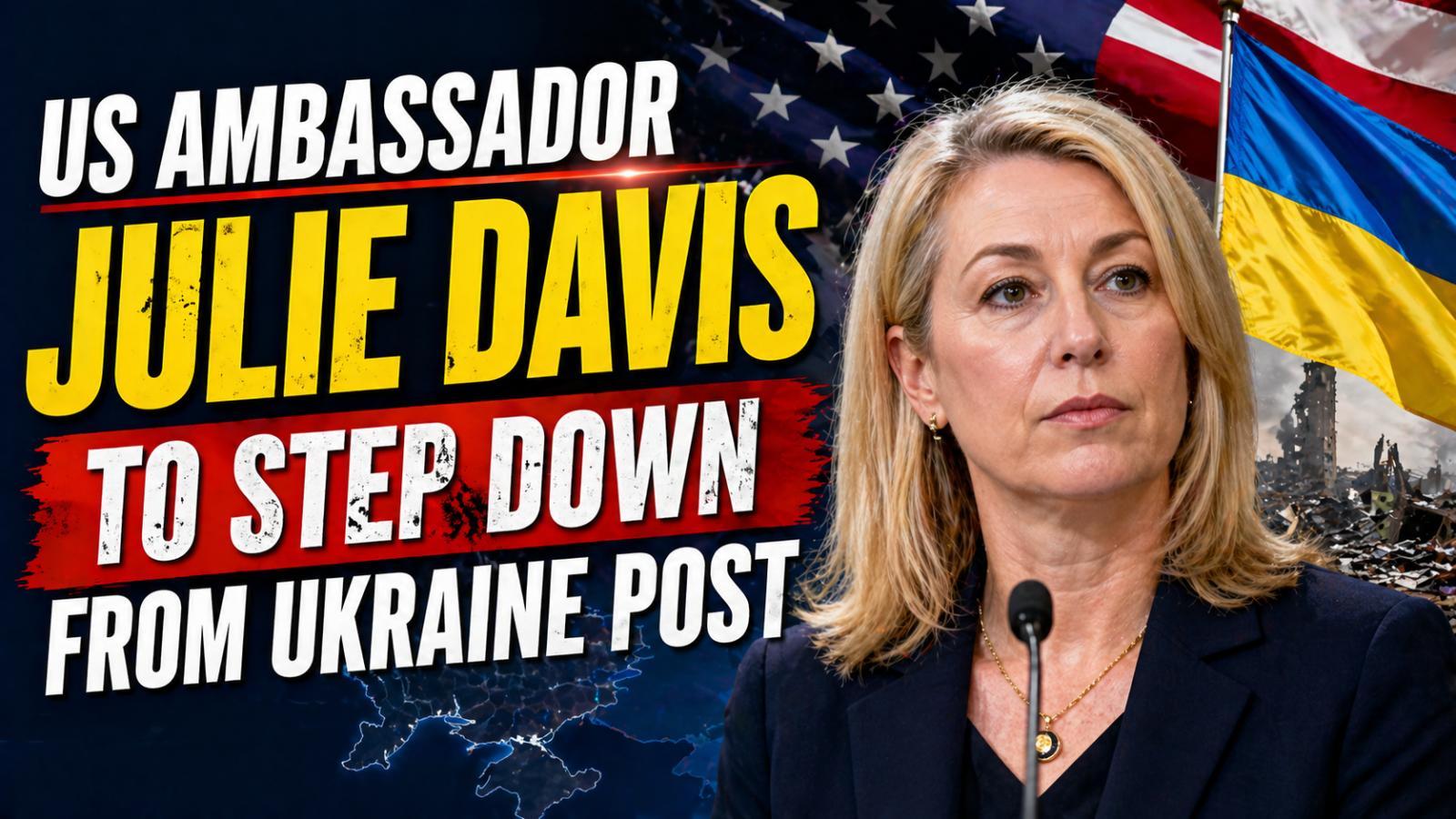
Julie Davis Announces Exit as US Faces Challenges in Ukraine Peace Efforts
The United States Department of State confirmed on April 28 that Julie Davis will step down from her role as acting ambassador to Ukraine after serving less than a year in the position. The announcement comes at a time when diplomatic efforts by the United States to facilitate a peace agreement between Ukraine and Russia have yet to produce a breakthrough. Davis, who also serves as ambassador to Cyprus, had been handling dual responsibilities since her appointment by Donald Trump in May of the previous year. She assumed the Kyiv role following the departure of Bridget Brink, who had been appointed earlier and later stepped down. The State Department stated that Davis cited retirement as the reason for her decision. Her tenure coincided with increased diplomatic pressure from Washington on Kyiv to consider terms that could advance negotiations with Moscow. Trump has publicly emphasized the need for a resolution, including the possibility of territorial concessions by Ukraine, as part of a broader effort to secure a ceasefire. However, these initiatives have not resulted in a formal agreement, and fighting has continued without a comprehensive settlement. Reports suggesting internal disagreements regarding US policy toward Ukraine were rejected by officials, who maintained that no such disputes influenced Davis’s decision. Brink, Davis’s predecessor, had previously expressed concern over what she described as an approach that placed disproportionate pressure on Ukraine during negotiations. Davis’s departure highlights the ongoing complexity of US diplomatic engagement in the region. With peace talks stalled and geopolitical tensions unresolved, the transition comes at a critical moment for American foreign policy and its role in shaping outcomes in Eastern Europe.
Julie Davis Announces Exit as US Faces Challenges in Ukraine Peace Efforts
The United States Department of State confirmed on April 28 that Julie Davis will step down from her role as acting ambassador to Ukraine after serving less than a year in the position. The announcement comes at a time when diplomatic efforts by the United States to facilitate a peace agreement between Ukraine and Russia have yet to produce a breakthrough. Davis, who also serves as ambassador to Cyprus, had been handling dual responsibilities since her appointment by Donald Trump in May of the previous year. She assumed the Kyiv role following the departure of Bridget Brink, who had been appointed earlier and later stepped down. The State Department stated that Davis cited retirement as the reason for her decision. Her tenure coincided with increased diplomatic pressure from Washington on Kyiv to consider terms that could advance negotiations with Moscow. Trump has publicly emphasized the need for a resolution, including the possibility of territorial concessions by Ukraine, as part of a broader effort to secure a ceasefire. However, these initiatives have not resulted in a formal agreement, and fighting has continued without a comprehensive settlement. Reports suggesting internal disagreements regarding US policy toward Ukraine were rejected by officials, who maintained that no such disputes influenced Davis’s decision. Brink, Davis’s predecessor, had previously expressed concern over what she described as an approach that placed disproportionate pressure on Ukraine during negotiations. Davis’s departure highlights the ongoing complexity of US diplomatic engagement in the region. With peace talks stalled and geopolitical tensions unresolved, the transition comes at a critical moment for American foreign policy and its role in shaping outcomes in Eastern Europe.
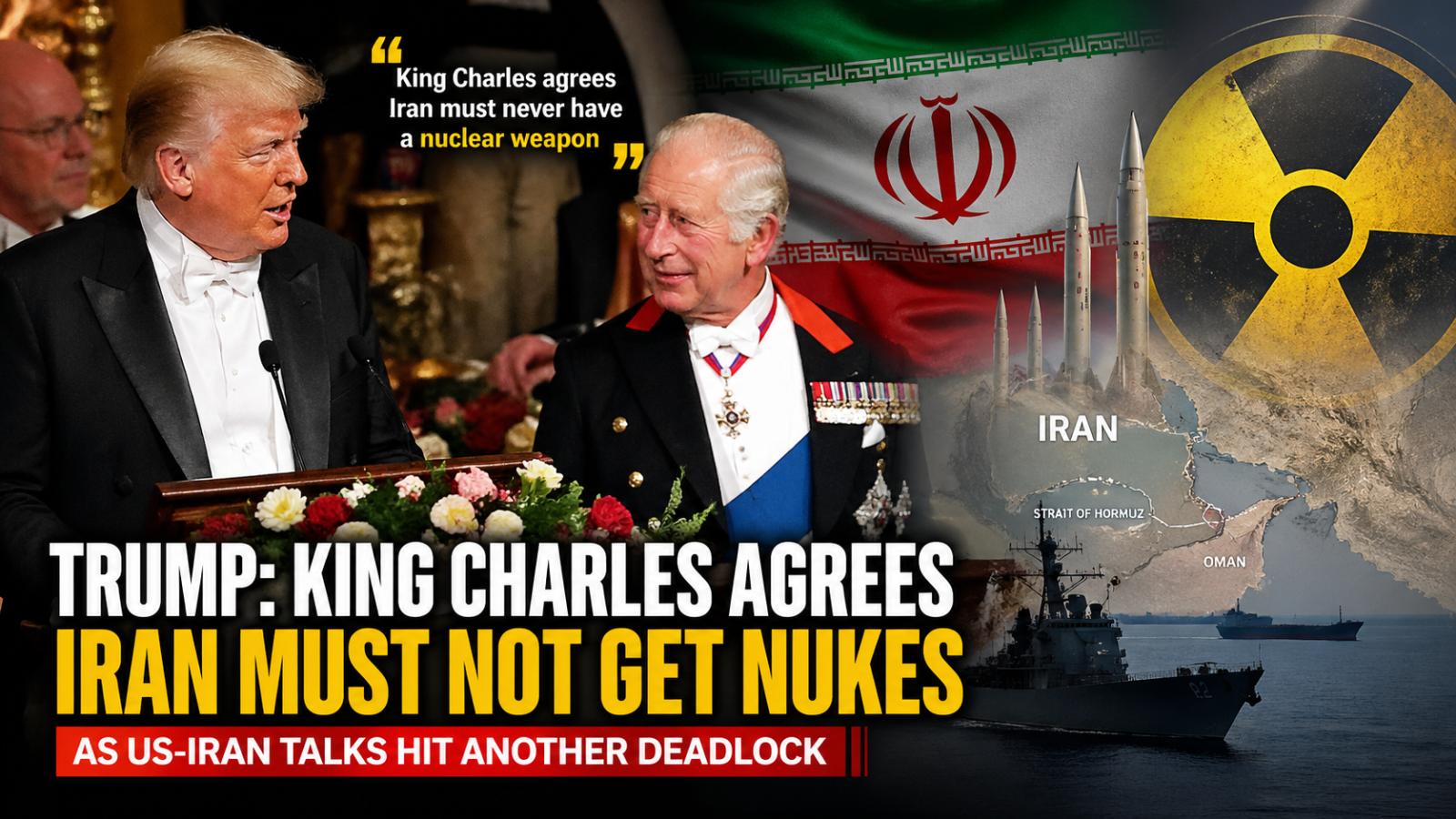
What did Trump say about Iran at the state dinner? He claimed King Charles agrees Iran must not have nuclear weapons
During a state dinner honoring the United Kingdom’s monarch, former U.S. President Donald Trump said King Charles III shares his view that Iran must never obtain nuclear weapons, while emphasizing the strength of U.S.-UK defense ties. Speaking at the formal event, Trump described the alliance between the two nations as rooted in “unconquerable courage,” referencing shared military history across multiple global conflicts. Trump used the occasion to highlight ongoing U.S. mili
What did Trump say about Iran at the state dinner? He claimed King Charles agrees Iran must not have nuclear weapons
During a state dinner honoring the United Kingdom’s monarch, former U.S. President Donald Trump said King Charles III shares his view that Iran must never obtain nuclear weapons, while emphasizing the strength of U.S.-UK defense ties. Speaking at the formal event, Trump described the alliance between the two nations as rooted in “unconquerable courage,” referencing shared military history across multiple global conflicts. Trump used the occasion to highlight ongoing U.S. mili
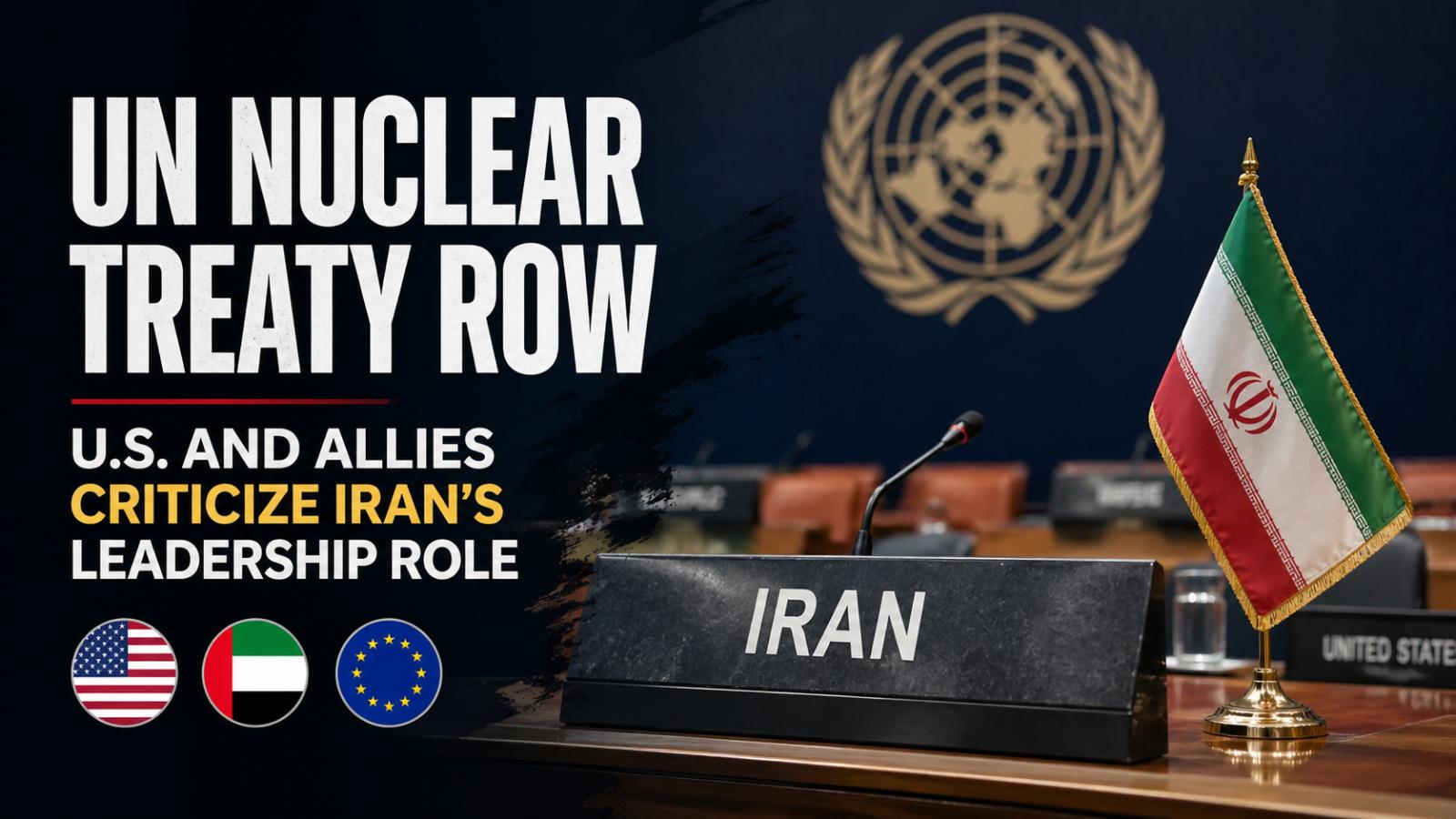
Why did the UN grant Iran a leadership role? It reflects procedural voting dynamics despite criticism
It reflects procedural voting dynamics despite criticism The United States, joined by the United Arab Emirates and supported by several European governments, condemned a United Nations decision made on Monday, April 28, 2026, to appoint Iran as one of the vice presidents at a major nuclear treaty conference in New York. Iran’s appointment through Non-Aligned Movement voting bloc The controversy emerged as the 11th Review Conference of
Why did the UN grant Iran a leadership role? It reflects procedural voting dynamics despite criticism
It reflects procedural voting dynamics despite criticism The United States, joined by the United Arab Emirates and supported by several European governments, condemned a United Nations decision made on Monday, April 28, 2026, to appoint Iran as one of the vice presidents at a major nuclear treaty conference in New York. Iran’s appointment through Non-Aligned Movement voting bloc The controversy emerged as the 11th Review Conference of
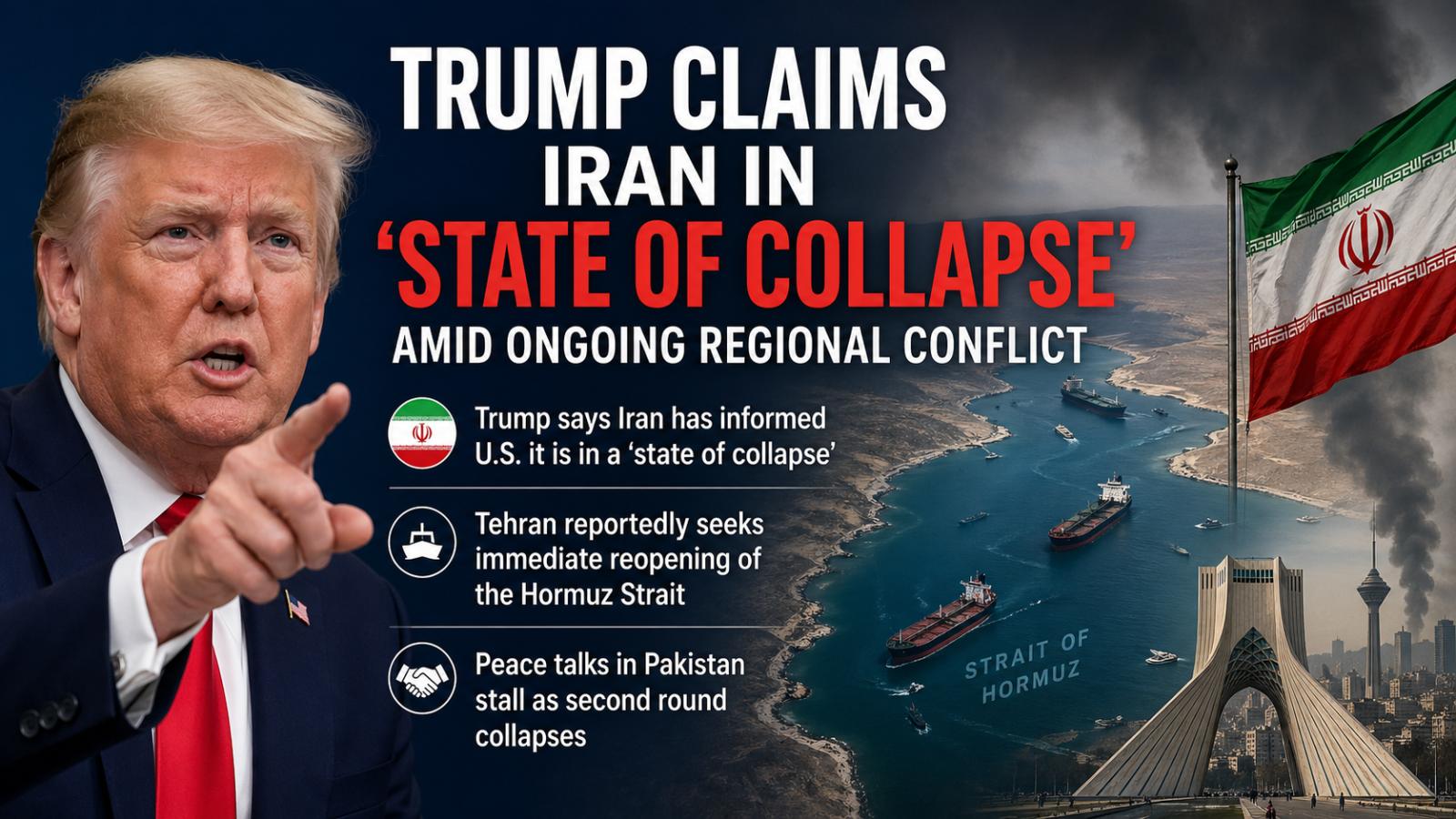
Trump claims Iran in ‘state of collapse’ amid ongoing regional conflict
Trump says Iran is in “collapse” and seeks reopening of the Hormuz Strait as conflict continues. Peace talks in Pakistan stalled, leaving regional tensions unresolved. Trump claims Iran in ‘state of collapse’ amid ongoing regional conflict as former U.S. President Donald Trump said the Iranian government has informed Washington it is facing a severe breakdown in l
Trump claims Iran in ‘state of collapse’ amid ongoing regional conflict
Trump says Iran is in “collapse” and seeks reopening of the Hormuz Strait as conflict continues. Peace talks in Pakistan stalled, leaving regional tensions unresolved. Trump claims Iran in ‘state of collapse’ amid ongoing regional conflict as former U.S. President Donald Trump said the Iranian government has informed Washington it is facing a severe breakdown in l

Does over-pampering help children? It often leads to entitlement later
Does over-pampering help children? It often leads to entitlement later is a question many parents overlook in the early years, often confusing love with giving everything a child asks for. While providing comfort and care is natural, a lack of boundaries during early childhood can quietly shape behavior in ways that become difficult to manage later. When love becomes unlimited giving In many homes, parents try to fulfill every small demand, believing it wil
Does over-pampering help children? It often leads to entitlement later
Does over-pampering help children? It often leads to entitlement later is a question many parents overlook in the early years, often confusing love with giving everything a child asks for. While providing comfort and care is natural, a lack of boundaries during early childhood can quietly shape behavior in ways that become difficult to manage later. When love becomes unlimited giving In many homes, parents try to fulfill every small demand, believing it wil
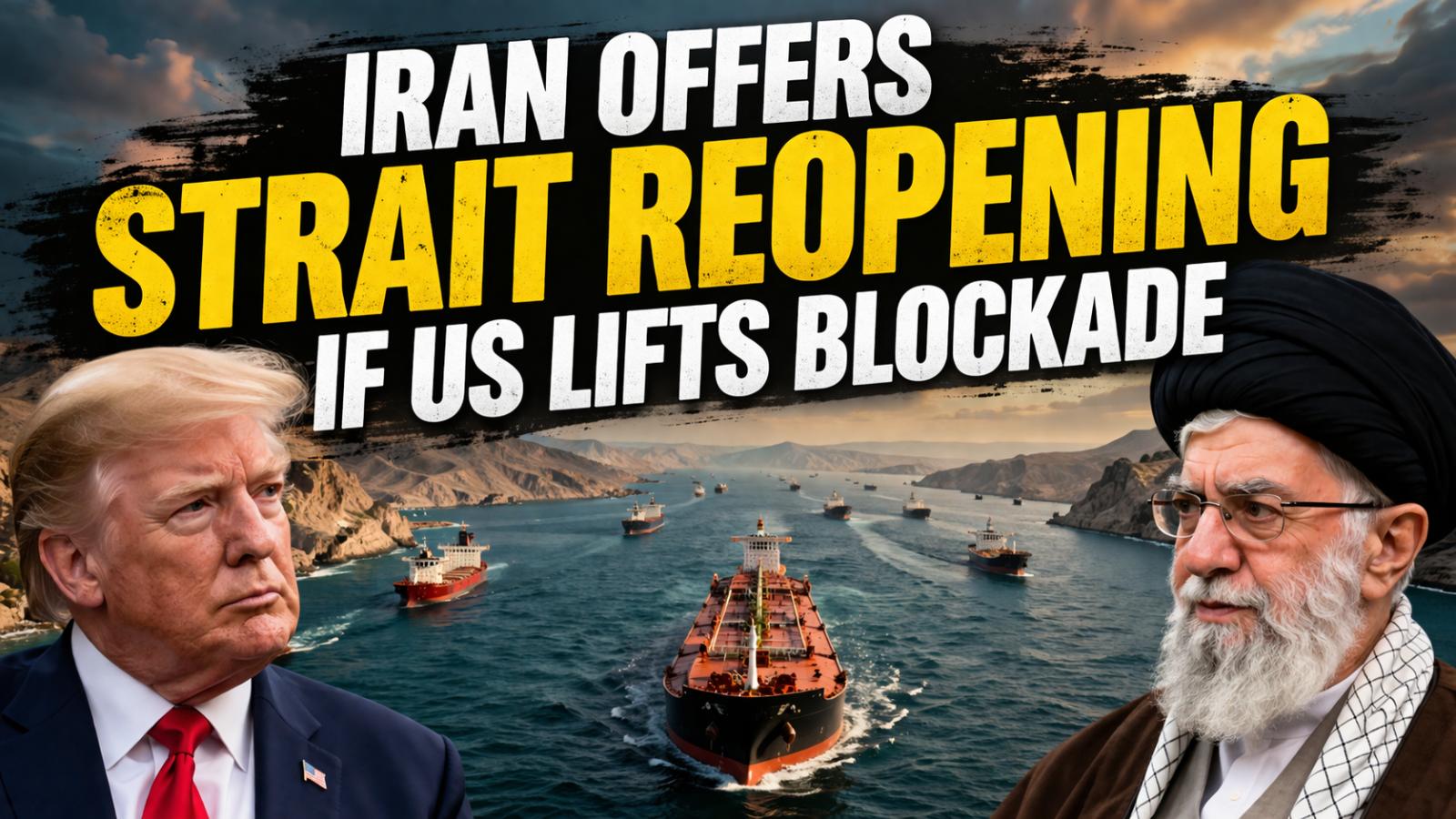
Iran offers Strait of Hormuz reopening if US lifts blockade, delays nuclear talks
Iran offered to reopen the Strait of Hormuz if the U.S. lifts its blockade and ends hostilities, but Washington insists any deal must address Tehran’s nuclear program, leaving tensions high and global energy markets under strain. Iran has proposed reopening the Strait of Hormuz if the United States lifts its blockade and agrees to end hostilities, according to regional officials familiar with negotiations disclosed on Monday, April 28, 2026. The proposal, deliver
Iran offers Strait of Hormuz reopening if US lifts blockade, delays nuclear talks
Iran offered to reopen the Strait of Hormuz if the U.S. lifts its blockade and ends hostilities, but Washington insists any deal must address Tehran’s nuclear program, leaving tensions high and global energy markets under strain. Iran has proposed reopening the Strait of Hormuz if the United States lifts its blockade and agrees to end hostilities, according to regional officials familiar with negotiations disclosed on Monday, April 28, 2026. The proposal, deliver
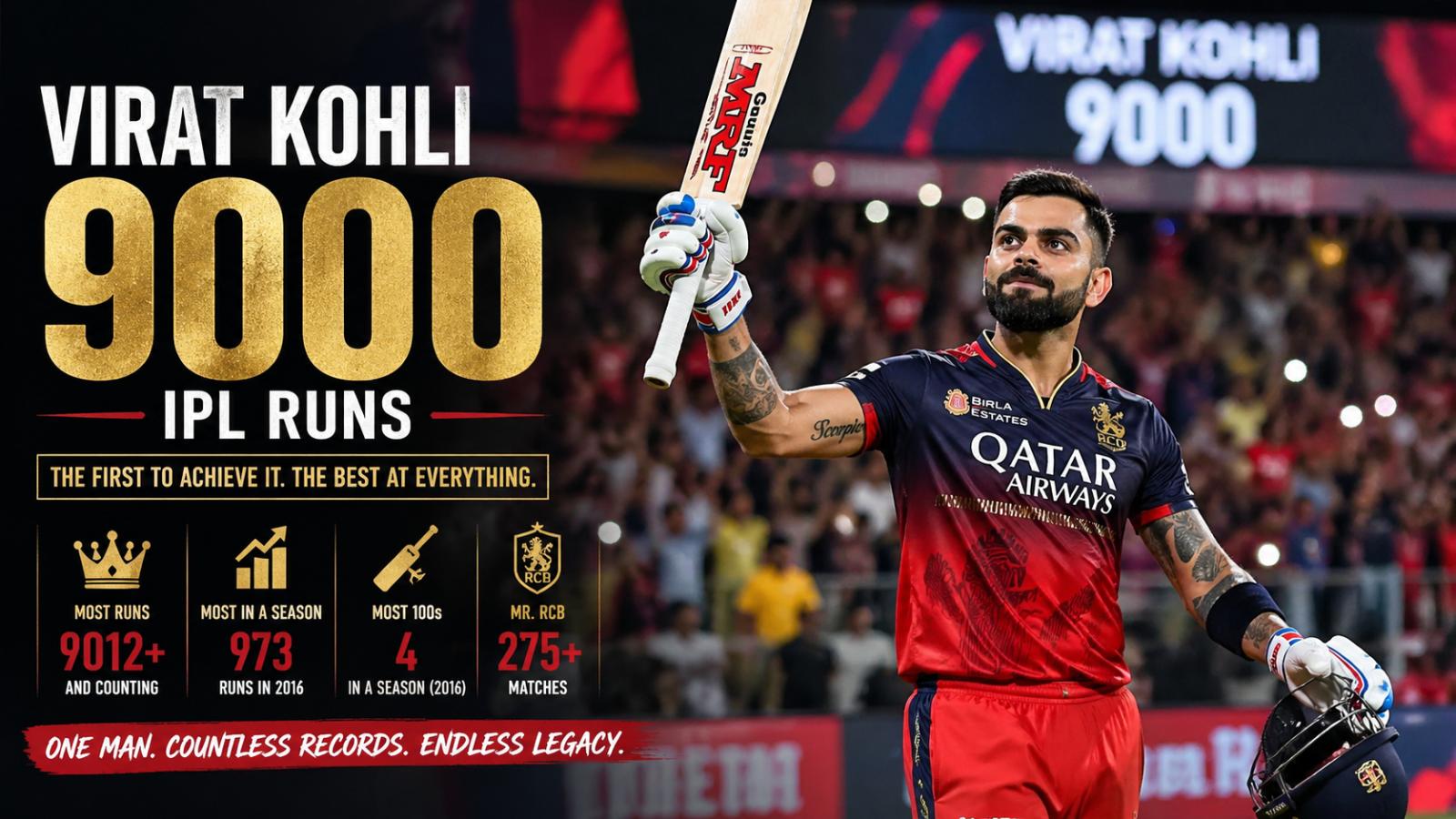
How did Virat Kohli create IPL history? First to 9000 runs and multiple records
Is Virat Kohli now the greatest IPL batter ever? He reaches historic 9000 runs milestone Virat Kohli added another milestone to his remarkable career in the Indian Premier League by becoming the first player to surpass 9000 runs. The achievement came during Royal Challengers Bengaluru’s match against Delhi Capitals at the Arun Jaitley Stadium on Monday, April 27, 2026 (IST), reinforcing his position as the league’s most prolific batter. Landmark moment in Delhi highlights Kohli’s dominance Playing in his hometown, Kohli reached the milestone while chasing a modest total, finishing the game in commanding fashion for Royal Challengers Bengaluru. The innings extended his lead over Rohit Sharma by nearly 2000 runs, further separating him from other leading run-scorers in IPL history. Kohli’s IPL record book: 10 milestones that define greatness Kohli’s career is built on a series of historic achievements that underline his consistency, longevity, and peak dominance. Most runs in IPL history: Kohli has scored over 9012 runs, becoming the first player to cross 6000, 7000, 8000, and 9000 runs, setting a benchmark for longevity and consistency. Most runs in a single IPL season: He scored 973 runs in the 2016 season, the highest ever in a single edition, a record that remains unmatched. Most centuries in a single IPL season: Kohli struck four centuries in 2016, a feat no other batter has equaled in one season. Most runs for a single franchise: Spending his entire IPL career with Bengaluru, Kohli holds the record for the most runs scored for one team in league history. Most 50-plus scores in IPL: With more than 70 fifty-plus scores, including 66 fifties and eight centuries, Kohli leads in consistent high-value innings. Most boundaries in IPL: He has hit over 800 fours, the highest in the tournament, along with more than 300 sixes, placing him among the top power hitters. Most matches for a single team: Kohli has played over 275 matches for Bengaluru, marking one of the longest single-franchise careers in T20 cricket. Fastest to multiple run milestones: He is the quickest player to reach 5000, 6000, 7000, 8000, and 9000 runs in IPL history. Highest average among top run-scorers: With an average of around 40, Kohli remains one of the most efficient batters, rivaled only by players such as KL Rahul among top scorers. Orange Cap achievements: Kohli has won the Orange Cap twice and has consistently been among the leading run-scorers across multiple seasons. A legacy built on sustained excellence and record-breaking impact Kohli’s dominance across these categories highlights a rare combination of peak performance and long-term consistency. While other players have excelled in specific roles, his ability to lead across multiple batting metrics sets him apart in the modern era of T20 cricket. With the 2026 season still in progress, Kohli’s latest milestone strengthens his case as the most accomplished batter in IPL history, with records that continue to redefine the standards of performance in the league.
How did Virat Kohli create IPL history? First to 9000 runs and multiple records
Is Virat Kohli now the greatest IPL batter ever? He reaches historic 9000 runs milestone Virat Kohli added another milestone to his remarkable career in the Indian Premier League by becoming the first player to surpass 9000 runs. The achievement came during Royal Challengers Bengaluru’s match against Delhi Capitals at the Arun Jaitley Stadium on Monday, April 27, 2026 (IST), reinforcing his position as the league’s most prolific batter. Landmark moment in Delhi highlights Kohli’s dominance Playing in his hometown, Kohli reached the milestone while chasing a modest total, finishing the game in commanding fashion for Royal Challengers Bengaluru. The innings extended his lead over Rohit Sharma by nearly 2000 runs, further separating him from other leading run-scorers in IPL history. Kohli’s IPL record book: 10 milestones that define greatness Kohli’s career is built on a series of historic achievements that underline his consistency, longevity, and peak dominance. Most runs in IPL history: Kohli has scored over 9012 runs, becoming the first player to cross 6000, 7000, 8000, and 9000 runs, setting a benchmark for longevity and consistency. Most runs in a single IPL season: He scored 973 runs in the 2016 season, the highest ever in a single edition, a record that remains unmatched. Most centuries in a single IPL season: Kohli struck four centuries in 2016, a feat no other batter has equaled in one season. Most runs for a single franchise: Spending his entire IPL career with Bengaluru, Kohli holds the record for the most runs scored for one team in league history. Most 50-plus scores in IPL: With more than 70 fifty-plus scores, including 66 fifties and eight centuries, Kohli leads in consistent high-value innings. Most boundaries in IPL: He has hit over 800 fours, the highest in the tournament, along with more than 300 sixes, placing him among the top power hitters. Most matches for a single team: Kohli has played over 275 matches for Bengaluru, marking one of the longest single-franchise careers in T20 cricket. Fastest to multiple run milestones: He is the quickest player to reach 5000, 6000, 7000, 8000, and 9000 runs in IPL history. Highest average among top run-scorers: With an average of around 40, Kohli remains one of the most efficient batters, rivaled only by players such as KL Rahul among top scorers. Orange Cap achievements: Kohli has won the Orange Cap twice and has consistently been among the leading run-scorers across multiple seasons. A legacy built on sustained excellence and record-breaking impact Kohli’s dominance across these categories highlights a rare combination of peak performance and long-term consistency. While other players have excelled in specific roles, his ability to lead across multiple batting metrics sets him apart in the modern era of T20 cricket. With the 2026 season still in progress, Kohli’s latest milestone strengthens his case as the most accomplished batter in IPL history, with records that continue to redefine the standards of performance in the league.
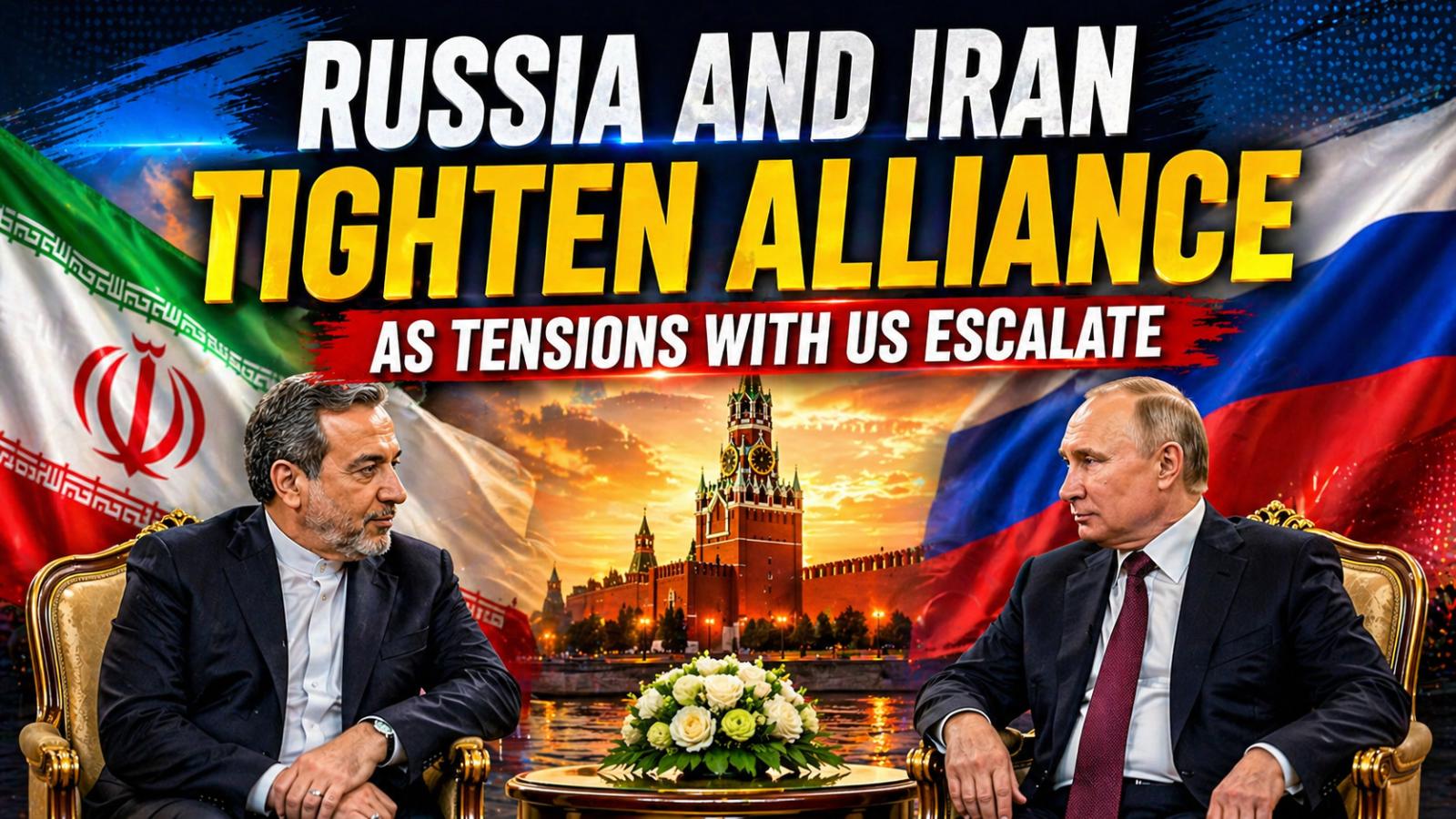
How are Russia and Iran responding to regional tensions? Leaders reaffirm alliance
Vladimir Putin met Abbas Araghchi in Moscow on Monday, reaffirming Russia’s commitment to maintaining strong strategic relations with Iran amid escalating tensions in West Asia. During the meeting, Putin emphasized that Russia would continue to act in ways that serve the interests of Iran and the broader
How are Russia and Iran responding to regional tensions? Leaders reaffirm alliance
Vladimir Putin met Abbas Araghchi in Moscow on Monday, reaffirming Russia’s commitment to maintaining strong strategic relations with Iran amid escalating tensions in West Asia. During the meeting, Putin emphasized that Russia would continue to act in ways that serve the interests of Iran and the broader
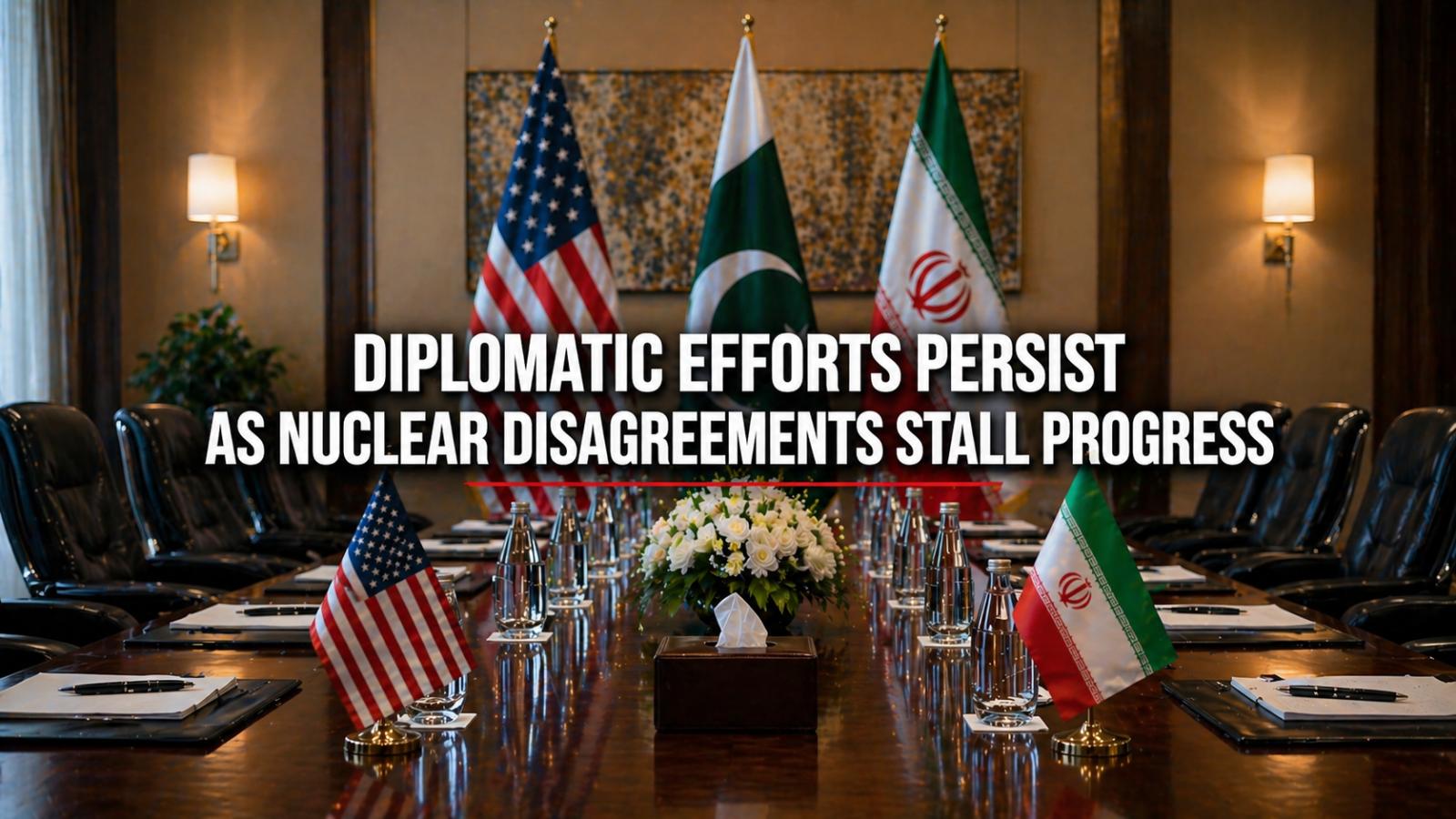
Why did Trump cancel envoy trip? Talks with Iran continue remotely
Talks with Iran continue remotely Diplomatic efforts to bridge differences between the United States and Iran remain active despite setbacks, including the cancellation of a planned envoy visit by President Donald Trump. Developments reported on Monday, April 27, 2026, indicate that negotiations are continuing through indirect channels, with Pakistan playing a mediating role. Iran proposes phased approach delaying nuclear negotiations According to sources familiar with the discussions, Iran has introduced a proposal that restructures the negotiation timeline. The plan would prioritize ending the ongoing conflict and resolving disputes over shipping in the Strait of Hormuz before addressing Iran’s nuclear program. This phased approach is expected to face resistance from Washington, which has consistently maintained that nuclear issues must be addressed at the outset of any agreement. Iranian Foreign Minister Abbas Araqchi has been actively engaged in shuttle diplomacy, traveling between Islamabad, Oman, and Russia over the weekend and into Monday, April 27, 2026. In Moscow, Araqchi met with Vladimir Putin, signaling continued support from Russia. Pakistan facilitates remote negotiations after canceled meetings Plans for face-to-face talks in Islamabad were abandoned after Trump called off a visit by his envoys, including Steve Witkoff and Jared Kushner. The cancellation followed what Trump described as an insufficient Iranian proposal. As a result, Pakistan has shifted to facilitating remote negotiations, with officials indicating that in-person meetings will only occur once substantial progress is made toward a draft agreement. Oil markets react as tensions persist in the Gulf The ongoing standoff has had immediate economic implications, particularly in global energy markets. Oil prices rose when trading resumed on Monday, April 27, 2026, with Brent crude increasing by approximately 2.5% to around $108 per barrel. The volatility reflects concerns over restricted shipping through the Strait of Hormuz, a critical route for global oil supplies. Since the conflict began, Iran has limited access to the waterway, while the United States has imposed a blockade on Iranian shipping. These actions have heightened fears of prolonged disruption, contributing to inflationary pressures and uncertainty in global economic growth. Domestic and geopolitical pressures shape next steps Trump faces increasing domestic pressure to resolve the conflict as approval ratings decline, while Iran continues to leverage its control over regional shipping routes. Despite a ceasefire that has paused active strikes since February 28, 2026, no comprehensive agreement has been reached to formally end hostilities. The gap between the two sides remains significant, particularly over nuclear restrictions and regional security. With both nations appearing prepared for a prolonged negotiation process, analysts suggest the outcome may depend on which side can withstand the economic and political pressures longer.
Why did Trump cancel envoy trip? Talks with Iran continue remotely
Talks with Iran continue remotely Diplomatic efforts to bridge differences between the United States and Iran remain active despite setbacks, including the cancellation of a planned envoy visit by President Donald Trump. Developments reported on Monday, April 27, 2026, indicate that negotiations are continuing through indirect channels, with Pakistan playing a mediating role. Iran proposes phased approach delaying nuclear negotiations According to sources familiar with the discussions, Iran has introduced a proposal that restructures the negotiation timeline. The plan would prioritize ending the ongoing conflict and resolving disputes over shipping in the Strait of Hormuz before addressing Iran’s nuclear program. This phased approach is expected to face resistance from Washington, which has consistently maintained that nuclear issues must be addressed at the outset of any agreement. Iranian Foreign Minister Abbas Araqchi has been actively engaged in shuttle diplomacy, traveling between Islamabad, Oman, and Russia over the weekend and into Monday, April 27, 2026. In Moscow, Araqchi met with Vladimir Putin, signaling continued support from Russia. Pakistan facilitates remote negotiations after canceled meetings Plans for face-to-face talks in Islamabad were abandoned after Trump called off a visit by his envoys, including Steve Witkoff and Jared Kushner. The cancellation followed what Trump described as an insufficient Iranian proposal. As a result, Pakistan has shifted to facilitating remote negotiations, with officials indicating that in-person meetings will only occur once substantial progress is made toward a draft agreement. Oil markets react as tensions persist in the Gulf The ongoing standoff has had immediate economic implications, particularly in global energy markets. Oil prices rose when trading resumed on Monday, April 27, 2026, with Brent crude increasing by approximately 2.5% to around $108 per barrel. The volatility reflects concerns over restricted shipping through the Strait of Hormuz, a critical route for global oil supplies. Since the conflict began, Iran has limited access to the waterway, while the United States has imposed a blockade on Iranian shipping. These actions have heightened fears of prolonged disruption, contributing to inflationary pressures and uncertainty in global economic growth. Domestic and geopolitical pressures shape next steps Trump faces increasing domestic pressure to resolve the conflict as approval ratings decline, while Iran continues to leverage its control over regional shipping routes. Despite a ceasefire that has paused active strikes since February 28, 2026, no comprehensive agreement has been reached to formally end hostilities. The gap between the two sides remains significant, particularly over nuclear restrictions and regional security. With both nations appearing prepared for a prolonged negotiation process, analysts suggest the outcome may depend on which side can withstand the economic and political pressures longer.
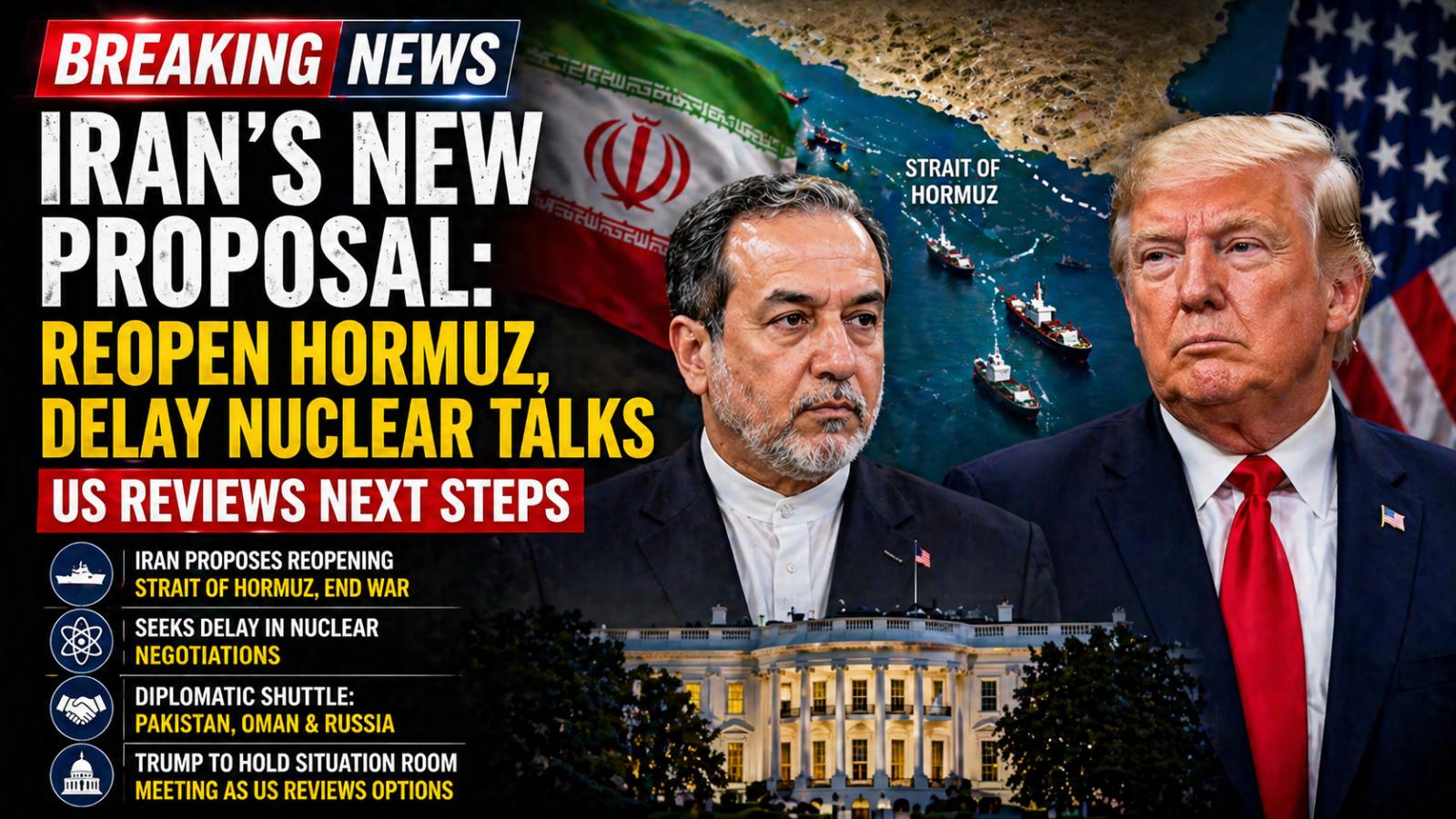
Iran Proposes Strait of Hormuz Deal While Delaying Nuclear Talks
Iran has reportedly put forward a new proposal aimed at reopening the Strait of Hormuz and easing ongoing tensions, while suggesting that nuclear negotiations be postponed. The development comes as US officials review the offer, with President Donald Trump expected to meet with senior national security advisers to assess the situation and determine next steps. According to sources familiar with the discussions, the proposal was conveyed through intermediaries and focuses on de-escalation measures tied to maritime security and regional stability. However, Iranian officials have indicated that broader nuclear negotiations should be deferred until key issues, including economic restrictions and security concerns, are addressed. There has been no official confirmation from either side regarding the specifics of the proposal. The latest diplomatic activity follows a series of engagements by Abbas Araghchi, who recently traveled between Pakistan and Oman in an effort to facilitate dialogue. Iranian authorities emphasized that no direct meetings with US representatives were scheduled during his visit to Islamabad. Earlier, planned discussions involving US envoys were canceled, adding to the uncertainty surrounding the negotiation process. Tensions have been further complicated by differing expectations between Washington and Tehran. US officials have reiterated that any agreement must include strict limitations on Iran’s nuclear capabilities, including restrictions on enrichment activities. Iranian leaders, meanwhile, have maintained that negotiations cannot proceed under pressure, citing concerns over ongoing restrictions and security measures affecting the country. The situation remains fluid as diplomatic channels continue to operate through regional mediators. Iran’s leadership has also engaged with international partners, including Russia, as part of broader efforts to manage the crisis. While the proposal to reopen the Strait of Hormuz signals a potential pathway toward de-escalation, the delay in nuclear talks underscores the challenges that remain in reaching a comprehensive agreement.
Iran Proposes Strait of Hormuz Deal While Delaying Nuclear Talks
Iran has reportedly put forward a new proposal aimed at reopening the Strait of Hormuz and easing ongoing tensions, while suggesting that nuclear negotiations be postponed. The development comes as US officials review the offer, with President Donald Trump expected to meet with senior national security advisers to assess the situation and determine next steps. According to sources familiar with the discussions, the proposal was conveyed through intermediaries and focuses on de-escalation measures tied to maritime security and regional stability. However, Iranian officials have indicated that broader nuclear negotiations should be deferred until key issues, including economic restrictions and security concerns, are addressed. There has been no official confirmation from either side regarding the specifics of the proposal. The latest diplomatic activity follows a series of engagements by Abbas Araghchi, who recently traveled between Pakistan and Oman in an effort to facilitate dialogue. Iranian authorities emphasized that no direct meetings with US representatives were scheduled during his visit to Islamabad. Earlier, planned discussions involving US envoys were canceled, adding to the uncertainty surrounding the negotiation process. Tensions have been further complicated by differing expectations between Washington and Tehran. US officials have reiterated that any agreement must include strict limitations on Iran’s nuclear capabilities, including restrictions on enrichment activities. Iranian leaders, meanwhile, have maintained that negotiations cannot proceed under pressure, citing concerns over ongoing restrictions and security measures affecting the country. The situation remains fluid as diplomatic channels continue to operate through regional mediators. Iran’s leadership has also engaged with international partners, including Russia, as part of broader efforts to manage the crisis. While the proposal to reopen the Strait of Hormuz signals a potential pathway toward de-escalation, the delay in nuclear talks underscores the challenges that remain in reaching a comprehensive agreement.
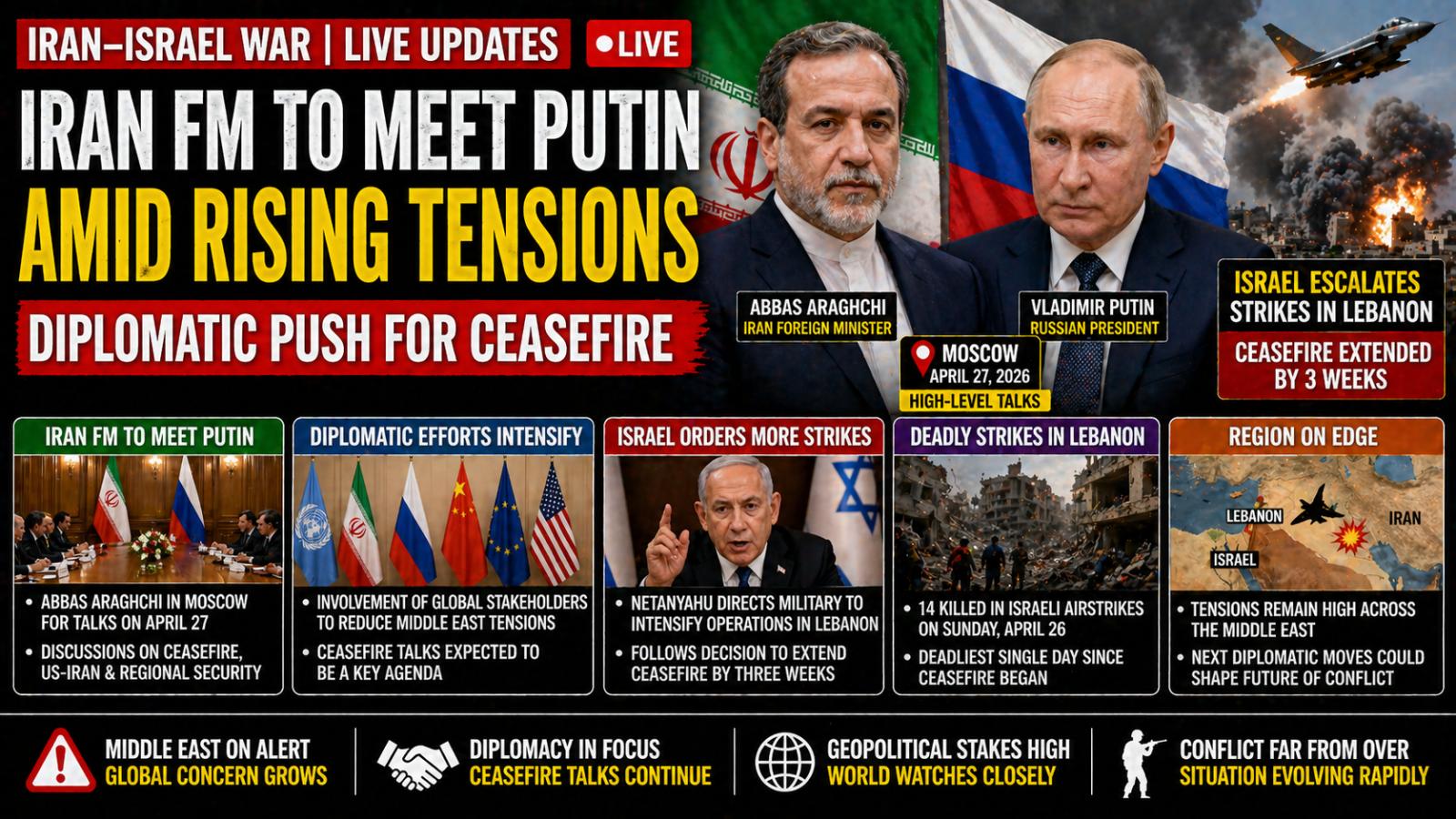
Iran-Israel war live updates: Iran FM to meet Putin amid rising tensions
Iran’s foreign minister Abbas Araghchi meets Vladimir Putin in Moscow on Monday, April 27, for ceasefire talks as Israel intensifies strikes on Hezbollah in Lebanon, where 14 were killed Sunday, April 26, marking the deadliest day since the truce began. Iran-Israel war live updates: Iran FM to meet Putin amid rising tensions as Abbas Araghchi prepares for high-level tal
Iran-Israel war live updates: Iran FM to meet Putin amid rising tensions
Iran’s foreign minister Abbas Araghchi meets Vladimir Putin in Moscow on Monday, April 27, for ceasefire talks as Israel intensifies strikes on Hezbollah in Lebanon, where 14 were killed Sunday, April 26, marking the deadliest day since the truce began. Iran-Israel war live updates: Iran FM to meet Putin amid rising tensions as Abbas Araghchi prepares for high-level tal
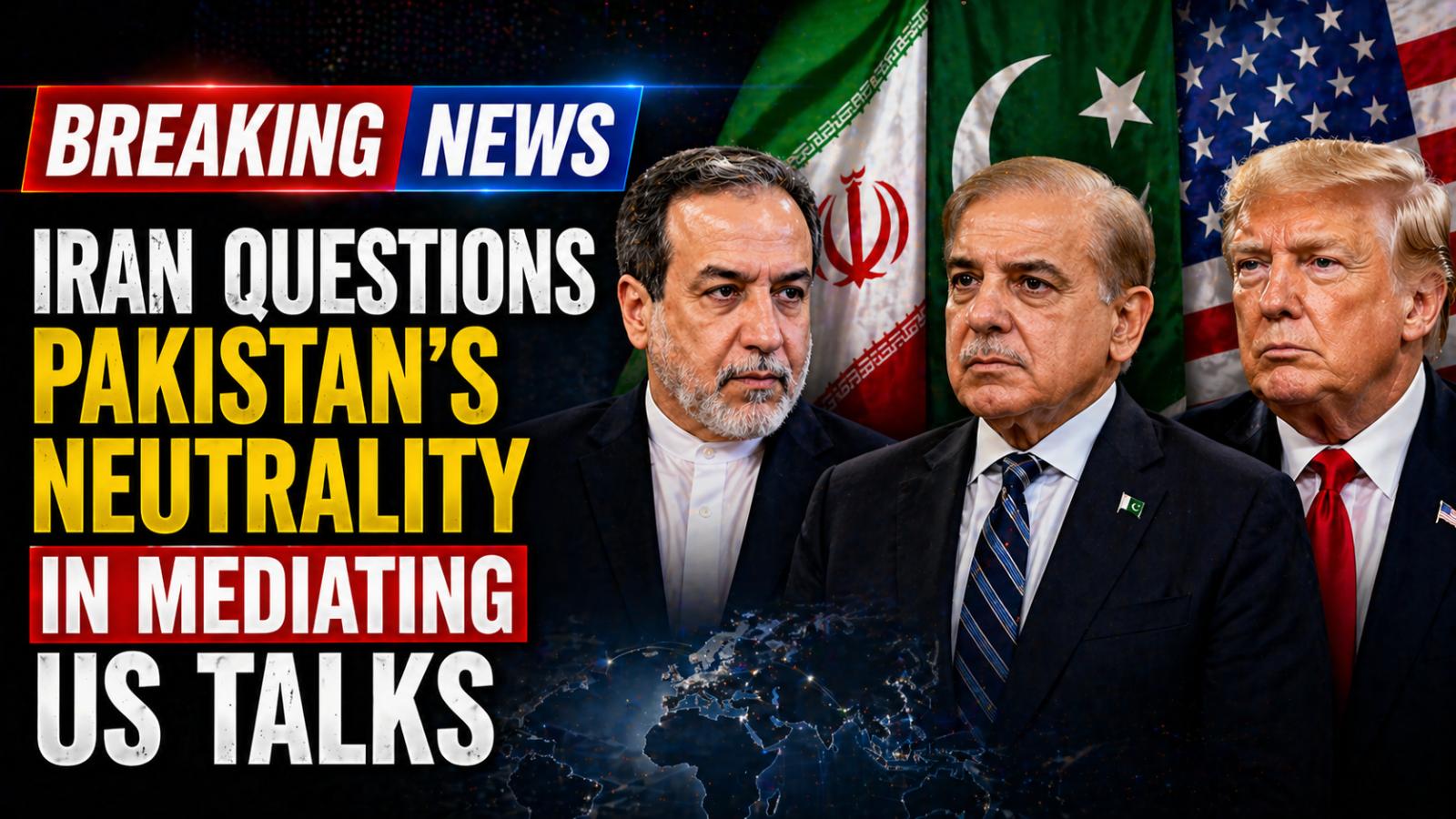
Tehran Raises Doubts Over Pakistan Role in US-Iran Negotiations
Iran has raised concerns about Pakistan’s role as a mediator in ongoing diplomatic efforts with the United States, with officials questioning Islamabad’s neutrality. Ebrahim Rezaei, spokesperson for Iran’s National Security and Foreign Policy Commission, said Pakistan lacks the credibility required to act as an impartial intermediary in sensitive negotiations. Rezaei argued that Paki
Tehran Raises Doubts Over Pakistan Role in US-Iran Negotiations
Iran has raised concerns about Pakistan’s role as a mediator in ongoing diplomatic efforts with the United States, with officials questioning Islamabad’s neutrality. Ebrahim Rezaei, spokesperson for Iran’s National Security and Foreign Policy Commission, said Pakistan lacks the credibility required to act as an impartial intermediary in sensitive negotiations. Rezaei argued that Paki

SRH Chase Down 228 as Abhishek, Ishan Outshine Vaibhav’s IPL Ton
Sunrisers Hyderabad chased down 229 in 18.3 overs to defeat Rajasthan Royals, who posted 228/6 in 20 overs, winning by 5 wickets at Sawai Mansingh Stadium, Jaipur.
SRH Chase Down 228 as Abhishek, Ishan Outshine Vaibhav’s IPL Ton
Sunrisers Hyderabad chased down 229 in 18.3 overs to defeat Rajasthan Royals, who posted 228/6 in 20 overs, winning by 5 wickets at Sawai Mansingh Stadium, Jaipur.










