











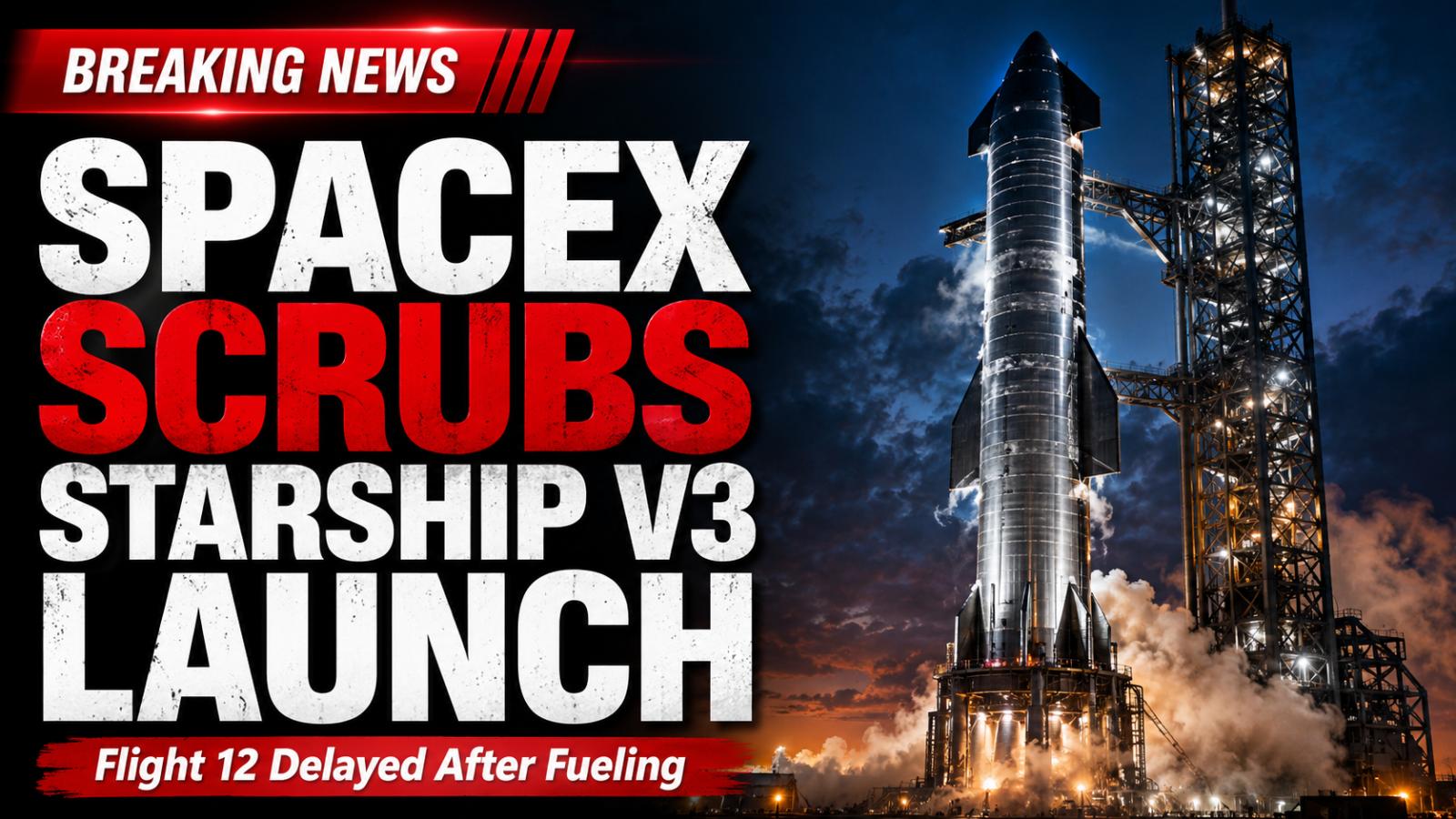
SpaceX Scrubs Starship V3 Flight 12 Launch After Fully Fueling Rocket
SpaceX Scrubs Starship V3 Launch After Fueling SpaceX postponed the launch of its massive Starship V3 rocket on Thursday after the spacecraft had already been fully fueled at the company’s Starbase facility in southern Texas. A 90-minute launch window opened at 6:30 p.m. ET, but the rocket did not lift off. During the company’s live broadcast, SpaceX hosts said the vehicle had been fully loaded before the launch was offi
SpaceX Scrubs Starship V3 Flight 12 Launch After Fully Fueling Rocket
SpaceX Scrubs Starship V3 Launch After Fueling SpaceX postponed the launch of its massive Starship V3 rocket on Thursday after the spacecraft had already been fully fueled at the company’s Starbase facility in southern Texas. A 90-minute launch window opened at 6:30 p.m. ET, but the rocket did not lift off. During the company’s live broadcast, SpaceX hosts said the vehicle had been fully loaded before the launch was offi
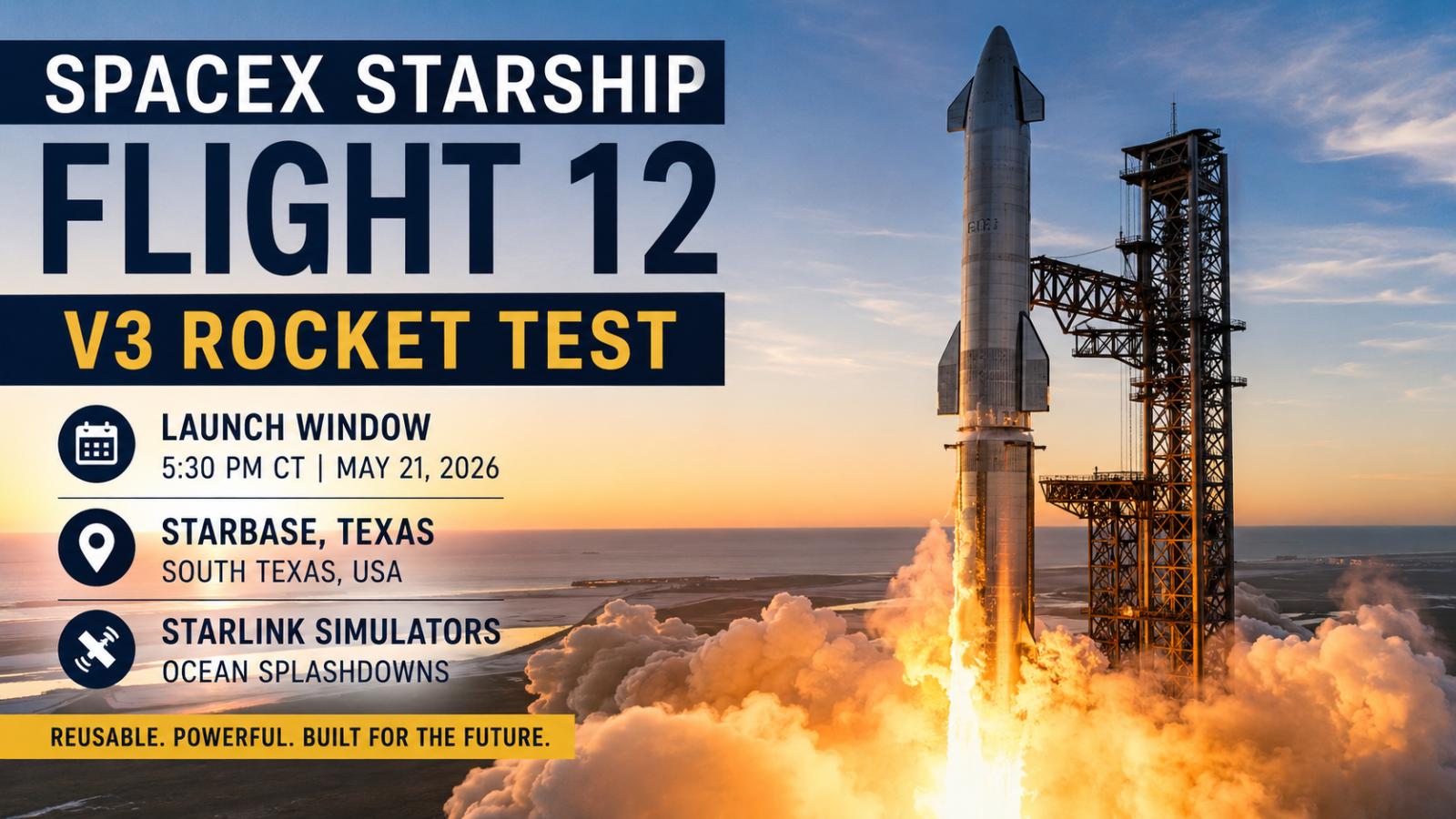
SpaceX Starship Flight 12 Launch Time: V3 Rocket Test From Texas
SpaceX is preparing to launch Starship Flight 12 from Starbase in South Texas, with liftoff scheduled during a window opening at 5:30 p.m. CT on Thursday, May 21, 2026. For India-based viewers, that is 4:00 a.m. IST on Friday, May 22, 2026. The uncrewed test flight will mark the debut of Starship Version 3, the next major redesign of SpaceX’s fully reusable rocket system. Starship includes the Super Heavy booster and the Starship upper-stage vehicle, which SpaceX is developing to
SpaceX Starship Flight 12 Launch Time: V3 Rocket Test From Texas
SpaceX is preparing to launch Starship Flight 12 from Starbase in South Texas, with liftoff scheduled during a window opening at 5:30 p.m. CT on Thursday, May 21, 2026. For India-based viewers, that is 4:00 a.m. IST on Friday, May 22, 2026. The uncrewed test flight will mark the debut of Starship Version 3, the next major redesign of SpaceX’s fully reusable rocket system. Starship includes the Super Heavy booster and the Starship upper-stage vehicle, which SpaceX is developing to

SpaceX IPO: $80B Valuation and Starlink’s Global Growth
SpaceX has officially submitted its initial public offering (IPO), targeting a valuation exceeding $80 billion. The filing outlines the company’s board structure, revenue performance, Starlink broadband expansion, and upcoming orbital AI projects. This IPO is positioned to be among the largest in history, aiming to surpass previous records in the aerospace and tech sector. Massive Market Opportunity for SpaceX The comp
SpaceX IPO: $80B Valuation and Starlink’s Global Growth
SpaceX has officially submitted its initial public offering (IPO), targeting a valuation exceeding $80 billion. The filing outlines the company’s board structure, revenue performance, Starlink broadband expansion, and upcoming orbital AI projects. This IPO is positioned to be among the largest in history, aiming to surpass previous records in the aerospace and tech sector. Massive Market Opportunity for SpaceX The comp

AMCA Defence Hub in Puttaparthi: Rajnath & Chandrababu Lay Foundation
Defence Minister Rajnath Singh and Andhra Pradesh Chief Minister N. Chandrababu Naidu recently laid the foundation stone for the Rs 15,000-crore AMCA defence hub in Puttaparthi. The Advanced Medium Combat Aircraft (AMCA) flight testing and integration complex is a key part of India’s fifth-generation stealth fighter programme, aiming to strengthen the country’s defence aerospace capabilities. Previously, the Tamil Nadu government under Chief Minister MK Stalin had prop
AMCA Defence Hub in Puttaparthi: Rajnath & Chandrababu Lay Foundation
Defence Minister Rajnath Singh and Andhra Pradesh Chief Minister N. Chandrababu Naidu recently laid the foundation stone for the Rs 15,000-crore AMCA defence hub in Puttaparthi. The Advanced Medium Combat Aircraft (AMCA) flight testing and integration complex is a key part of India’s fifth-generation stealth fighter programme, aiming to strengthen the country’s defence aerospace capabilities. Previously, the Tamil Nadu government under Chief Minister MK Stalin had prop

India-Russia talks focus on defence, fertiliser, and space cooperation
During the BRICS Foreign Ministers’ Meeting in India, Russian Foreign Minister Sergey Lavrov held extensive discussions with Indian leaders, focusing on defence cooperation, fertiliser trade, and space collaboration. The meetings reinforced the India-Russia strategic partnership, building on previous agreements from the India-Russia summit and bilateral discussions between Prime Minister Narendra Mo
India-Russia talks focus on defence, fertiliser, and space cooperation
During the BRICS Foreign Ministers’ Meeting in India, Russian Foreign Minister Sergey Lavrov held extensive discussions with Indian leaders, focusing on defence cooperation, fertiliser trade, and space collaboration. The meetings reinforced the India-Russia strategic partnership, building on previous agreements from the India-Russia summit and bilateral discussions between Prime Minister Narendra Mo

Operation Sindoor Anniversary: How India’s Battlefield Success Sparked a Defence Export Boom
Operation Sindoor Anniversary Puts India’s Defence Exports in Focus Operation Sindoor anniversary has placed India’s defence export boom back in the spotlight, with official data showing exports touched a record Rs 38,424 crore in FY 2025–26. The May 7–10, 2025 conflict, described by officials as a focused military response, has now become more than a battlefield milestone. It is being viewed as a turning point for India’s defence industry.
Operation Sindoor Anniversary: How India’s Battlefield Success Sparked a Defence Export Boom
Operation Sindoor Anniversary Puts India’s Defence Exports in Focus Operation Sindoor anniversary has placed India’s defence export boom back in the spotlight, with official data showing exports touched a record Rs 38,424 crore in FY 2025–26. The May 7–10, 2025 conflict, described by officials as a focused military response, has now become more than a battlefield milestone. It is being viewed as a turning point for India’s defence industry.

Modern Air Combat: F-35 Sensor Fusion Meets F-15IA Payload Strength
Modern air combat strategy increasingly relies on the complementary strengths of advanced fighter aircraft, particularly the combination of stealth capabilities and high payload capacity. The F-35 and F-15IA represent this dual approach, where each platform fulfills a distinct but interconnected role in complex operations. The F-35 is designed for stealth and precision, enabling it to operate deep within contested airspace while avoiding detection. Its ability to gather and process battlefield data in real time allows it to identify and track threats with high accuracy. This sensor fusion capability creates a comprehensive operational picture, which can be shared seamlessly with other aircraft to improve coordination and targeting efficiency. In contrast, the F-15IA is built for power and endurance. Often described as a high-capacity weapons platform, it can carry a significantly larger payload compared to stealth-focused aircraft. Once air defenses are identified and weakened, the F-15IA can engage multiple targets using a wide range of munitions, including larger weapons that are not compatible with stealth aircraft configurations. Its advanced radar system enhances its ability to detect and engage threats over extended distances. The combination of these aircraft also supports long-range missions. The F-15IA’s extended range and fuel capacity make it well-suited for operations requiring sustained flight over large distances. This allows it to conduct deep strike missions with fewer refueling requirements, complementing the F-35’s forward reconnaissance and targeting role. Operational efficiency is another key factor in this pairing. The F-15IA is designed for durability and rapid turnaround, enabling frequent sorties during extended engagements. Meanwhile, the F-35’s advanced systems provide critical intelligence that enhances the effectiveness of each mission. Together, they form a coordinated system that balances stealth, firepower, and operational flexibility in modern aerial warfare.
Modern Air Combat: F-35 Sensor Fusion Meets F-15IA Payload Strength
Modern air combat strategy increasingly relies on the complementary strengths of advanced fighter aircraft, particularly the combination of stealth capabilities and high payload capacity. The F-35 and F-15IA represent this dual approach, where each platform fulfills a distinct but interconnected role in complex operations. The F-35 is designed for stealth and precision, enabling it to operate deep within contested airspace while avoiding detection. Its ability to gather and process battlefield data in real time allows it to identify and track threats with high accuracy. This sensor fusion capability creates a comprehensive operational picture, which can be shared seamlessly with other aircraft to improve coordination and targeting efficiency. In contrast, the F-15IA is built for power and endurance. Often described as a high-capacity weapons platform, it can carry a significantly larger payload compared to stealth-focused aircraft. Once air defenses are identified and weakened, the F-15IA can engage multiple targets using a wide range of munitions, including larger weapons that are not compatible with stealth aircraft configurations. Its advanced radar system enhances its ability to detect and engage threats over extended distances. The combination of these aircraft also supports long-range missions. The F-15IA’s extended range and fuel capacity make it well-suited for operations requiring sustained flight over large distances. This allows it to conduct deep strike missions with fewer refueling requirements, complementing the F-35’s forward reconnaissance and targeting role. Operational efficiency is another key factor in this pairing. The F-15IA is designed for durability and rapid turnaround, enabling frequent sorties during extended engagements. Meanwhile, the F-35’s advanced systems provide critical intelligence that enhances the effectiveness of each mission. Together, they form a coordinated system that balances stealth, firepower, and operational flexibility in modern aerial warfare.

Interstellar comet 3I/ATLAS reveals origins in an alien solar system
Interstellar comet 3I/ATLAS reveals origins in an alien solar system as astronomers analyzing the rare celestial object have uncovered evidence suggesting it formed in conditions vastly different from those that shaped our own planetary system. The comet, known as 3I/ATLAS, was first detected passing through our solar system in July and is only the third known interstellar object ever observed in such a trajectory. New findings, published on Wednesday, April 23, 2026, in the journal Nature Astronomy, indicate that the comet likely originated in an extremely cold and distant region of another planetary system. Researchers used the Atacama Large Millimeter/submillimeter Array (ALMA) in Chile to observe the comet in early November, shortly after it made its closest approach to the sun. The study marks the first time scientists have detected deuterium, a heavier isotope of hydrogen, in an interstellar object. This form of hydrogen is typically found in deuterated water, also known as semi-heavy water. According to lead researcher Luis Eduardo Salazar Manzano of the University of Michigan, the concentration of deuterium in 3I/ATLAS is more than 40 times higher than levels found in Earth’s oceans and over 30 times higher than in comets within our solar system. Such unusually high levels suggest that the comet formed in an environment with extremely low temperatures—below 30 Kelvin, or approximately minus 405 degrees Fahrenheit. Scientists believe this indicates formation in the outer regions of a protoplanetary disk, far from its host star, where icy materials can preserve their original chemical signatures for billions of years. Further analysis suggests that 3I/ATLAS may be up to 11 billion years old, making it significantly older than our solar system, which formed about 4.5 billion years ago. The preserved water within the comet likely dates back to the early stages of the Milky Way, offering a rare glimpse into the galaxy’s ancient conditions. Researchers also noted that standard water (H₂O) was not directly detected during observations, likely due to instrument sensitivity limits. However, the clear detection of deuterated water underscores the comet’s unusual composition and reinforces its value as a scientific “time capsule.” Experts say interstellar objects like 3I/ATLAS provide unique insights into how planetary systems form and evolve across the universe. Future observations from facilities such as the Vera C. Rubin Observatory are expected to identify more such objects, potentially helping scientists determine whether 3I/ATLAS is an anomaly or part of a broader population of chemically distinct comets. By studying these rare visitors, astronomers hope to better understand how the composition of planets—and even the building blocks of life—may differ across the galaxy, offering new perspectives on the origins of planetary systems beyond our own.
Interstellar comet 3I/ATLAS reveals origins in an alien solar system
Interstellar comet 3I/ATLAS reveals origins in an alien solar system as astronomers analyzing the rare celestial object have uncovered evidence suggesting it formed in conditions vastly different from those that shaped our own planetary system. The comet, known as 3I/ATLAS, was first detected passing through our solar system in July and is only the third known interstellar object ever observed in such a trajectory. New findings, published on Wednesday, April 23, 2026, in the journal Nature Astronomy, indicate that the comet likely originated in an extremely cold and distant region of another planetary system. Researchers used the Atacama Large Millimeter/submillimeter Array (ALMA) in Chile to observe the comet in early November, shortly after it made its closest approach to the sun. The study marks the first time scientists have detected deuterium, a heavier isotope of hydrogen, in an interstellar object. This form of hydrogen is typically found in deuterated water, also known as semi-heavy water. According to lead researcher Luis Eduardo Salazar Manzano of the University of Michigan, the concentration of deuterium in 3I/ATLAS is more than 40 times higher than levels found in Earth’s oceans and over 30 times higher than in comets within our solar system. Such unusually high levels suggest that the comet formed in an environment with extremely low temperatures—below 30 Kelvin, or approximately minus 405 degrees Fahrenheit. Scientists believe this indicates formation in the outer regions of a protoplanetary disk, far from its host star, where icy materials can preserve their original chemical signatures for billions of years. Further analysis suggests that 3I/ATLAS may be up to 11 billion years old, making it significantly older than our solar system, which formed about 4.5 billion years ago. The preserved water within the comet likely dates back to the early stages of the Milky Way, offering a rare glimpse into the galaxy’s ancient conditions. Researchers also noted that standard water (H₂O) was not directly detected during observations, likely due to instrument sensitivity limits. However, the clear detection of deuterated water underscores the comet’s unusual composition and reinforces its value as a scientific “time capsule.” Experts say interstellar objects like 3I/ATLAS provide unique insights into how planetary systems form and evolve across the universe. Future observations from facilities such as the Vera C. Rubin Observatory are expected to identify more such objects, potentially helping scientists determine whether 3I/ATLAS is an anomaly or part of a broader population of chemically distinct comets. By studying these rare visitors, astronomers hope to better understand how the composition of planets—and even the building blocks of life—may differ across the galaxy, offering new perspectives on the origins of planetary systems beyond our own.

Iran airspace resumes operations amid ongoing US-Iran conflict tensions
Iran airspace has resumed operations nearly two months after being shut down following joint airstrikes by the United States and Israel, marking a cautious step toward normalcy amid ongoing regional tensions. The reopening of Imam Khomeini International Airport on April 25 signals a gradual recovery in Iran’s aviation sector, even as diplomatic uncertainty continues to cloud the broader US-Iran conflict. The airspace closure was enforced on February 28 after coordinated military action escalated into a wider confrontation, forcing Iran to halt civilian aviation across the country. With security assessments and operational preparations now underway, authorities have begun restoring flight services in phases. Initial departures from Tehran include routes to Medina, Muscat, and Istanbul, reflecting limited but significant progress in reconnecting international travel corridors. Iran’s Civil Aviation Authority has indicated that full restoration of aviation services will depend on continued coordination between military and civilian agencies. Earlier, on April 18, Iran reopened its eastern airspace to international flights, allowing transit operations to resume and easing pressure on regional air traffic routes. Officials emphasize that passenger safety remains the top priority during this phased reopening. At the same time, diplomatic efforts to de-escalate the US-Iran war have encountered fresh complications. A delegation linked to former US President Donald Trump, including envoy Steve Witkoff and adviser Jared Kushner, is currently in Pakistan for a second round of peace talks. However, Iran has clearly denied any direct engagement with US representatives during this visit, raising doubts about the progress of negotiations. Iran’s Foreign Ministry has clarified that its position will be conveyed through Pakistani intermediaries, with Foreign Minister Abbas Araghchi actively involved in discussions aimed at reducing tensions. Tehran continues to describe the conflict as “an externally imposed war of aggression”, stressing the importance of restoring regional stability and easing sanctions pressure. Previous negotiations collapsed after Iran strongly objected to US demands to maintain sanctions and naval restrictions during talks. As both sides remain firm in their positions, the reopening of Iran airspace stands as a significant operational step, even as broader geopolitical challenges remain unresolved.
Iran airspace resumes operations amid ongoing US-Iran conflict tensions
Iran airspace has resumed operations nearly two months after being shut down following joint airstrikes by the United States and Israel, marking a cautious step toward normalcy amid ongoing regional tensions. The reopening of Imam Khomeini International Airport on April 25 signals a gradual recovery in Iran’s aviation sector, even as diplomatic uncertainty continues to cloud the broader US-Iran conflict. The airspace closure was enforced on February 28 after coordinated military action escalated into a wider confrontation, forcing Iran to halt civilian aviation across the country. With security assessments and operational preparations now underway, authorities have begun restoring flight services in phases. Initial departures from Tehran include routes to Medina, Muscat, and Istanbul, reflecting limited but significant progress in reconnecting international travel corridors. Iran’s Civil Aviation Authority has indicated that full restoration of aviation services will depend on continued coordination between military and civilian agencies. Earlier, on April 18, Iran reopened its eastern airspace to international flights, allowing transit operations to resume and easing pressure on regional air traffic routes. Officials emphasize that passenger safety remains the top priority during this phased reopening. At the same time, diplomatic efforts to de-escalate the US-Iran war have encountered fresh complications. A delegation linked to former US President Donald Trump, including envoy Steve Witkoff and adviser Jared Kushner, is currently in Pakistan for a second round of peace talks. However, Iran has clearly denied any direct engagement with US representatives during this visit, raising doubts about the progress of negotiations. Iran’s Foreign Ministry has clarified that its position will be conveyed through Pakistani intermediaries, with Foreign Minister Abbas Araghchi actively involved in discussions aimed at reducing tensions. Tehran continues to describe the conflict as “an externally imposed war of aggression”, stressing the importance of restoring regional stability and easing sanctions pressure. Previous negotiations collapsed after Iran strongly objected to US demands to maintain sanctions and naval restrictions during talks. As both sides remain firm in their positions, the reopening of Iran airspace stands as a significant operational step, even as broader geopolitical challenges remain unresolved.

India moves over 1.1 million people from Gulf region during ceasefire window
India has evacuated more than 1.1 million people from West Asia as regional tensions and airspace restrictions continue to disrupt commercial travel, officials said during a government briefing in New Delhi. The large-scale movement has been carried out through sustained flight operations from multiple countries, with authorities relying on alternate routes where airspace remains accessible. Officials said that since February 28, approximately 1,130,000 passengers have traveled fro
India moves over 1.1 million people from Gulf region during ceasefire window
India has evacuated more than 1.1 million people from West Asia as regional tensions and airspace restrictions continue to disrupt commercial travel, officials said during a government briefing in New Delhi. The large-scale movement has been carried out through sustained flight operations from multiple countries, with authorities relying on alternate routes where airspace remains accessible. Officials said that since February 28, approximately 1,130,000 passengers have traveled fro

Science Snapshots April 19 2026 Three Breakthroughs You Can Read In A Minute
In a world where scientific progress moves at lightning speed, staying updated can feel overwhelming. Science Snapshots for April 19, 2026 brings together three important research developments that are shaping the future across health, technology, and space. These quick updates are designed to give readers a clear and engaging overview of what is happening in the world of science without diving into overly complex details. The first major development comes from the field of healthcare, where researchers have made promising progress in early disease detection. A new diagnostic approach uses advanced data modeling and biomarkers to identify illnesses at a much earlier stage than traditional methods. This could significantly improve survival rates for conditions that depend on early intervention. The research highlights how artificial intelligence and medical science are increasingly working together to provide faster and more accurate results, potentially transforming how healthcare systems operate worldwide. Another breakthrough is emerging from the technology sector, where scientists are exploring new materials that could redefine energy efficiency. These materials are designed to store and transfer energy more effectively, which could lead to longer-lasting batteries and more sustainable power solutions. As the global demand for clean energy rises, innovations like these are critical in reducing reliance on traditional energy sources. Experts believe that such advancements could play a key role in addressing climate challenges while also powering the next generation of electronic devices. Quick Insights That Matter The third update comes from space research, where new observations are shedding light on distant cosmic phenomena. Scientists have captured detailed data that may help explain the formation of galaxies and the behavior of mysterious cosmic forces. These findings not only deepen our understanding of the universe but also open the door to future exploration and discovery. Space agencies and research institutions are continuing to collaborate on projects that aim to push the boundaries of human knowledge. What makes these developments significant is not just their individual impact but their collective influence on the future. From improving healthcare outcomes to advancing sustainable technology and expanding our understanding of space, each breakthrough represents a step forward for humanity. The ability to condense such complex information into quick, accessible updates ensures that more people can stay informed and engaged with scientific progress. Why These Breakthroughs Matter Scientific research often unfolds over years, but moments of breakthrough can redefine entire fields. These snapshots provide a glimpse into the direction in which science is heading. They also highlight the importance of continued investment in research and innovation, as well as the need for collaboration across disciplines and borders. As new discoveries continue to emerge, keeping track of them in a simple and digestible format becomes increasingly valuable. Science Snapshots aims to bridge the gap between complex research and everyday understanding, ensuring that important developments reach a wider audience. Whether it is advancements in medicine, technology, or space exploration, these updates remind us that science is constantly evolving and shaping the world around us.
Science Snapshots April 19 2026 Three Breakthroughs You Can Read In A Minute
In a world where scientific progress moves at lightning speed, staying updated can feel overwhelming. Science Snapshots for April 19, 2026 brings together three important research developments that are shaping the future across health, technology, and space. These quick updates are designed to give readers a clear and engaging overview of what is happening in the world of science without diving into overly complex details. The first major development comes from the field of healthcare, where researchers have made promising progress in early disease detection. A new diagnostic approach uses advanced data modeling and biomarkers to identify illnesses at a much earlier stage than traditional methods. This could significantly improve survival rates for conditions that depend on early intervention. The research highlights how artificial intelligence and medical science are increasingly working together to provide faster and more accurate results, potentially transforming how healthcare systems operate worldwide. Another breakthrough is emerging from the technology sector, where scientists are exploring new materials that could redefine energy efficiency. These materials are designed to store and transfer energy more effectively, which could lead to longer-lasting batteries and more sustainable power solutions. As the global demand for clean energy rises, innovations like these are critical in reducing reliance on traditional energy sources. Experts believe that such advancements could play a key role in addressing climate challenges while also powering the next generation of electronic devices. Quick Insights That Matter The third update comes from space research, where new observations are shedding light on distant cosmic phenomena. Scientists have captured detailed data that may help explain the formation of galaxies and the behavior of mysterious cosmic forces. These findings not only deepen our understanding of the universe but also open the door to future exploration and discovery. Space agencies and research institutions are continuing to collaborate on projects that aim to push the boundaries of human knowledge. What makes these developments significant is not just their individual impact but their collective influence on the future. From improving healthcare outcomes to advancing sustainable technology and expanding our understanding of space, each breakthrough represents a step forward for humanity. The ability to condense such complex information into quick, accessible updates ensures that more people can stay informed and engaged with scientific progress. Why These Breakthroughs Matter Scientific research often unfolds over years, but moments of breakthrough can redefine entire fields. These snapshots provide a glimpse into the direction in which science is heading. They also highlight the importance of continued investment in research and innovation, as well as the need for collaboration across disciplines and borders. As new discoveries continue to emerge, keeping track of them in a simple and digestible format becomes increasingly valuable. Science Snapshots aims to bridge the gap between complex research and everyday understanding, ensuring that important developments reach a wider audience. Whether it is advancements in medicine, technology, or space exploration, these updates remind us that science is constantly evolving and shaping the world around us.

Amazon to acquire Globalstar in $11.57 billion satellite internet deal
Amazon has entered into a definitive agreement to acquire Globalstar in a deal valued at $11.57 billion, marking a significant expansion of its satellite internet strategy as it seeks to compete with SpaceX’s Starlink network. The companies formally signed the agreement on Monday, April 13, 2026, with the transaction publicly announced on Tuesday, April 14, 2026. The acquisition represents a major step in Amazon’s broader push into low Earth orbit connectivity under its Amazon Leo
Amazon to acquire Globalstar in $11.57 billion satellite internet deal
Amazon has entered into a definitive agreement to acquire Globalstar in a deal valued at $11.57 billion, marking a significant expansion of its satellite internet strategy as it seeks to compete with SpaceX’s Starlink network. The companies formally signed the agreement on Monday, April 13, 2026, with the transaction publicly announced on Tuesday, April 14, 2026. The acquisition represents a major step in Amazon’s broader push into low Earth orbit connectivity under its Amazon Leo
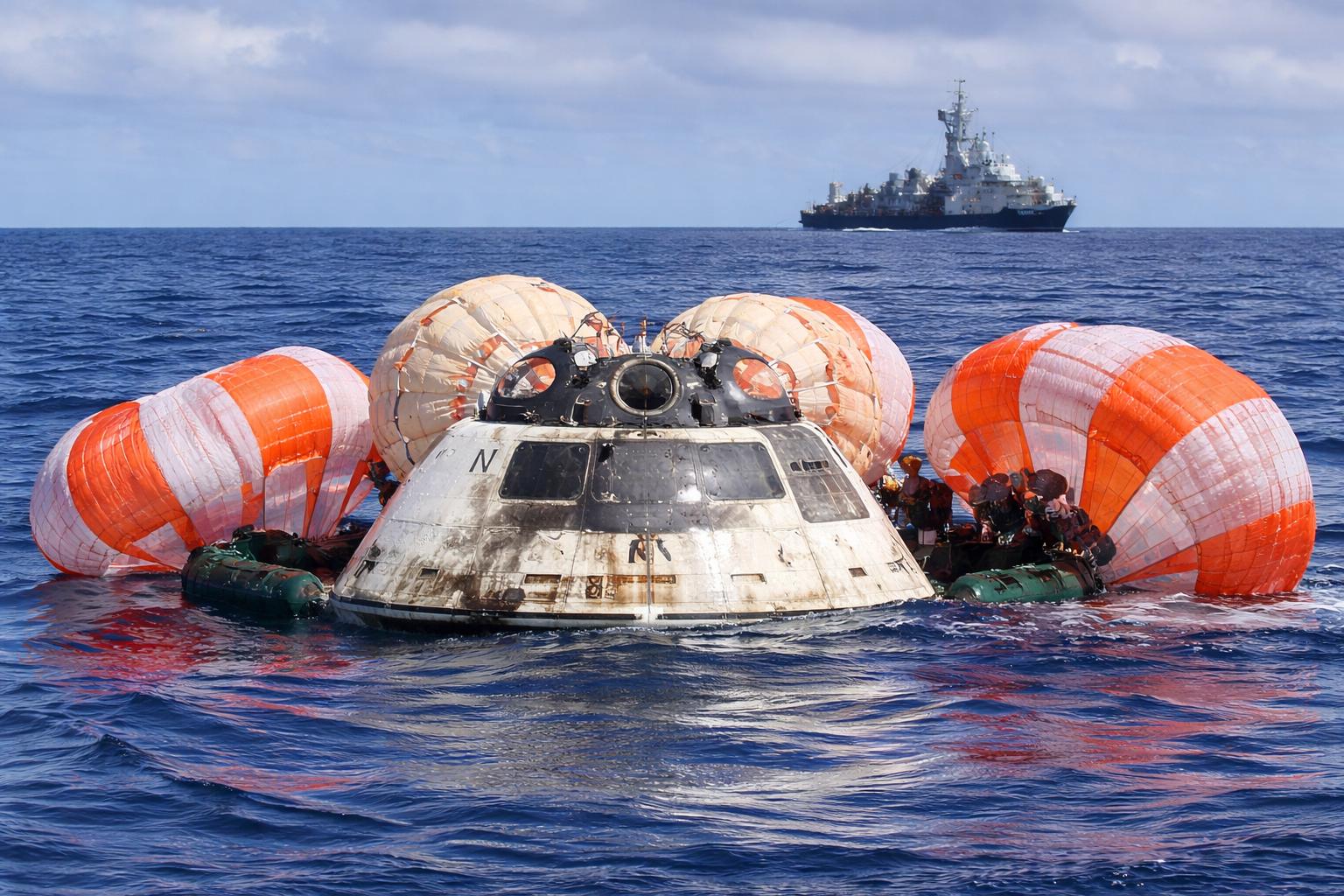
Artemis II Mission Marks Historic Return of Astronauts from the Moon
The Artemis II mission, a landmark achievement in human space exploration, has successfully concluded with a dramatic splashdown in the Pacific Ocean. The mission, which took four astronauts farther than any human before, traversed 4,06,778 kilometers from Earth, reaching the vicinity of the Moon. This daring journey marked humanity’s first crewed mission to the Moon since the Apollo program. The crew, consisting of Commander Reid Wiseman, Pilot Victor Glover, and Mission Speciali
Artemis II Mission Marks Historic Return of Astronauts from the Moon
The Artemis II mission, a landmark achievement in human space exploration, has successfully concluded with a dramatic splashdown in the Pacific Ocean. The mission, which took four astronauts farther than any human before, traversed 4,06,778 kilometers from Earth, reaching the vicinity of the Moon. This daring journey marked humanity’s first crewed mission to the Moon since the Apollo program. The crew, consisting of Commander Reid Wiseman, Pilot Victor Glover, and Mission Speciali

NASA Artemis II Mission: Crew Prepares for Pacific Ocean Splashdown
NASA is preparing for the safe return of the Artemis II mission after successfully completing its 10-day journey around the Moon. The spacecraft is expected to splash down in the Pacific Ocean, off the coast of California, on Friday, April 10 at around 8 PM EDT (5:37 AM IST, April 11). NASA officials have confirmed that all mission operations are going smoothly and are on track.
NASA Artemis II Mission: Crew Prepares for Pacific Ocean Splashdown
NASA is preparing for the safe return of the Artemis II mission after successfully completing its 10-day journey around the Moon. The spacecraft is expected to splash down in the Pacific Ocean, off the coast of California, on Friday, April 10 at around 8 PM EDT (5:37 AM IST, April 11). NASA officials have confirmed that all mission operations are going smoothly and are on track.

Artemis II Crew Captures Stunning Views of Moon's Far Side in Historic Flyby
The Artemis II crew has made history by capturing breathtaking views of the far side of the Moon during a record-setting flyby. This landmark achievement in space exploration comes as part of NASA's Artemis program, which aims to return humans to the Moon and ultimately send astronauts to Mars. The crew of Artemis II, aboard the Orion spacecraft, achieved a rare and remarkable perspective of the lunar surface, providing viewers with never-before-seen imagery of the Moon’s far side.
Artemis II Crew Captures Stunning Views of Moon's Far Side in Historic Flyby
The Artemis II crew has made history by capturing breathtaking views of the far side of the Moon during a record-setting flyby. This landmark achievement in space exploration comes as part of NASA's Artemis program, which aims to return humans to the Moon and ultimately send astronauts to Mars. The crew of Artemis II, aboard the Orion spacecraft, achieved a rare and remarkable perspective of the lunar surface, providing viewers with never-before-seen imagery of the Moon’s far side.

Artemis II: NASA Regains Contact with Astronauts Following Moon Flyby
On April 7, 2026, the crew set a new record for the farthest human spaceflight, surpassing the distance achieved during the Apollo 13 mission in 1970. During the lunar flyby, astronauts Reid Wiseman,
Artemis II: NASA Regains Contact with Astronauts Following Moon Flyby
On April 7, 2026, the crew set a new record for the farthest human spaceflight, surpassing the distance achieved during the Apollo 13 mission in 1970. During the lunar flyby, astronauts Reid Wiseman,
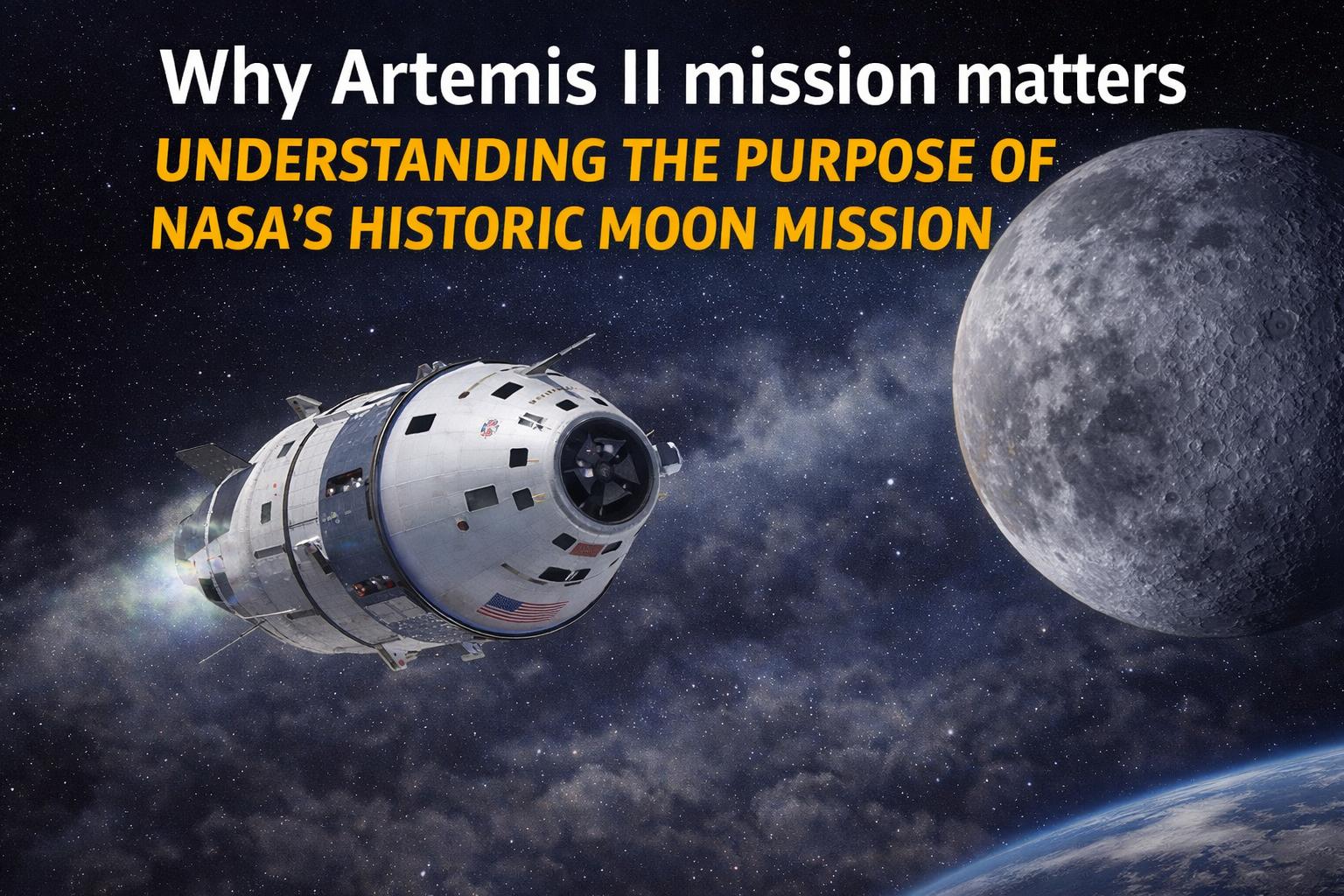
How Artemis II prepares humans for future lunar and Mars missions
NASA’s Artemis II mission marks a major step in the United States’ return to deep space exploration, serving as a critical test before astronauts attempt to land on the moon again. While the mission does not include a lunar landing, its primary purpose is to validate systems and operations required for future crewed missions. Artemis II will carry astronauts beyond Earth’s orbit for the first time in more than 50 years, testing the Orion spacecraft and Space Launch System unde
How Artemis II prepares humans for future lunar and Mars missions
NASA’s Artemis II mission marks a major step in the United States’ return to deep space exploration, serving as a critical test before astronauts attempt to land on the moon again. While the mission does not include a lunar landing, its primary purpose is to validate systems and operations required for future crewed missions. Artemis II will carry astronauts beyond Earth’s orbit for the first time in more than 50 years, testing the Orion spacecraft and Space Launch System unde
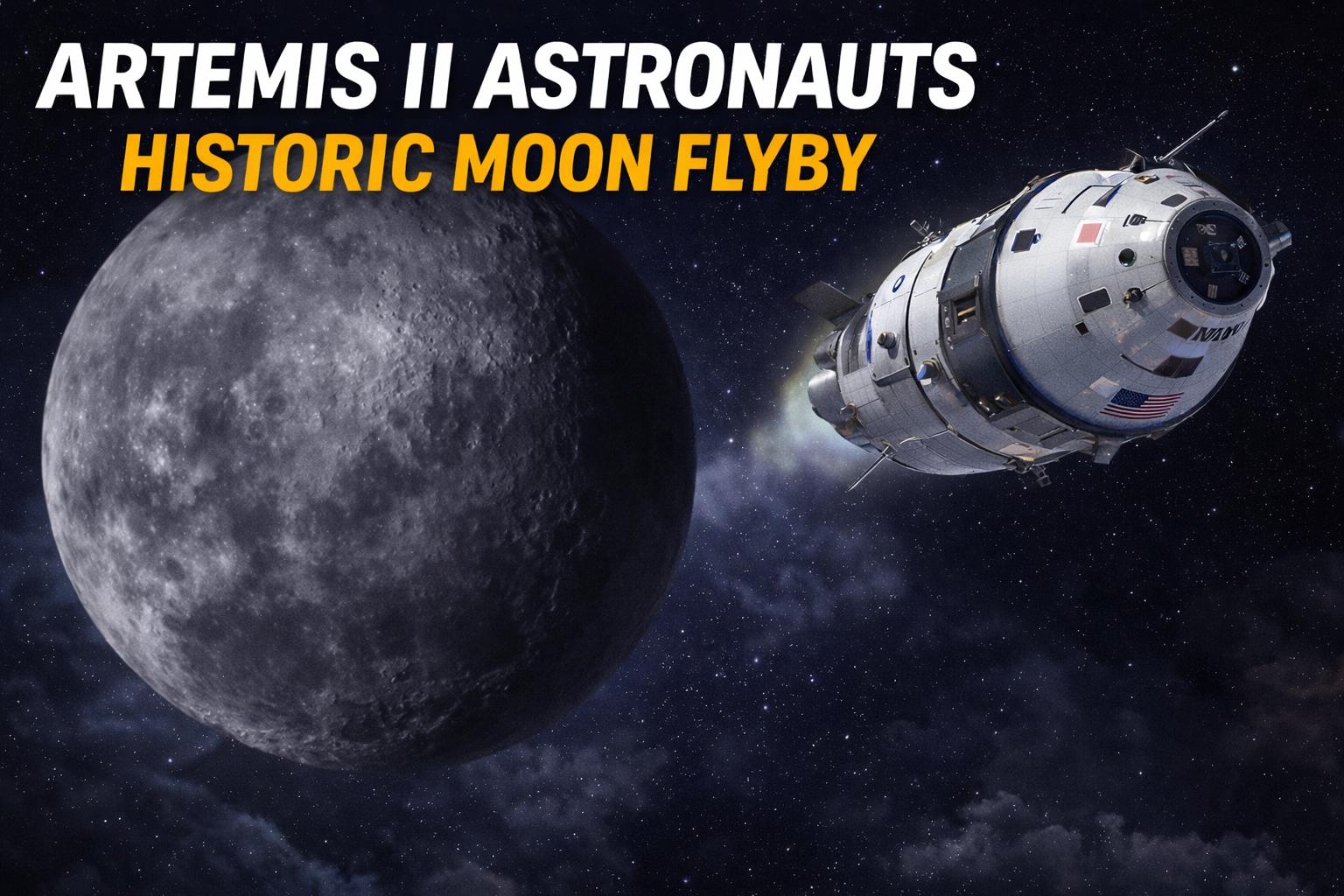
Artemis II astronauts begin historic moon flyby mission
The NASA-led Artemis II mission is marking a historic milestone as four astronauts conduct a seven-hour flyby of the moon, traveling farther into space than any humans have before. The flyby operations are scheduled to begin at 2:45 PM ET and conclude at 9:20 PM ET on the same day (full date not specified in the official report), representing a key phase of the mission. The crew includes NASA astronauts Reid Wiseman, Victor Glover, and Christina Koch, along with Canadian Space Agenc
Artemis II astronauts begin historic moon flyby mission
The NASA-led Artemis II mission is marking a historic milestone as four astronauts conduct a seven-hour flyby of the moon, traveling farther into space than any humans have before. The flyby operations are scheduled to begin at 2:45 PM ET and conclude at 9:20 PM ET on the same day (full date not specified in the official report), representing a key phase of the mission. The crew includes NASA astronauts Reid Wiseman, Victor Glover, and Christina Koch, along with Canadian Space Agenc

Elon Musk pushes SpaceX IPO banks to subscribe to Grok AI ahead of public listing
In a surprising development that has sparked debate across the tech and financial sectors, Elon Musk has reportedly asked banks involved in a potential SpaceX IPO to subscribe to Grok AI, the chatbot developed by his artificial intelligence venture xAI. The move is being seen as an unusual blending of financial negotiations with technology adoption, raising questions about influence, strategy, and ethics. According to reports, Musk has encouraged major financial institutions that are expected to play a role in SpaceX’s much-anticipated public offering to purchase subscriptions to Grok AI. Grok, integrated into the platform of X, is positioned as a competitor to other leading AI chatbots, aiming to provide real-time, conversational intelligence with a unique personality. By pushing Grok subscriptions, Musk appears to be leveraging his business relationships to expand the reach and adoption of his AI ecosystem. Industry analysts believe this strategy could serve multiple purposes. On one hand, it helps boost early enterprise adoption of Grok, potentially strengthening xAI’s valuation and credibility in the rapidly evolving artificial intelligence market. On the other hand, it may also create synergies between Musk’s ventures, aligning financial partners with his broader technological vision. Why this move is gaining attention The reported request has drawn scrutiny because it blurs the lines between separate business interests. While it is not uncommon for business leaders to promote their products, tying such expectations to high-stakes financial deals like an IPO is relatively rare. Experts suggest that this could raise concerns among regulators and investors, especially regarding fairness and transparency in financial negotiations. At the same time, some supporters argue that banks and institutions often adopt new technologies as part of strategic partnerships. If Grok AI proves to be a valuable tool for financial analysis, communication, or data processing, its adoption could be seen as a logical step rather than an obligation. Impact on SpaceX IPO and AI competition The potential SpaceX IPO is already one of the most anticipated events in global markets, given the company’s dominant position in private space exploration and satellite technology. Any additional layer of complexity, such as this reported push for AI subscriptions, could influence how investors and stakeholders perceive the deal. Meanwhile, the move highlights the intensifying competition in the AI space. With major players racing to capture market share, enterprise adoption is becoming a key battleground. By integrating Grok into financial institutions, Musk may be attempting to position xAI as a serious contender alongside other established AI platforms. As the story continues to unfold, it remains to be seen whether this strategy will accelerate Grok’s growth or invite regulatory attention. What is clear, however, is that Musk’s approach once again demonstrates his willingness to challenge conventional boundaries between industries, reshaping how technology and finance intersect in the modern era.
Elon Musk pushes SpaceX IPO banks to subscribe to Grok AI ahead of public listing
In a surprising development that has sparked debate across the tech and financial sectors, Elon Musk has reportedly asked banks involved in a potential SpaceX IPO to subscribe to Grok AI, the chatbot developed by his artificial intelligence venture xAI. The move is being seen as an unusual blending of financial negotiations with technology adoption, raising questions about influence, strategy, and ethics. According to reports, Musk has encouraged major financial institutions that are expected to play a role in SpaceX’s much-anticipated public offering to purchase subscriptions to Grok AI. Grok, integrated into the platform of X, is positioned as a competitor to other leading AI chatbots, aiming to provide real-time, conversational intelligence with a unique personality. By pushing Grok subscriptions, Musk appears to be leveraging his business relationships to expand the reach and adoption of his AI ecosystem. Industry analysts believe this strategy could serve multiple purposes. On one hand, it helps boost early enterprise adoption of Grok, potentially strengthening xAI’s valuation and credibility in the rapidly evolving artificial intelligence market. On the other hand, it may also create synergies between Musk’s ventures, aligning financial partners with his broader technological vision. Why this move is gaining attention The reported request has drawn scrutiny because it blurs the lines between separate business interests. While it is not uncommon for business leaders to promote their products, tying such expectations to high-stakes financial deals like an IPO is relatively rare. Experts suggest that this could raise concerns among regulators and investors, especially regarding fairness and transparency in financial negotiations. At the same time, some supporters argue that banks and institutions often adopt new technologies as part of strategic partnerships. If Grok AI proves to be a valuable tool for financial analysis, communication, or data processing, its adoption could be seen as a logical step rather than an obligation. Impact on SpaceX IPO and AI competition The potential SpaceX IPO is already one of the most anticipated events in global markets, given the company’s dominant position in private space exploration and satellite technology. Any additional layer of complexity, such as this reported push for AI subscriptions, could influence how investors and stakeholders perceive the deal. Meanwhile, the move highlights the intensifying competition in the AI space. With major players racing to capture market share, enterprise adoption is becoming a key battleground. By integrating Grok into financial institutions, Musk may be attempting to position xAI as a serious contender alongside other established AI platforms. As the story continues to unfold, it remains to be seen whether this strategy will accelerate Grok’s growth or invite regulatory attention. What is clear, however, is that Musk’s approach once again demonstrates his willingness to challenge conventional boundaries between industries, reshaping how technology and finance intersect in the modern era.

NASA Reveals First Stunning Earth Images from Artemis II Crew
NASA’s Artemis 2 mission is advancing as the agency prepares to send astronauts on a historic journey around the moon, marking the first crewed lunar mission in decades. The mission represents a major milestone in the broader Artemis program, which aims to establish a sustained human presence on the lunar surface and eventually support deeper space exploration. The Artemis 2 crew is expected to travel aboard the Orion spacecraf
NASA Reveals First Stunning Earth Images from Artemis II Crew
NASA’s Artemis 2 mission is advancing as the agency prepares to send astronauts on a historic journey around the moon, marking the first crewed lunar mission in decades. The mission represents a major milestone in the broader Artemis program, which aims to establish a sustained human presence on the lunar surface and eventually support deeper space exploration. The Artemis 2 crew is expected to travel aboard the Orion spacecraf










