












NASA accelerates Moon base plan with $600 million contract boost
NASA Accelerates Lunar Base Development Strategy NASA has moved forward with an accelerated timeline for establishing a permanent human presence on the Moon, marking a significant step in its long-term lunar exploration strategy. The US space agency has awarded nearly $600 million in new contracts to three commercial partners to support upcoming lunar missions aimed a
NASA accelerates Moon base plan with $600 million contract boost
NASA Accelerates Lunar Base Development Strategy NASA has moved forward with an accelerated timeline for establishing a permanent human presence on the Moon, marking a significant step in its long-term lunar exploration strategy. The US space agency has awarded nearly $600 million in new contracts to three commercial partners to support upcoming lunar missions aimed a

Robotic mission aims to lift NASA’s Swift Observatory
NASA prepares rescue mission for Swift NASA is preparing a $30 million robotic mission to prevent the Neil Gehrels Swift Observatory from re-entering Earth’s atmosphere after two decades of service in space. The agency has described the effort as a race against time and gravity, as the aging telescope continues to lose altitude because of orbital decay. The mission will be led by Katalyst Space Technologies, a startup developing a three-armed spacecra
Robotic mission aims to lift NASA’s Swift Observatory
NASA prepares rescue mission for Swift NASA is preparing a $30 million robotic mission to prevent the Neil Gehrels Swift Observatory from re-entering Earth’s atmosphere after two decades of service in space. The agency has described the effort as a race against time and gravity, as the aging telescope continues to lose altitude because of orbital decay. The mission will be led by Katalyst Space Technologies, a startup developing a three-armed spacecra

ISRO Semi-Cryogenic Engine Test Hits 88% Power for LVM3
ISRO’s semi-cryogenic engine test reached 88% of its designed thrust on Wednesday, June 24, 2026, marking a major step toward upgrading India’s LVM3 rocket. The Indian Space Research Organisation tested the Power Head Test Article, or PHTA, at its propulsion facility in Mahendragiri, Tamil Nadu. The PHTA includes most major engine systems but excludes the thrust chamber, allowing engineers to evaluate fuel delivery, ignition and pressure performance before testing the complete e
ISRO Semi-Cryogenic Engine Test Hits 88% Power for LVM3
ISRO’s semi-cryogenic engine test reached 88% of its designed thrust on Wednesday, June 24, 2026, marking a major step toward upgrading India’s LVM3 rocket. The Indian Space Research Organisation tested the Power Head Test Article, or PHTA, at its propulsion facility in Mahendragiri, Tamil Nadu. The PHTA includes most major engine systems but excludes the thrust chamber, allowing engineers to evaluate fuel delivery, ignition and pressure performance before testing the complete e

Rolls-Royce Eyes India Manufacturing Investment Under UK Pact
Rolls-Royce and India discussed deeper manufacturing investment, technology partnerships and an engine proposal tied to the country’s next-generation AMCA fighter program on Friday, June 26, 2026. The talks focused on how the India-UK Comprehensive Economic and Trade Agreement, or CETA, could support advanced manufacturing, engineering cooperation and more resilient supply chains. Rolls-Royce India Manufacturing Investment
Rolls-Royce Eyes India Manufacturing Investment Under UK Pact
Rolls-Royce and India discussed deeper manufacturing investment, technology partnerships and an engine proposal tied to the country’s next-generation AMCA fighter program on Friday, June 26, 2026. The talks focused on how the India-UK Comprehensive Economic and Trade Agreement, or CETA, could support advanced manufacturing, engineering cooperation and more resilient supply chains. Rolls-Royce India Manufacturing Investment
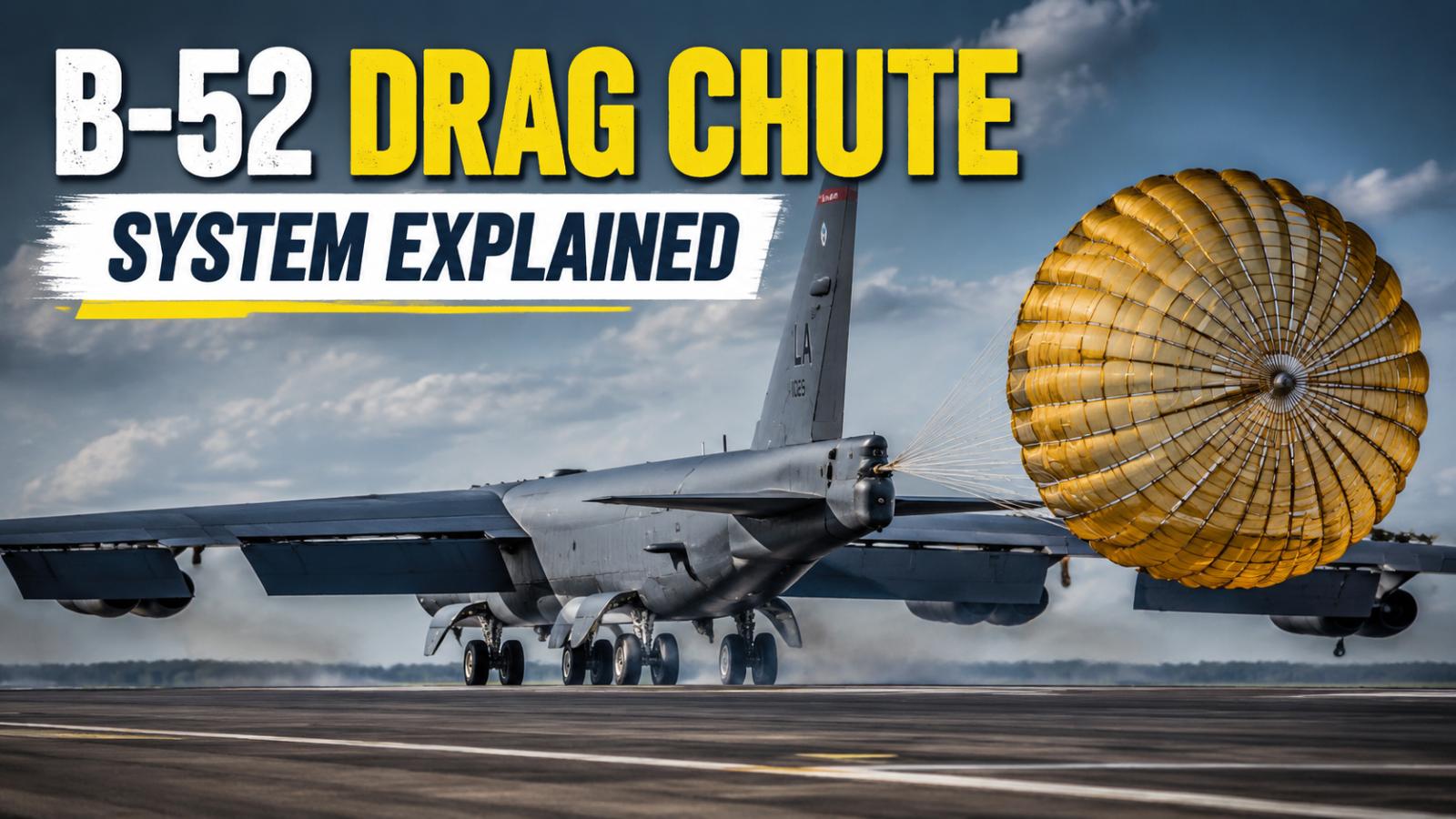
B-52 drag chute system and landing braking explained
The B-52 Stratofortress relies on a drag chute to help slow the aircraft immediately after touchdown. Instead of depending only on wheel brakes, the system deploys a parachute from the rear of the aircraft that creates strong air resistance. This resistance reduces speed quickly and stabilizes the landing rollout, especially important for such a large and heavy bomber. Why the aircraft needs extra braking support A fully loaded B-52 carries enormous mass and lands at high speeds, which naturally generates extreme heat and stress on its wheel braking system. If only standard brakes were used, stopping distance would increase significantly and brake components could overheat or wear out rapidly. The drag chute reduces this burden by absorbing a portion of the kinetic energy during rollout. How the system is activated during landing Once the aircraft touches down and is stable on the runway, the crew initiates the drag chute deployment. A small pilot chute is released first, which pulls out the main parachute from its housing in the tail section. As it inflates, it creates immediate drag force that slows the aircraft even before full brake pressure is applied on the wheels. Impact on runway distance and safety The chute significantly shortens the distance required to bring the bomber to a safe stop. This becomes especially valuable on wet, icy, or short runways where braking efficiency is reduced. By lowering reliance on friction-based braking alone, the system improves safety margins and allows more flexible landing operations in different environments. Operational use in real conditions In practice, crews often rely on the drag chute as a standard part of landing procedures because it protects the braking system and enhances control. It is particularly important during adverse weather conditions or high-weight landings. Ground teams then recover and repack the chute after use for the next mission. A system built for rapid nuclear response... Why the system is still relevant today Despite being designed decades ago, the drag chute remains an effective and simple solution to a complex problem: stopping a very heavy aircraft safely in limited runway space. Its continued use highlights how practical engineering solutions can stay valuable long after the aircraft itself enters modern service cycles.
B-52 drag chute system and landing braking explained
The B-52 Stratofortress relies on a drag chute to help slow the aircraft immediately after touchdown. Instead of depending only on wheel brakes, the system deploys a parachute from the rear of the aircraft that creates strong air resistance. This resistance reduces speed quickly and stabilizes the landing rollout, especially important for such a large and heavy bomber. Why the aircraft needs extra braking support A fully loaded B-52 carries enormous mass and lands at high speeds, which naturally generates extreme heat and stress on its wheel braking system. If only standard brakes were used, stopping distance would increase significantly and brake components could overheat or wear out rapidly. The drag chute reduces this burden by absorbing a portion of the kinetic energy during rollout. How the system is activated during landing Once the aircraft touches down and is stable on the runway, the crew initiates the drag chute deployment. A small pilot chute is released first, which pulls out the main parachute from its housing in the tail section. As it inflates, it creates immediate drag force that slows the aircraft even before full brake pressure is applied on the wheels. Impact on runway distance and safety The chute significantly shortens the distance required to bring the bomber to a safe stop. This becomes especially valuable on wet, icy, or short runways where braking efficiency is reduced. By lowering reliance on friction-based braking alone, the system improves safety margins and allows more flexible landing operations in different environments. Operational use in real conditions In practice, crews often rely on the drag chute as a standard part of landing procedures because it protects the braking system and enhances control. It is particularly important during adverse weather conditions or high-weight landings. Ground teams then recover and repack the chute after use for the next mission. A system built for rapid nuclear response... Why the system is still relevant today Despite being designed decades ago, the drag chute remains an effective and simple solution to a complex problem: stopping a very heavy aircraft safely in limited runway space. Its continued use highlights how practical engineering solutions can stay valuable long after the aircraft itself enters modern service cycles.

China Shenlong mission sparks debate after object release
A Chinese reusable spacecraft linked to the Shenlong program has triggered fresh global scrutiny after tracking data showed a separate object appearing in close proximity during its latest orbital phase. The event, observed in June 2026, has added new uncertainty around the nature of China’s secretive spaceplane operations. Tracking data reveals unexpected separation in orbit Independent space surveillance firm LeoLabs reported detection of a new object near the Shenlong spacecraft during routine orbital monitoring. The timing and proximity suggested a possible release or separation event from the main vehicle. The object was later incorporated into the US Space Force satellite catalog, allowing continued tracking through global space surveillance networks. What the Shenlong spaceplane is designed for Shenlong spaceplane is China’s experimental reusable orbital vehicle designed to launch via rocket and return to Earth like a conventional aircraft. The system is believed to support long-duration missions involving orbital testing, reconnaissance experiments, and reusable spacecraft technologies. It is often compared to the US X-37B program due to its similar operational profile and secrecy surrounding mission objectives. Launch background and mission profile The spacecraft associated with this mission was launched from the Jiuquan Satellite Launch Center aboard a Long March 2F rocket. Since launch, Chinese authorities have released minimal operational details, leaving external analysts to rely heavily on radar tracking, orbital behavior, and third-party observations to interpret mission activity. Why the object detection raised questions The appearance of a separate object in close orbital proximity has led analysts to consider several possibilities, including experimental deployment, satellite servicing tests, or controlled separation of hardware. While none of these scenarios have been confirmed, the pattern aligns with rendezvous and proximity operations (RPO), a capability used for inspecting or interacting with objects in space. Strategic implications and global monitoring The development is being closely monitored because RPO technology has dual-use applications. It can support peaceful maintenance missions but also enable advanced surveillance or counter-space capabilities. As a result, both US and international tracking systems continue to observe Shenlong missions for behavioral patterns that may indicate evolving strategic capabilities. Ongoing uncertainty around mission details Despite growing external analysis, no official clarification has been issued regarding the nature of the detected object. This lack of transparency keeps the mission under active observation, with each new orbital event contributing to broader assessments of China’s reusable spacecraft program and its long-term strategic direction.
China Shenlong mission sparks debate after object release
A Chinese reusable spacecraft linked to the Shenlong program has triggered fresh global scrutiny after tracking data showed a separate object appearing in close proximity during its latest orbital phase. The event, observed in June 2026, has added new uncertainty around the nature of China’s secretive spaceplane operations. Tracking data reveals unexpected separation in orbit Independent space surveillance firm LeoLabs reported detection of a new object near the Shenlong spacecraft during routine orbital monitoring. The timing and proximity suggested a possible release or separation event from the main vehicle. The object was later incorporated into the US Space Force satellite catalog, allowing continued tracking through global space surveillance networks. What the Shenlong spaceplane is designed for Shenlong spaceplane is China’s experimental reusable orbital vehicle designed to launch via rocket and return to Earth like a conventional aircraft. The system is believed to support long-duration missions involving orbital testing, reconnaissance experiments, and reusable spacecraft technologies. It is often compared to the US X-37B program due to its similar operational profile and secrecy surrounding mission objectives. Launch background and mission profile The spacecraft associated with this mission was launched from the Jiuquan Satellite Launch Center aboard a Long March 2F rocket. Since launch, Chinese authorities have released minimal operational details, leaving external analysts to rely heavily on radar tracking, orbital behavior, and third-party observations to interpret mission activity. Why the object detection raised questions The appearance of a separate object in close orbital proximity has led analysts to consider several possibilities, including experimental deployment, satellite servicing tests, or controlled separation of hardware. While none of these scenarios have been confirmed, the pattern aligns with rendezvous and proximity operations (RPO), a capability used for inspecting or interacting with objects in space. Strategic implications and global monitoring The development is being closely monitored because RPO technology has dual-use applications. It can support peaceful maintenance missions but also enable advanced surveillance or counter-space capabilities. As a result, both US and international tracking systems continue to observe Shenlong missions for behavioral patterns that may indicate evolving strategic capabilities. Ongoing uncertainty around mission details Despite growing external analysis, no official clarification has been issued regarding the nature of the detected object. This lack of transparency keeps the mission under active observation, with each new orbital event contributing to broader assessments of China’s reusable spacecraft program and its long-term strategic direction.

Indian Space Startups Build NavIC Support Layer For Defence And Navigation
Indian Space Startups Strengthen NavIC Push With Eyes And Ears In Orbit India’s private space companies are no longer just supporting Isro — they are building satellites that could help the country watch borders, track signals, and strengthen NavIC. At the India Space Congress 2026 in New Delhi, several Indian firms showcased satellite technologies focused on surveillance, si
Indian Space Startups Build NavIC Support Layer For Defence And Navigation
Indian Space Startups Strengthen NavIC Push With Eyes And Ears In Orbit India’s private space companies are no longer just supporting Isro — they are building satellites that could help the country watch borders, track signals, and strengthen NavIC. At the India Space Congress 2026 in New Delhi, several Indian firms showcased satellite technologies focused on surveillance, si

Cursor Deal Makes Aman Sanger And Sualeh Asif Billionaires
Massive AI Deal Reshapes Silicon Valley Wealth Landscape A high-value acquisition involving Elon Musk’s SpaceX has triggered a major wealth shift in the global tech ecosystem. The company has reportedly acquired Anysphere, the parent of AI coding platform Cursor, in a $60 billion all-stock transaction. The deal has instantly pushed key founders and early stakeholders into billionaire status, marking one of
Cursor Deal Makes Aman Sanger And Sualeh Asif Billionaires
Massive AI Deal Reshapes Silicon Valley Wealth Landscape A high-value acquisition involving Elon Musk’s SpaceX has triggered a major wealth shift in the global tech ecosystem. The company has reportedly acquired Anysphere, the parent of AI coding platform Cursor, in a $60 billion all-stock transaction. The deal has instantly pushed key founders and early stakeholders into billionaire status, marking one of

SpaceX $60B Cursor Deal Could Value Indian-Origin Founder at $2.7B
SpaceX’s $60 billion Cursor deal could value each Anysphere co-founder’s estimated stake at about $2.7 billion. However, that figure represents the estimated value of stock, not a confirmed cash payout. SpaceX agreed on Tuesday, June 16, 2026, to acquire San Francisco-based Anysphere, the company behind the AI coding platform Cursor, in an all-stock transaction. The deal is expected to close in the third quarter of 2026, subject to regulatory approval and other customary conditi
SpaceX $60B Cursor Deal Could Value Indian-Origin Founder at $2.7B
SpaceX’s $60 billion Cursor deal could value each Anysphere co-founder’s estimated stake at about $2.7 billion. However, that figure represents the estimated value of stock, not a confirmed cash payout. SpaceX agreed on Tuesday, June 16, 2026, to acquire San Francisco-based Anysphere, the company behind the AI coding platform Cursor, in an all-stock transaction. The deal is expected to close in the third quarter of 2026, subject to regulatory approval and other customary conditi

Moon mass loss and breakup: Earth impact explained
If a moon mass change effect happens, Earth will not be destroyed, but many natural systems will slowly change. In a moon mass change effect, the biggest impact would be on ocean tides, night brightness, and long-term climate stability. The Moon controls tides by its gravity, so if it becomes smaller or loses mass, ocean tides will become weaker. This means the sea will not rise and fall as strongly as it does today. Coastal areas, fishing activity, and marin
Moon mass loss and breakup: Earth impact explained
If a moon mass change effect happens, Earth will not be destroyed, but many natural systems will slowly change. In a moon mass change effect, the biggest impact would be on ocean tides, night brightness, and long-term climate stability. The Moon controls tides by its gravity, so if it becomes smaller or loses mass, ocean tides will become weaker. This means the sea will not rise and fall as strongly as it does today. Coastal areas, fishing activity, and marin

Elon Musk’s $164.8B Gain Was Nearly Twice Ambani’s Net Worth
Elon Musk’s wealth gain compared with Mukesh Ambani’s net worth became a striking measure of the SpaceX IPO rally on Monday, June 15, 2026. Forbes’ Real-Time Billionaires tracker estimated Musk’s fortune at approximately $1.3 trillion after it increased by $164.8 billion, or 14.71%, from the previous trading day. Figures cited for the same period placed Reliance Industries Chairman Mukesh Ambani’s fortune at about $89.7 billion. Elon Musk Wealth Gain vs
Elon Musk’s $164.8B Gain Was Nearly Twice Ambani’s Net Worth
Elon Musk’s wealth gain compared with Mukesh Ambani’s net worth became a striking measure of the SpaceX IPO rally on Monday, June 15, 2026. Forbes’ Real-Time Billionaires tracker estimated Musk’s fortune at approximately $1.3 trillion after it increased by $164.8 billion, or 14.71%, from the previous trading day. Figures cited for the same period placed Reliance Industries Chairman Mukesh Ambani’s fortune at about $89.7 billion. Elon Musk Wealth Gain vs

SpaceX IPO Makes Elon Musk the First Trillionaire
Elon Musk became the world’s first trillionaire on paper after SpaceX completed its record-setting stock-market debut on Friday, June 12, 2026. The milestone also renewed attention on the modest South Texas home Musk has described as his primary residence. SpaceX IPO Makes Elon Musk the First Trillionaire SpaceX priced its initial public offering at $135 per share, valuing the company at approximately $1.77 trillion before trading began. Shares, listed
SpaceX IPO Makes Elon Musk the First Trillionaire
Elon Musk became the world’s first trillionaire on paper after SpaceX completed its record-setting stock-market debut on Friday, June 12, 2026. The milestone also renewed attention on the modest South Texas home Musk has described as his primary residence. SpaceX IPO Makes Elon Musk the First Trillionaire SpaceX priced its initial public offering at $135 per share, valuing the company at approximately $1.77 trillion before trading began. Shares, listed

India-Russia Su-57E jet deal moves to advanced production stage
Negotiations between India and Russia for the Su-57E fighter jet have reached a critical stage. The agreement envisions a combination of ready-to-fly aircraft and licensed local production at Hindustan Aeronautics Limited (HAL). A customized two-seater version for India is included, alongside integration of Indian-made systems and local production of Russian aerial weapons. This deal aims to modernize the Indian Air Force and strengthen domestic aerospace capabilities.
India-Russia Su-57E jet deal moves to advanced production stage
Negotiations between India and Russia for the Su-57E fighter jet have reached a critical stage. The agreement envisions a combination of ready-to-fly aircraft and licensed local production at Hindustan Aeronautics Limited (HAL). A customized two-seater version for India is included, alongside integration of Indian-made systems and local production of Russian aerial weapons. This deal aims to modernize the Indian Air Force and strengthen domestic aerospace capabilities.

Pakistan Satellite Surge With China Support Raises India Security Concerns
Pakistan’s rapid satellite expansion with Chinese support is raising fresh security concerns in India, as analysts warn that the South Asian rivalry is increasingly moving into space. More than a year after India launched Operation Sindoor on Wednesday, May 7, 2025, following the Pahalgam terror attack on Tuesday, April 22, 2025, a quieter contest is unfolding hundreds of kilometers above Earth. Pakistan Expands Earth-Observation Satellite Network
Pakistan Satellite Surge With China Support Raises India Security Concerns
Pakistan’s rapid satellite expansion with Chinese support is raising fresh security concerns in India, as analysts warn that the South Asian rivalry is increasingly moving into space. More than a year after India launched Operation Sindoor on Wednesday, May 7, 2025, following the Pahalgam terror attack on Tuesday, April 22, 2025, a quieter contest is unfolding hundreds of kilometers above Earth. Pakistan Expands Earth-Observation Satellite Network

NASA Names Artemis III Crew for 2027 Docking Test
NASA named the Artemis III crew for a 2027 docking test that will send astronauts into low Earth orbit before the agency attempts a future Moon landing. The Artemis III docking test is designed to check how NASA’s Orion spacecraft works with commercial lunar landers being developed by SpaceX and Blue Origin, a key step before astronauts return to the lunar surface. Artemis III Crew Announced in Houston NASA announced the crew on Tuesday, June
NASA Names Artemis III Crew for 2027 Docking Test
NASA named the Artemis III crew for a 2027 docking test that will send astronauts into low Earth orbit before the agency attempts a future Moon landing. The Artemis III docking test is designed to check how NASA’s Orion spacecraft works with commercial lunar landers being developed by SpaceX and Blue Origin, a key step before astronauts return to the lunar surface. Artemis III Crew Announced in Houston NASA announced the crew on Tuesday, June

ISS Zvezda Module Air Leak Shows Aging Risks for Space Station
The ISS Zvezda module air leak is drawing renewed attention to the challenge of maintaining aging spacecraft hardware in low-Earth orbit. NASA and Roscosmos continue to manage the long-running issue inside the International Space Station’s Zvezda service module, where small cracks have been linked to the PrK tunnel. ISS Zvezda Module Air Leak Remains Under Monitoring The Zvezda module, launched in July 2000, provides living s
ISS Zvezda Module Air Leak Shows Aging Risks for Space Station
The ISS Zvezda module air leak is drawing renewed attention to the challenge of maintaining aging spacecraft hardware in low-Earth orbit. NASA and Roscosmos continue to manage the long-running issue inside the International Space Station’s Zvezda service module, where small cracks have been linked to the PrK tunnel. ISS Zvezda Module Air Leak Remains Under Monitoring The Zvezda module, launched in July 2000, provides living s

SpaceX Plans $75B IPO, Could Reach $1.765 Trillion Valuation
SpaceX Eyes Historic IPO Elon Musk-led SpaceX is preparing to raise approximately $75 billion through an initial public offering, according to a regulatory filing released on June 3. If completed, the IPO would value the company at around $1.765 trillion, placing SpaceX among the most valuable corporations globally. The offering plans to sell 555,555,555 shares at $135 per share, leveraging nearly 13 billio
SpaceX Plans $75B IPO, Could Reach $1.765 Trillion Valuation
SpaceX Eyes Historic IPO Elon Musk-led SpaceX is preparing to raise approximately $75 billion through an initial public offering, according to a regulatory filing released on June 3. If completed, the IPO would value the company at around $1.765 trillion, placing SpaceX among the most valuable corporations globally. The offering plans to sell 555,555,555 shares at $135 per share, leveraging nearly 13 billio

Chicago Green Fireball Boom Reports Raise Space Debris Questions
Chicago green fireball boom reports spread across the Midwest after a bright green object crossed the night sky over the Chicago area on a Monday night. The source material did not provide a calendar date or exact time, but reports described sightings from Illinois, Indiana, Michigan, Wisconsin and Ohio. Chicago Green Fireball Boom Reports Across the Midwest Hundreds of people reported seeing a bright green fireball over the Chicago area and ne
Chicago Green Fireball Boom Reports Raise Space Debris Questions
Chicago green fireball boom reports spread across the Midwest after a bright green object crossed the night sky over the Chicago area on a Monday night. The source material did not provide a calendar date or exact time, but reports described sightings from Illinois, Indiana, Michigan, Wisconsin and Ohio. Chicago Green Fireball Boom Reports Across the Midwest Hundreds of people reported seeing a bright green fireball over the Chicago area and ne

Russian Drone Hits Romanian Apartment Building Near Ukraine Border
Drone Hits Building In Galati A Russian drone struck an apartment building in the Romanian city of Galati early Friday, May 29, causing a fire and injuring two people, Romania’s defence ministry said. The incident took place near the country’s river border with Ukraine during a renewed wave of Russian drone attacks on civilian and infrastructure targets across Ukraine. Videos shared online showed an explosion at the moment of impact, though authorities have not provided further details on the full extent of the damage. Romania Reports Airspace Breach According to Romania’s defence ministry, one of the drones entered Romanian airspace during the overnight attack and was tracked by radar as it moved toward the southern part of Galati. The drone later crashed onto the roof of an apartment building, where the impact triggered a fire. The ministry said the aircraft was linked to Russia’s wider drone operations targeting areas in Ukraine close to Romania’s border. War Spillover Raises Concern The strike has renewed concerns about the risk of the Russia-Ukraine war spilling into NATO territory. Romania, a NATO member, has previously reported drone fragments and airspace violations linked to Russian attacks near the Ukrainian border. However, an impact on a residential building inside Romania adds a more serious civilian safety concern and raises questions about border security, air defence monitoring and the growing risks faced by communities near the conflict zone. The Galati incident comes as Russian forces continue to use drones against Ukrainian civilian and infrastructure targets close to Romania. Romanian officials said the drone was tracked before it crashed, but did not immediately say whether it was intercepted or whether further military action was considered. The immediate priority remained firefighting, medical response and damage assessment at the apartment building. The event is likely to increase pressure on Romanian and NATO authorities to strengthen surveillance and response systems along the border while avoiding any escalation beyond defensive security measures.
Russian Drone Hits Romanian Apartment Building Near Ukraine Border
Drone Hits Building In Galati A Russian drone struck an apartment building in the Romanian city of Galati early Friday, May 29, causing a fire and injuring two people, Romania’s defence ministry said. The incident took place near the country’s river border with Ukraine during a renewed wave of Russian drone attacks on civilian and infrastructure targets across Ukraine. Videos shared online showed an explosion at the moment of impact, though authorities have not provided further details on the full extent of the damage. Romania Reports Airspace Breach According to Romania’s defence ministry, one of the drones entered Romanian airspace during the overnight attack and was tracked by radar as it moved toward the southern part of Galati. The drone later crashed onto the roof of an apartment building, where the impact triggered a fire. The ministry said the aircraft was linked to Russia’s wider drone operations targeting areas in Ukraine close to Romania’s border. War Spillover Raises Concern The strike has renewed concerns about the risk of the Russia-Ukraine war spilling into NATO territory. Romania, a NATO member, has previously reported drone fragments and airspace violations linked to Russian attacks near the Ukrainian border. However, an impact on a residential building inside Romania adds a more serious civilian safety concern and raises questions about border security, air defence monitoring and the growing risks faced by communities near the conflict zone. The Galati incident comes as Russian forces continue to use drones against Ukrainian civilian and infrastructure targets close to Romania. Romanian officials said the drone was tracked before it crashed, but did not immediately say whether it was intercepted or whether further military action was considered. The immediate priority remained firefighting, medical response and damage assessment at the apartment building. The event is likely to increase pressure on Romanian and NATO authorities to strengthen surveillance and response systems along the border while avoiding any escalation beyond defensive security measures.

Iran Claims US MQ-9 Reaper Drone Shot Down After Gulf Airspace Breach
Iran has claimed that its forces shot down a US MQ-9 Reaper drone after what it described as an airspace violation over the Gulf region. According to Iran’s Islamic Revolutionary Guard Corps, the aircraft entered Iranian airspace before being targeted. The IRGC also claimed that its forces fired at an RQ-4 surveillance drone and an F-35 fighter jet, saying the aircraft were forced away from Iranian airspace. The claim has not yet answered several important questions. The exact time, location, flight path and independent confirmation of the incident remain unclear. Because of that, the event should be treated as a claim from Iran unless the United States or another reliable source confirms more details. Why This Gulf Drone Incident Matters The Gulf region is one of the most sensitive military zones in the world. It includes major shipping routes, energy corridors and heavily monitored airspace. Any military aircraft activity in this area can quickly increase tension, especially when it involves the United States and Iran. Iran says the drone crossed into its airspace. In past Gulf incidents, Washington and Tehran have often disagreed over whether US aircraft were flying in international airspace or inside Iranian territory. That is why the location of this alleged drone incident is important. If the drone was inside Iranian airspace, Iran will present it as a defensive action. If it was outside Iranian airspace, the incident could be seen as a serious escalation. What Is the MQ-9 Reaper Drone? The MQ-9 Reaper is a remotely piloted US military drone used for intelligence, surveillance, reconnaissance and precision strike missions. In simple terms, it is a large unmanned aircraft that can stay in the sky for long hours, monitor wide areas and support military operations from a distance. The MQ-9A Reaper is built by General Atomics Aeronautical Systems. It is known for long endurance, high-altitude operations and flexible mission use. General Atomics says the MQ-9A can fly for more than 27 hours, reach speeds of 240 KTAS, operate up to 50,000 feet and carry a payload of 3,850 pounds. Why the Reaper Drone Is Important for the US Military The MQ-9 Reaper is valuable because it can perform both surveillance and strike roles. It can watch military zones, track movement, support troops, monitor maritime routes and carry guided weapons when required. The drone can be equipped with cameras, infrared sensors, radar systems and weapons such as Hellfire missiles and guided bombs. This makes it useful in conflict zones where long-distance monitoring and quick response are needed. For the United States, losing an MQ-9 Reaper is not just a financial loss. It can also affect intelligence gathering, battlefield awareness and military messaging in a tense region. Why Iran’s Claim Is Getting Attention Iran’s statement is getting attention because it comes during a period of high regional tension. Drone activity, fighter jet movement and air defense operations in the Gulf can easily turn into a larger diplomatic or military dispute. The mention of an RQ-4 drone and an F-35 fighter jet makes the claim even more sensitive. The RQ-4 is associated with high-altitude surveillance, while the F-35 is one of the most advanced fighter jets used by the US and its allies. However, Iran’s statement does not clearly prove that all aircraft were hit or damaged. The clearer claim is about the MQ-9 Reaper drone. What Is Still Not Clear? Several key facts are still missing. There is no fully clear public confirmation about the exact location of the alleged airspace breach. There is also no complete independent verification of whether a US MQ-9 Reaper was actually shot down in the manner Iran described. The United States’ official response is also important. Until more details are confirmed, the safest way to report the incident is to say that Iran claims it shot down the drone, not that the drone was definitely shot down. Bigger Picture: US-Iran Tensions in the Gulf The Gulf has seen repeated military tension between Iran and the United States over the years. Drone surveillance, naval patrols, sanctions, regional alliances and conflict spillovers have all contributed to mistrust. A drone shootdown claim can become more than a military headline. It can affect diplomacy, oil markets, regional security and public messaging from both sides. That is why this incident is being watched closely. Final Takeaway Iran has claimed that it shot down a US MQ-9 Reaper drone after an alleged airspace breach over the Gulf region. The IRGC also said it fired at other US aircraft, including an RQ-4 drone and an F-35 fighter jet. However, important details such as the exact location, timing and independent confirmation are still unclear. For now, the incident should be seen as a major claim from Iran, not a fully confirmed military event. If verified, it could become another serious flashpoint between Iran and the United States in the Gulf.
Iran Claims US MQ-9 Reaper Drone Shot Down After Gulf Airspace Breach
Iran has claimed that its forces shot down a US MQ-9 Reaper drone after what it described as an airspace violation over the Gulf region. According to Iran’s Islamic Revolutionary Guard Corps, the aircraft entered Iranian airspace before being targeted. The IRGC also claimed that its forces fired at an RQ-4 surveillance drone and an F-35 fighter jet, saying the aircraft were forced away from Iranian airspace. The claim has not yet answered several important questions. The exact time, location, flight path and independent confirmation of the incident remain unclear. Because of that, the event should be treated as a claim from Iran unless the United States or another reliable source confirms more details. Why This Gulf Drone Incident Matters The Gulf region is one of the most sensitive military zones in the world. It includes major shipping routes, energy corridors and heavily monitored airspace. Any military aircraft activity in this area can quickly increase tension, especially when it involves the United States and Iran. Iran says the drone crossed into its airspace. In past Gulf incidents, Washington and Tehran have often disagreed over whether US aircraft were flying in international airspace or inside Iranian territory. That is why the location of this alleged drone incident is important. If the drone was inside Iranian airspace, Iran will present it as a defensive action. If it was outside Iranian airspace, the incident could be seen as a serious escalation. What Is the MQ-9 Reaper Drone? The MQ-9 Reaper is a remotely piloted US military drone used for intelligence, surveillance, reconnaissance and precision strike missions. In simple terms, it is a large unmanned aircraft that can stay in the sky for long hours, monitor wide areas and support military operations from a distance. The MQ-9A Reaper is built by General Atomics Aeronautical Systems. It is known for long endurance, high-altitude operations and flexible mission use. General Atomics says the MQ-9A can fly for more than 27 hours, reach speeds of 240 KTAS, operate up to 50,000 feet and carry a payload of 3,850 pounds. Why the Reaper Drone Is Important for the US Military The MQ-9 Reaper is valuable because it can perform both surveillance and strike roles. It can watch military zones, track movement, support troops, monitor maritime routes and carry guided weapons when required. The drone can be equipped with cameras, infrared sensors, radar systems and weapons such as Hellfire missiles and guided bombs. This makes it useful in conflict zones where long-distance monitoring and quick response are needed. For the United States, losing an MQ-9 Reaper is not just a financial loss. It can also affect intelligence gathering, battlefield awareness and military messaging in a tense region. Why Iran’s Claim Is Getting Attention Iran’s statement is getting attention because it comes during a period of high regional tension. Drone activity, fighter jet movement and air defense operations in the Gulf can easily turn into a larger diplomatic or military dispute. The mention of an RQ-4 drone and an F-35 fighter jet makes the claim even more sensitive. The RQ-4 is associated with high-altitude surveillance, while the F-35 is one of the most advanced fighter jets used by the US and its allies. However, Iran’s statement does not clearly prove that all aircraft were hit or damaged. The clearer claim is about the MQ-9 Reaper drone. What Is Still Not Clear? Several key facts are still missing. There is no fully clear public confirmation about the exact location of the alleged airspace breach. There is also no complete independent verification of whether a US MQ-9 Reaper was actually shot down in the manner Iran described. The United States’ official response is also important. Until more details are confirmed, the safest way to report the incident is to say that Iran claims it shot down the drone, not that the drone was definitely shot down. Bigger Picture: US-Iran Tensions in the Gulf The Gulf has seen repeated military tension between Iran and the United States over the years. Drone surveillance, naval patrols, sanctions, regional alliances and conflict spillovers have all contributed to mistrust. A drone shootdown claim can become more than a military headline. It can affect diplomacy, oil markets, regional security and public messaging from both sides. That is why this incident is being watched closely. Final Takeaway Iran has claimed that it shot down a US MQ-9 Reaper drone after an alleged airspace breach over the Gulf region. The IRGC also said it fired at other US aircraft, including an RQ-4 drone and an F-35 fighter jet. However, important details such as the exact location, timing and independent confirmation are still unclear. For now, the incident should be seen as a major claim from Iran, not a fully confirmed military event. If verified, it could become another serious flashpoint between Iran and the United States in the Gulf.










