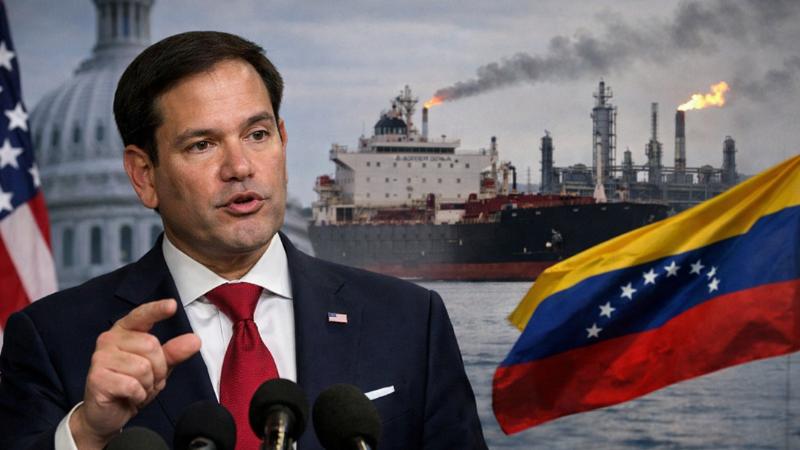
United States Secretary of State Marco Rubio said on Wednesday that Washington holds significant leverage over Venezuela’s interim authorities and is preparing to execute a plan that would place control of the country’s oil exports firmly in US hands. Speaking to reporters on Capitol Hill, Rubio said the administration is finalising an arrangement to take possession of oil currently immobilised in Venezuela and sell it on global markets at full market prices.
According to Rubio, the proceeds from those sales would not flow through existing political structures in Caracas but would instead be managed under a framework designed to prevent corruption and limit the influence of entrenched power networks. He said the funds would be distributed in a way intended to benefit ordinary Venezuelans rather than strengthening remnants of the previous regime. Rubio stressed that the United States believes it can ensure transparency and accountability by directly overseeing how revenues are handled.
Addressing questions about the political loyalties of Venezuela’s interim leadership, Rubio said the focus in Washington is less on personalities and more on process. He argued that the United States has established mechanisms that give it substantial influence over what interim authorities are able to do, particularly when it comes to the energy sector. He said this leverage is rooted in the fact that Venezuela cannot move or sell significant volumes of oil without US approval.
Rubio said the interim leaders in Caracas understand that cooperation with Washington is essential to avoid deeper economic collapse. He added that, in the current environment, oil exports remain Venezuela’s only viable source of large-scale revenue, making access to international markets critical. As a result, he said, interim officials have asked that oil cargoes seized from two tankers be incorporated into a broader agreement with the United States.
While describing the policy as a transitional measure, Rubio emphasised that the long-term future of Venezuela ultimately rests with its citizens. He said the US approach is structured in phases, beginning with stabilisation, followed by economic recovery, and culminating in a political transition determined by Venezuelan voters. He added that Washington is prepared to adjust its posture if specific conditions are met, but made clear that control over oil exports remains a central point of leverage.
Rubio also briefly addressed questions on unrelated foreign policy issues, declining to comment on the potential use of military force in Greenland while confirming he plans to meet Danish representatives next week. He noted that past US leaders have previously discussed acquiring Greenland, suggesting the idea is not unprecedented in American strategic thinking.
Defence Secretary Peter Hegseth reinforced the administration’s message, describing recent US actions involving Venezuelan oil shipments as historically successful. He said the seizure of two tankers underscored Washington’s ability to enforce its policies and demonstrated the reach of US military and economic power. Hegseth said the administration intends to continue using that leverage to advance national interests, adding that the president has been clear about following through on stated objectives.
Energy Secretary Chris Wright offered further detail on the scope of the plan, saying the United States intends to assume long-term control over the marketing and sale of Venezuelan crude. Speaking at an industry conference, Wright said Washington plans to manage Venezuelan oil sales directly and indefinitely, selling production into global markets under US oversight.
President Donald Trump earlier said Venezuela would soon transfer tens of millions of barrels of oil to the United States, estimating shipments of between 30 million and 50 million barrels. He said the US would control the profits generated from those sales, framing the move as part of a broader strategy to apply pressure while shaping the country’s economic transition.
Together, the statements from senior officials signal a significant escalation in US involvement in Venezuela’s energy sector, positioning oil revenue control as a central tool in Washington’s approach to the country’s political and economic future.