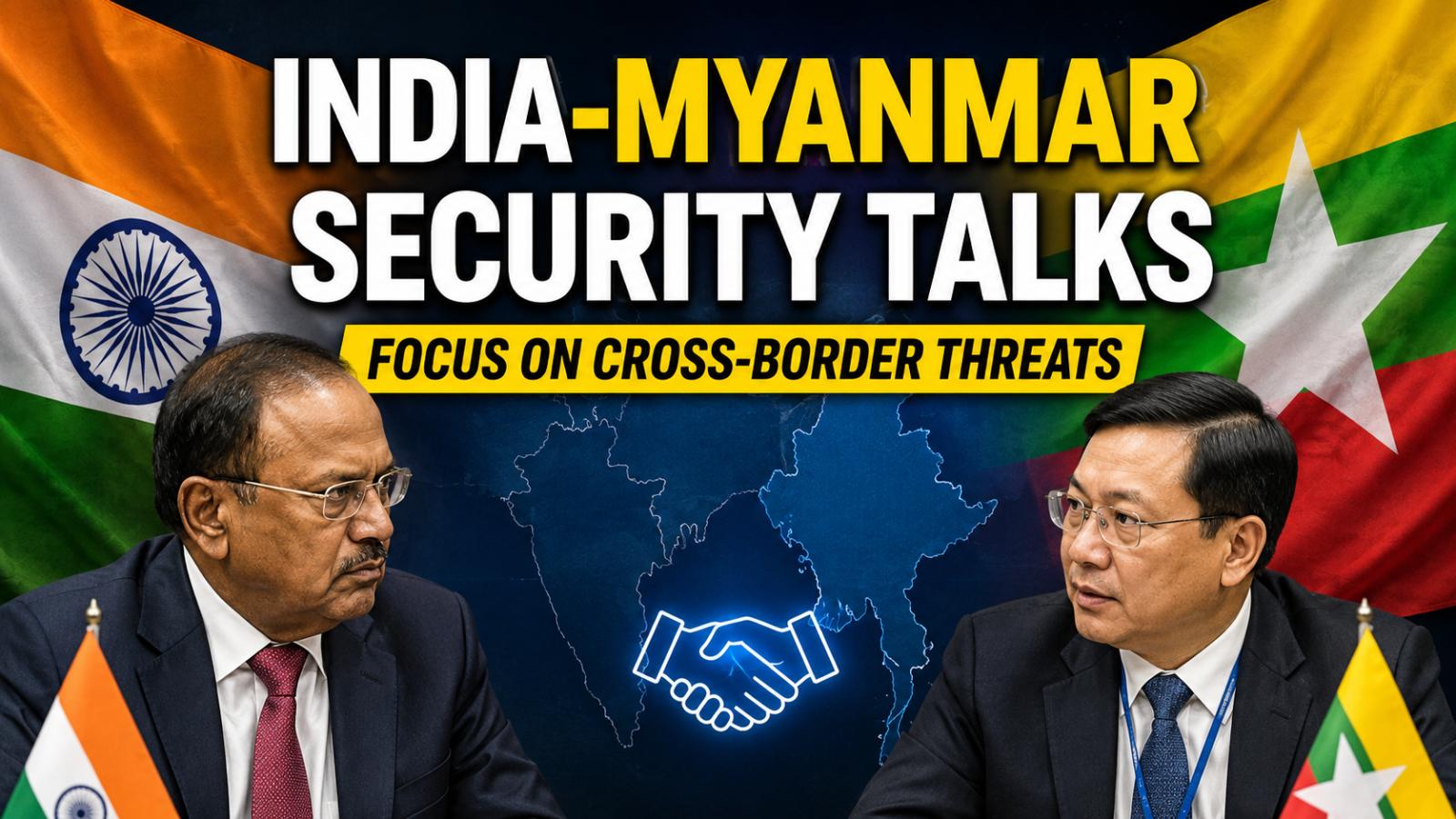
Indian National Security Adviser Ajit Doval reviewed India-Myanmar security cooperation with his Myanmar counterpart, U Tin Aung San, during bilateral talks held around the fifth BIMSTEC National Security Chiefs’ Meeting in New Delhi. The engagement came as conflict inside Myanmar continues to create security, humanitarian and economic challenges along India’s northeastern frontier.
Myanmar Risk to India’s Northeast
India’s concern is driven by Myanmar’s long and difficult-to-monitor border with Arunachal Pradesh, Nagaland, Manipur and Mizoram. Political instability and weakened administration across parts of Myanmar have created areas where armed groups, trafficking networks and criminal organisations can operate with limited interference.
Several insurgent organisations linked to Northeast India have historically used territory across the border for shelter, training and movement. Continued instability increases the risk that such groups could regroup, store weapons or support attacks inside India. New Delhi therefore wants Myanmar’s authorities to prevent their territory from being used for activities that threaten Indian security.
Official public updates said Doval and U Tin Aung San reviewed bilateral security cooperation and exchanged views on regional security. Their meeting took place before India hosted the fifth BIMSTEC National Security Chiefs’ Meeting on July 16, 2026.
Border Watch and Cross-Border Crime
The Myanmar conflict has also expanded opportunities for arms smuggling, narcotics trafficking, human trafficking and illegal movement across the frontier. Drug routes connected to the Golden Triangle pose a particular challenge because trafficking profits can support armed organisations and organised criminal networks.
India has responded by strengthening border surveillance and moving away from the earlier Free Movement Regime. The Union Home Ministry announced in February 2024 that it had decided to scrap the arrangement to protect internal security and preserve the demographic structure of northeastern border states.
Border fencing, biometric registration and improved monitoring may reduce illegal crossings, but infrastructure alone will not solve the problem. India still requires intelligence sharing, coordinated patrolling and cooperation from authorities operating on the Myanmar side.
Rebel Camps and Refugee Pressure
Fighting inside Myanmar has forced civilians to cross into Mizoram and Manipur, placing additional pressure on housing, public services and local administration. Refugees require humanitarian protection, but authorities must also distinguish displaced families from smugglers or armed operatives exploiting the same routes.
This creates a difficult policy balance. Excessively restrictive controls can divide ethnic communities with family ties across the border, while weak enforcement can expose Indian states to weapons, narcotics and insurgent movement. Effective screening and humane refugee management are therefore as important as fencing.
Act East Projects Face Delays
Myanmar is central to India’s Act East Policy because it provides the main land bridge between Northeast India and Southeast Asia. Projects such as the Kaladan Multi-Modal Transit Transport Project and the India-Myanmar-Thailand Trilateral Highway aim to improve trade, transport and strategic connectivity.
Persistent conflict threatens workers, disrupts construction and raises project costs. It also weakens India’s ability to develop the Northeast as a gateway to Southeast Asian markets. Stable relations with Myanmar are therefore not only a security requirement but also an economic and diplomatic priority.
BIMSTEC Security Cooperation
The BIMSTEC framework gives India and Myanmar a regional platform for addressing terrorism, organised crime, cyber threats and maritime security. The grouping includes Bangladesh, Bhutan, India, Myanmar, Nepal, Sri Lanka and Thailand.
The fifth security chiefs’ meeting continued work on practical regional coordination, including maritime law-enforcement principles and humanitarian assistance during disasters. BIMSTEC’s official security structure covers national security dialogue, maritime cooperation and cyber-security cooperation.
India’s message is clear: instability inside Myanmar cannot be allowed to create permanent safe havens or trafficking corridors along the Northeast border. Regular dialogue with Myanmar, backed by surveillance, development projects and BIMSTEC cooperation, remains essential to protecting India’s security and strengthening stability across the Bay of Bengal.