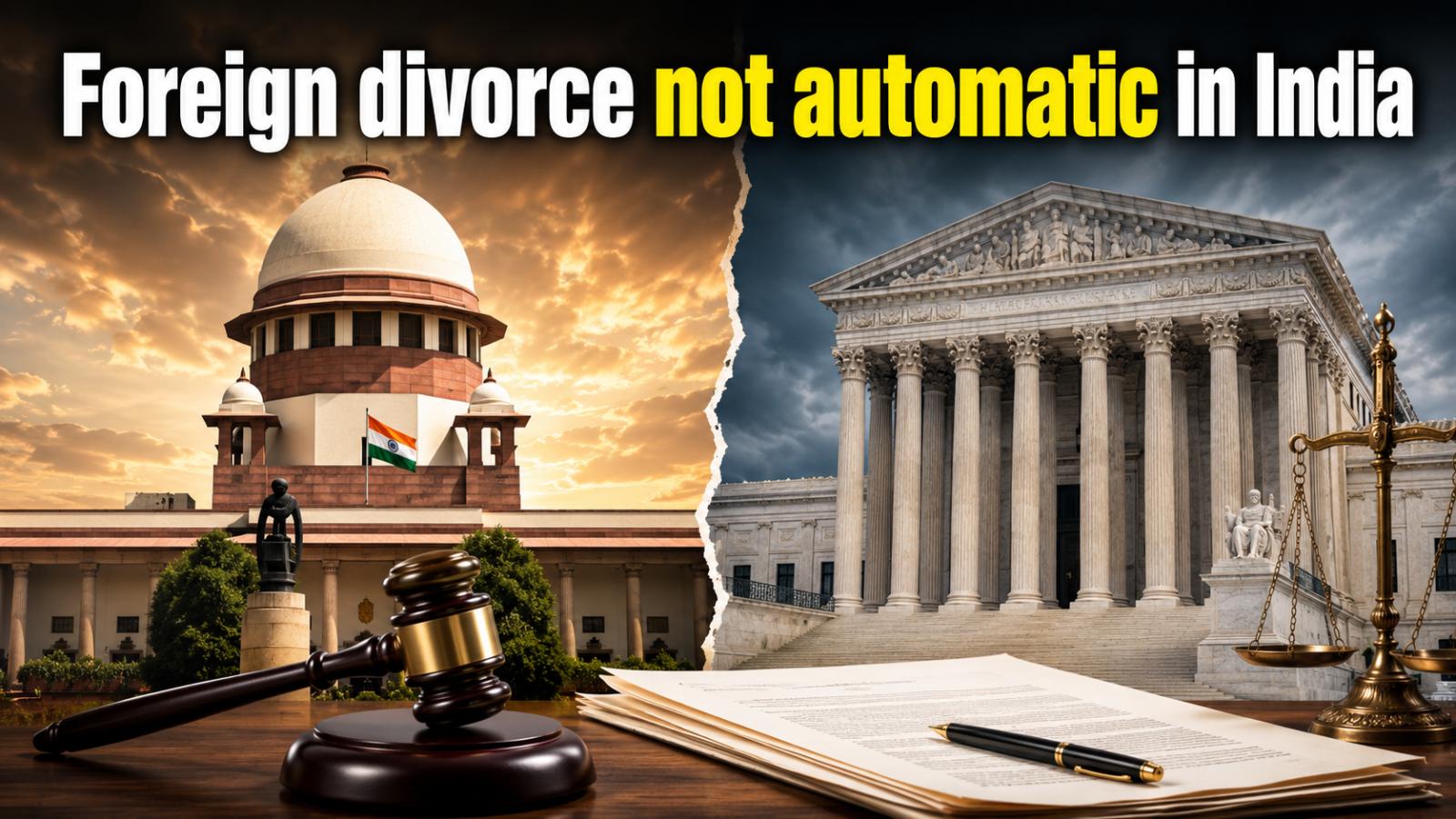
A foreign divorce is not automatically valid in India just because a court in another country grants it. The Supreme Court has made it clear that when a marriage is governed by Indian matrimonial law, especially the Hindu Marriage Act, 1955, any foreign divorce decree must satisfy India law, Section 13 CPC, jurisdiction rules, natural justice, and the legal principles already settled by the court. This means a US divorce may be valid in the US, but it may still fail in India if it does not match the law that governs the marriage.
Under US divorce law, courts in many states may grant divorce on grounds such as irretrievable breakdown of marriage, no-fault divorce, or breakdown beyond repair. A US court may also pass orders on property, money, attorney fees, alimony, and compensation according to its own rules. But Indian courts do not accept such a decree blindly. The key issue is whether the foreign court had proper jurisdiction and whether the divorce ground is recognised under Indian matrimonial law.
Section 13 CPC and Supreme Court test
In India, Section 13 of the Code of Civil Procedure, 1908 decides when a foreign judgment can be treated as conclusive. If the judgment is not passed by a competent court, is not on merits, violates Indian law, ignores natural justice, or goes against public policy, Indian courts can refuse to recognise it. For matrimonial cases, the Supreme Court’s ruling in Y. Narasimha Rao v. Y. Venkata Lakshmi remains important. It says a foreign divorce decree must be based on a ground available under the law governing the parties, and the opposite spouse must have voluntarily and effectively submitted to that foreign court.
Why can a US divorce fail in India?
A US divorce can fail in India if it is based only on irretrievable breakdown of marriage, because this is not a regular statutory ground under the HMA. If one spouse only receives notice but objects to the foreign court’s jurisdiction and does not truly participate, Indian courts may also reject the decree. Mere notice is not enough; fair participation and natural justice matter.
Article 142 and final relief
The Supreme Court held that the US decree was not enforceable in India, but it still granted divorce using Article 142 of the Constitution to do complete justice. However, the court did not expressly confirm the US financial order related to money, attorney fees, alimony, or compensation. The ruling is not only for green card holders. It can affect NRIs, OCI holders, Indian citizens abroad, and any couple whose marriage is governed by Indian law.