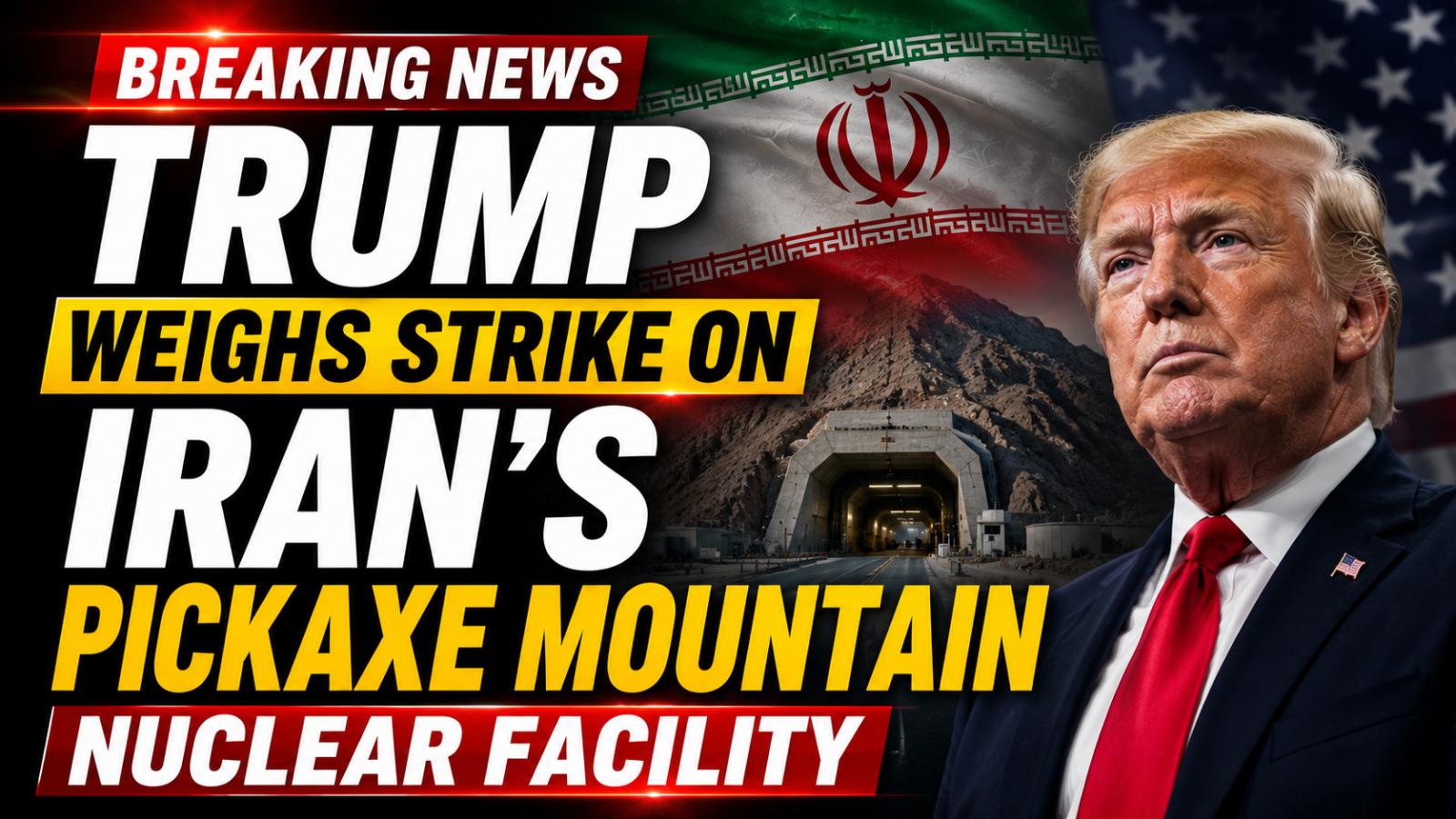
Trump Weighs Strike on Iran Pickaxe Mountain
President Donald Trump is reportedly reviewing military options against Iran's underground Pickaxe Mountain nuclear complex, a facility that US and Israeli officials believe could become a key part of Tehran's future nuclear programme. According to a report by The Wall Street Journal, Trump has spent several days receiving briefings from senior national security advisers while considering possible action against the site.
The underground complex is located near Iran's Natanz nuclear facility, one of the country's most important uranium enrichment centers. The reported discussions highlight growing concerns in Washington that Iran could eventually restore capabilities damaged during previous military operations and sabotage incidents.
Iran Pickaxe Mountain Facility Draws Attention
According to The Wall Street Journal, Iran began constructing the underground complex in 2020 after an aboveground enrichment facility at Natanz was damaged in an incident widely believed to have been sabotage. Former Iranian nuclear chief Ali Akbar Salehi later stated that the new underground site would house "sensitive" equipment designed to strengthen the country's nuclear infrastructure.
Former US and Israeli officials told the newspaper that the mountain facility could eventually support Iran's efforts to rebuild parts of its nuclear programme. However, the report noted that construction does not appear to be complete, and there is currently no public confirmation that nuclear activities are taking place inside the complex.
IAEA Access to Nuclear Site Remains Unresolved
International oversight of the facility has also become a major issue. The report states that Iran has not submitted design information for the underground complex to the International Atomic Energy Agency (IAEA), limiting international visibility into its purpose and development.
Earlier this year, IAEA Director General Rafael Grossi publicly stated that agency inspectors should be granted access to the site. International monitoring remains central to ongoing efforts aimed at ensuring Iran's nuclear activities comply with international obligations and transparency requirements.
Underground Nuclear Facility Raises Strategic Concerns
Independent analysts have also examined the facility's potential capabilities. The Washington-based Institute for Science and International Security estimated in a 2022 assessment that the underground complex could cover more than 5,000 square metres and may eventually accommodate uranium enrichment operations alongside other sensitive nuclear activities.
The institute also reported that satellite imagery suggested construction resumed following the June 2025 conflict, adding to concerns that Iran could continue expanding protected nuclear infrastructure beneath the mountain.
The Wall Street Journal also quoted former senior Pentagon official Dan Shapiro, who described the complex as "a plausible target for attack." According to the report, concerns within the Trump administration center on preventing Iran from rebuilding nuclear capabilities that US officials believe were significantly weakened during last year's conflict.
Background: Trump rejects US school strike claims Iran as the White House defends military actions
The reported military review comes as the White House says Iran continues talks with Washington, while President Trump has also rejected allegations linking the United States to the Minab school strike.
"Continues talks with Washington”
“Rejected allegations linking the United States to the Minab school strike”
At this stage, no decision on military action has been announced by the White House. The reported deliberations reflect ongoing debates over how the United States should respond to Iran's expanding nuclear infrastructure while balancing regional security, diplomacy, and international oversight. Information in this article is based on reporting by The Wall Street Journal, statements from the International Atomic Energy Agency, and analysis published by the Institute for Science and International Security.