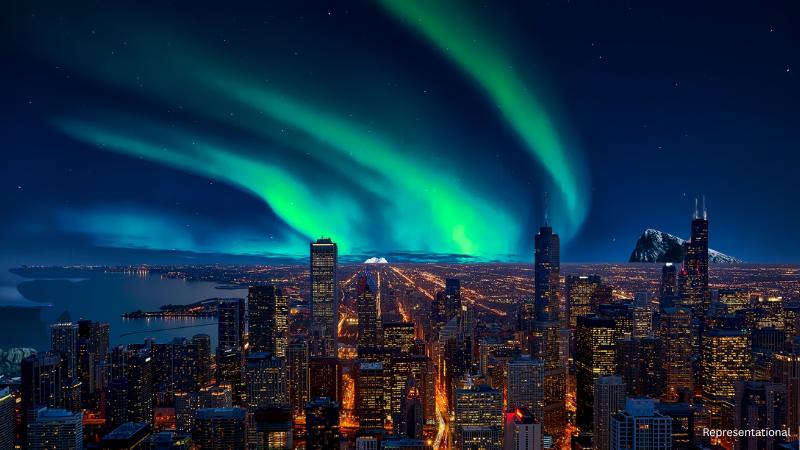
A geomagnetic storm that began Monday evening across the Northern Hemisphere has raised the possibility of a rare sight in the skies over Chicago, with the northern lights potentially visible overnight. The storm was triggered by a Coronal Mass Ejection, or CME, that erupted from the sun over the weekend. This burst of solar particles reached Earth near 5 p.m. EDT on Monday, with the first signs detected at the L1 orbital point about one million miles away from Earth by monitoring satellites.
The arrival of the CME marked the onset of a moderate geomagnetic storm, which is expected to intensify during the overnight hours. According to space weather forecasters, the storm could reach a G3, or strong category, between 1 a.m. and 4 a.m. Tuesday. There is also a slight possibility that it could briefly touch the G4, or severe level, which ranks as level four on a five-point scale. A geomagnetic storm watch remains in place through early Tuesday, keeping skywatchers alert for potential auroral displays.
The northern lights, also known as aurora borealis, are a result of solar particles interacting with the Earth’s magnetic field and atmosphere, producing glowing displays of light that range from green and pink to red and purple. While these displays are commonly seen in polar regions, strong geomagnetic storms can push visibility much farther south, sometimes reaching cities like Chicago.
Forecasters caution that predicting the exact timing and visibility of auroras remains a challenge. Unlike weather systems on Earth, solar activity and its impact on the atmosphere are complex and dynamic, which makes forecasts less than perfect. Even when conditions are favorable, it does not guarantee that the aurora will be visible. For those hoping to catch a glimpse, patience and realistic expectations are key. Experts also note that while the naked eye may not see the brilliant colors often displayed in photographs, modern smartphone cameras are much more sensitive and can capture the lights more vividly than human vision.
Skies over the Chicago area are expected to remain mostly clear through the night, improving the chances for visibility if the aurora becomes active. The peak viewing hours are anticipated during the early morning window between 1 a.m. and 4 a.m., though the exact timing could shift. Clear, dark areas away from city lights will offer the best chance of spotting the northern lights if they appear.
Over the past year and a half, Earth has experienced several significant geomagnetic storms as solar activity has been at its peak in the current 11-year solar cycle. These storms have surprised even seasoned forecasters, producing strong auroras across parts of the United States and Europe. With the solar cycle expected to gradually decline from its peak, such opportunities may become less frequent in the coming years. However, for now, observers in mid-latitude regions like Chicago remain in an exciting position to witness these rare displays.
The ongoing storm once again highlights the fascinating connection between our planet and the sun. Space weather can impact not only the beauty of the night sky but also modern technology, including satellites, navigation systems, and even power grids. Fortunately, monitoring agencies continue to track these events in real time, issuing alerts to ensure preparedness. For skywatchers in Chicago and beyond, tonight presents another reminder of the wonders of the natural world and the cosmic forces that shape our environment.
If the aurora borealis does make its appearance, it will be a fleeting but memorable experience, painting the skies with colors that connect observers to a phenomenon stretching from the Arctic Circle to unexpected urban skylines. Whether Chicagoans catch a faint glow or a vivid display, the night sky is set to deliver a reminder of how powerful and dynamic the sun’s influence truly is.