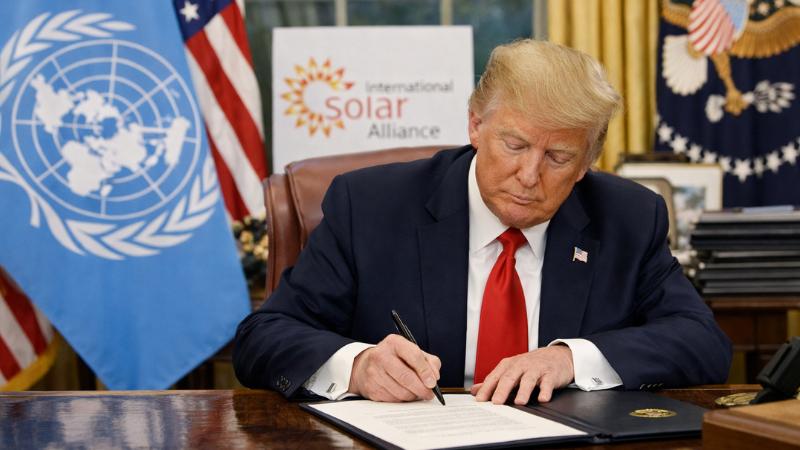
President Donald Trump on Wednesday signed an executive order directing the United States to withdraw from 66 international organisations and treaties, marking one of the most extensive reversals of US participation in global institutions in recent history. According to a White House memorandum, the administration determined that continued involvement in these bodies was contrary to the interests of the United States, citing concerns over sovereignty, ideological alignment, and financial commitments.
Among the most significant withdrawals is the decision to exit the United Nations Framework Convention on Climate Change, the foundational treaty underpinning major international climate agreements. The order also mandates the United States’ departure from the International Solar Alliance, an India-led initiative aimed at expanding solar energy deployment and improving energy access in developing nations. Additional exits include the Intergovernmental Panel on Climate Change, the International Renewable Energy Agency, UN Oceans, and UN Water, further signaling a broad retreat from multilateral climate and environmental cooperation.
Reports indicate that roughly half of the organisations and treaties listed in the order are affiliated with the United Nations system. These range from climate and environmental bodies to development, human rights, and peacebuilding institutions. The move follows Trump’s earlier decision during his first term to withdraw the United States from the Paris climate agreement, reinforcing his long-standing skepticism toward international climate frameworks and scientific consensus on climate change.
The legality of the withdrawals has quickly become a point of contention. While the US Constitution requires a two-thirds Senate majority to ratify treaties, it does not explicitly outline the process for withdrawal, leaving the issue in a constitutional gray area. Legal experts and advocacy groups argue that exiting a treaty ratified by the Senate without congressional approval could face judicial scrutiny. Critics contend that withdrawing from the UNFCCC carries broader legal and diplomatic implications than leaving nonbinding agreements, and some have indicated that potential legal challenges are being explored.
International policy analysts warn that the decision could undermine years of coordinated global efforts to address climate change. Observers note that the UNFCCC serves as the central framework for climate negotiations, data sharing, and emissions reporting, and that US disengagement may weaken global momentum at a time when international cooperation is seen as critical.
The administration has defended the move as a fulfillment of campaign promises to prioritize national interests. Secretary of State Marco Rubio stated that many international organisations had shifted toward what he described as progressive ideological agendas that restrict American autonomy. He argued that the administration is seeking to end US funding for institutions that, in its view, no longer align with core national priorities, emphasizing a foreign policy approach centered on sovereignty and domestic interests.
The withdrawals span a wide array of non-UN and UN-affiliated bodies, including organisations focused on energy policy, environmental protection, development assistance, cultural preservation, and regional cooperation. The breadth of the order underscores a broader recalibration of US engagement with multilateral institutions, one that is expected to have lasting implications for global diplomacy, climate action, and international governance.
As the exits take effect, questions remain over how the decisions will be implemented, whether Congress or the courts will intervene, and how international partners will respond to the sudden reduction in US participation across so many global forums.