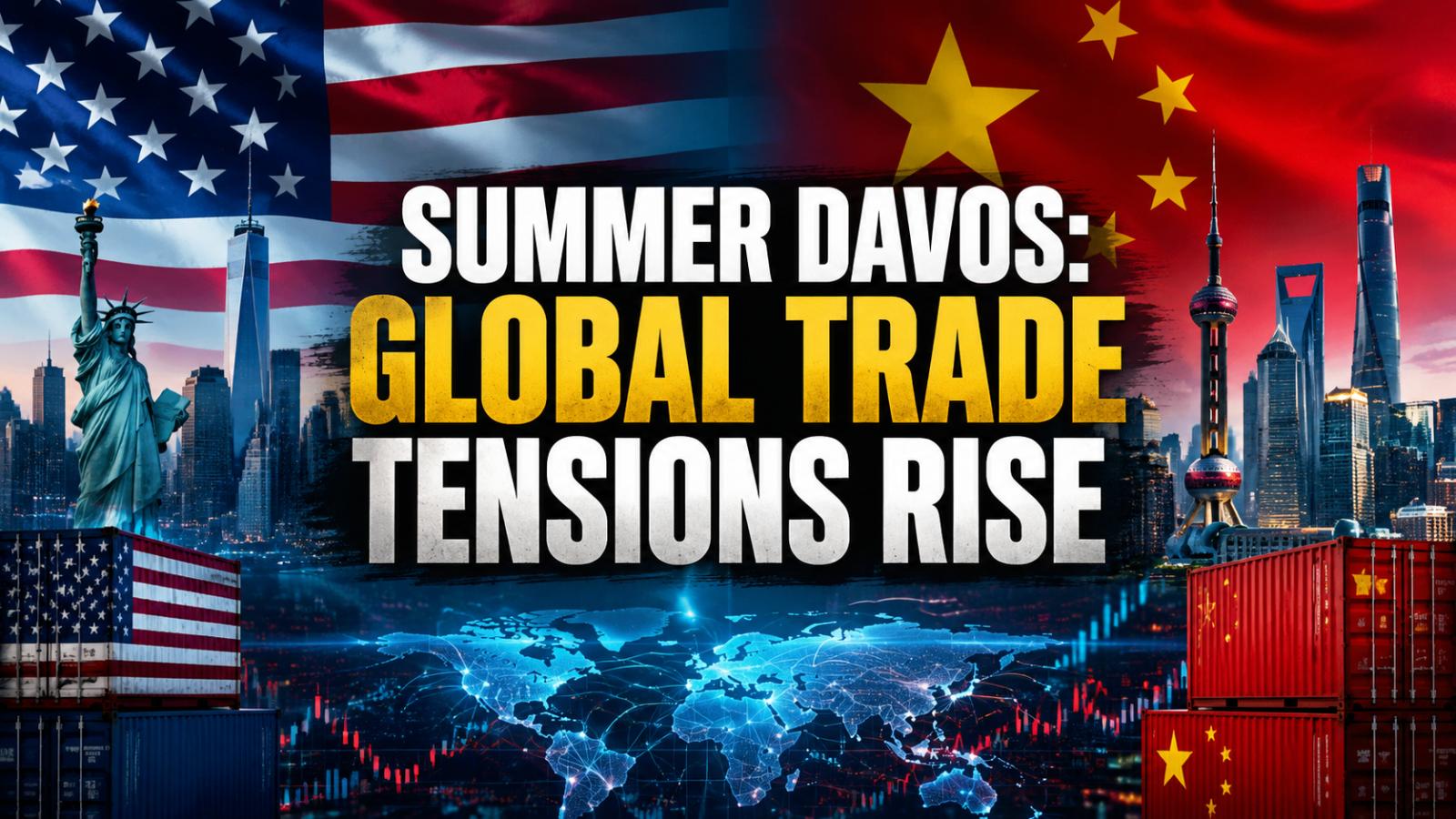
The gathering in Dalian under the World Economic Forum’s “Summer Davos” platform brought together policymakers, business leaders and economists at a time when global growth signals are weakening. The discussions reflected a clear shift in tone: confidence in stable trade expansion is fading, replaced by concern over fragmentation and competing economic blocs.
US–China relationship remains the central pressure point
A major focus of the discussions was the ongoing strain between the United States and China. Participants repeatedly pointed out that the relationship between the two economies is no longer just bilateral—it now influences pricing, investment decisions and supply chain planning across multiple regions.
Trade restrictions, technology controls and industrial policy shifts have created uncertainty for manufacturers and investors. Several speakers noted that businesses are increasingly building contingency supply chains rather than relying on single-country production models, raising long-term costs.
Policy divergence deepens global uncertainty
The forum highlighted how both economies are moving in different strategic directions. The United States continues to prioritize supply chain security and domestic manufacturing resilience, especially in critical sectors like semiconductors and clean energy.
China, meanwhile, is pushing a transition toward innovation-led growth, with stronger emphasis on domestic research, advanced manufacturing and digital industries. The gap between these strategies is widening, creating friction in trade negotiations and investment flows.
Artificial intelligence reshapes economic expectations
Beyond geopolitics, artificial intelligence emerged as one of the most disruptive themes of the meeting. Leaders discussed how AI adoption is accelerating productivity in some sectors while simultaneously increasing competitive pressure in labor-intensive industries.
A key concern raised was the uneven distribution of AI benefits. Advanced economies and large corporations are likely to capture most of the gains initially, while smaller firms and developing markets risk falling behind unless policy frameworks adapt quickly.
China signals long-term restructuring strategy
Chinese leadership used the platform to reinforce confidence in long-term economic restructuring. The messaging focused on moving from scale-driven manufacturing to higher-value innovation systems, including advanced technology development and global collaboration in emerging sectors.
However, analysts at the forum noted that this transition will not be smooth, especially under external trade pressure and shifting global demand patterns.
Global economy faces a structural turning point
The overall sentiment from Dalian pointed toward a more fragmented global economic environment. Instead of a single integrated growth system, the world may be moving toward parallel trade networks shaped by political alignment and strategic interests.
Participants agreed on one point: decisions made by the US and China over the next few years will not only define their bilateral relationship but will also set the trajectory for global trade stability, investment flows and technological competition.