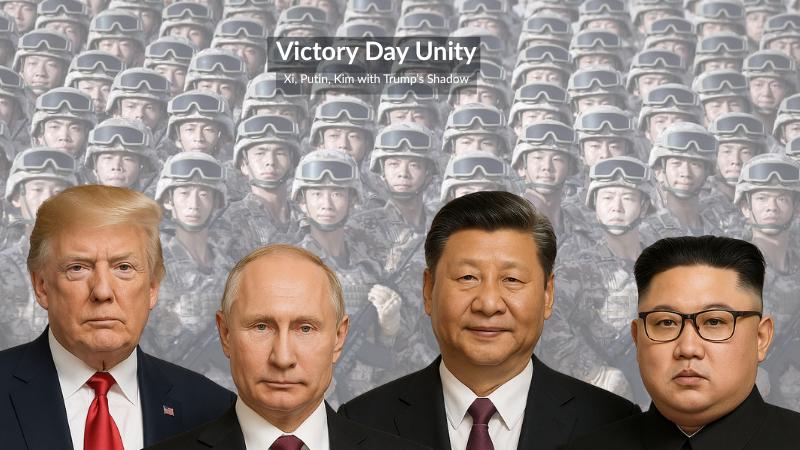
US President Donald Trump extended greetings to China on its Victory Day celebrations and sent what he described as warm regards to world leaders Vladimir Putin and Kim Jong Un. His message came in the form of a statement where he linked historical sacrifices made by American soldiers during China’s wartime struggle to present-day global politics. The statement sparked widespread attention, not only because of the sensitive timing of the message but also because of the leaders he specifically mentioned.
Trump highlighted that the United States had shed much blood to aid China’s path to freedom from a foreign invader during the Second World War. He stressed that many Americans had lost their lives in support of China’s eventual victory and suggested that this contribution should be recognized when President Xi addressed the event. He went further to include a note to Russia’s President Vladimir Putin and North Korea’s Kim Jong Un, writing that his warmest regards should be passed on to them even as they, in his words, conspired against the United States. This phrasing was notable for its mix of acknowledgment and criticism, reflecting Trump’s characteristic style of balancing confrontation with unexpected cordiality.
The backdrop to Trump’s message was the Victory Day parade in Beijing, a large-scale event that drew global attention as a display of China’s national pride and strength. The occasion was also symbolic for bringing together Xi Jinping, Vladimir Putin, and Kim Jong Un, creating a moment of unity between leaders who have each taken stances critical of the United States. The gathering took place soon after the Shanghai Cooperation Organization summit where leaders from across Asia, including India’s Prime Minister Narendra Modi, assembled to strengthen multilateral ties at a time when trade and security issues dominate the global agenda.
China presented the Victory Day parade as a show of unity with its allies and as a symbol of the nation’s ability to shape the global order. In his keynote speech, President Xi declared that China was unstoppable, emphasizing that the rejuvenation of the Chinese nation was inevitable and that the course of peace and development for humanity would prevail. His speech portrayed the world as standing at a crossroads between peace and war, positioning China as a champion of stability against the backdrop of global tensions. Xi’s words carried a pointed undertone as he warned against bullying behaviour by certain countries, remarks that were widely interpreted as directed at the United States.
The historical roots of the commemoration lie in China’s devastating war against imperial Japan during the 1930s and 40s. Millions of Chinese lost their lives in that prolonged conflict, which eventually merged with the global war following Japan’s attack on Pearl Harbor in 1941. Victory Day therefore not only celebrates the end of foreign aggression but also underscores China’s sense of resilience and national pride, making it an occasion with both historical reverence and contemporary political significance.
The parade gained additional global attention due to the presence of Kim Jong Un alongside Xi and Putin. This marked only the second time Kim has been reported traveling abroad in six years, and it was his first known public appearance with both Xi and Putin at the same event. The image of the three leaders together was seen as a coup for China, projecting its influence on the world stage and signaling a deeper alignment between the three countries at a time of increasing confrontation with the United States and its allies.
During the summit and related events, Putin used his platform to defend Russia’s ongoing military campaign in Ukraine. He placed responsibility for the conflict on Western countries, portraying Russia’s actions as a response to provocation rather than aggression. This narrative has been a consistent element of Putin’s messaging and is now increasingly amplified in forums where Russia’s allies are present. Xi’s supportive stance on broader global themes, coupled with Kim’s rare attendance, gave the event an additional layer of political significance that goes beyond ceremonial gestures.
For Trump, the event underscored challenges in his foreign policy approach, particularly as tariffs imposed by his administration continue to reverberate through the global economy. The alignment of China, Russia, and North Korea represents a counterweight to US influence at a moment when Trump faces opposition both internationally and domestically. The mention of these leaders in his message reflected an acknowledgment of their growing cooperation, even as he sought to remind China of the American sacrifices that contributed to its historic victory decades earlier.
The display of military power, unity among nations often at odds with the West, and the direct remarks by Xi and Putin have fueled debate about shifting global alliances. Trump’s message added another layer, blending historical context with present-day rivalries. The unusual tone of his remarks, sending regards to leaders he also accused of conspiring against America, reinforced the complexity of his diplomatic style. It is a style that draws sharp contrasts and grabs attention, keeping him at the center of discussions about the United States’ place in a changing global order.
As the dust settles from the Victory Day celebrations, the broader implications remain significant. The presence of Xi, Putin, and Kim together highlighted the emergence of a bloc that may increasingly coordinate on economic and security issues in opposition to American policies. Trump’s remarks tied America’s past contributions to China’s wartime struggles to the present, a reminder of historical cooperation, even as today’s realities mark a stark divergence. The parade in Beijing may have been a celebration of history, but it also served as a live demonstration of where power dynamics are shifting in the modern world.