If gold or jewelry is stolen in Texas, filing a police report quickly, preserving evidence and documenting each missing item can improve recovery and insurance efforts. Texas law also allows theft victims with an offense report to seek pawnshop assistance in locating stolen property.
Gold jewelry theft can involve far more than financial loss, particularly when wedding jewelry, inherited ornaments or family heirlooms are taken.
If gold or jewelry is stolen in Texas, victims should act quickly but avoid disturbing possible evidence. Families can reduce future risk by learning how to safely store gold jewelry in the U.S. using secure storage, documentation and home-security measures. The first priorities are personal safety, reporting the incident and creating a detailed record of what is missing.
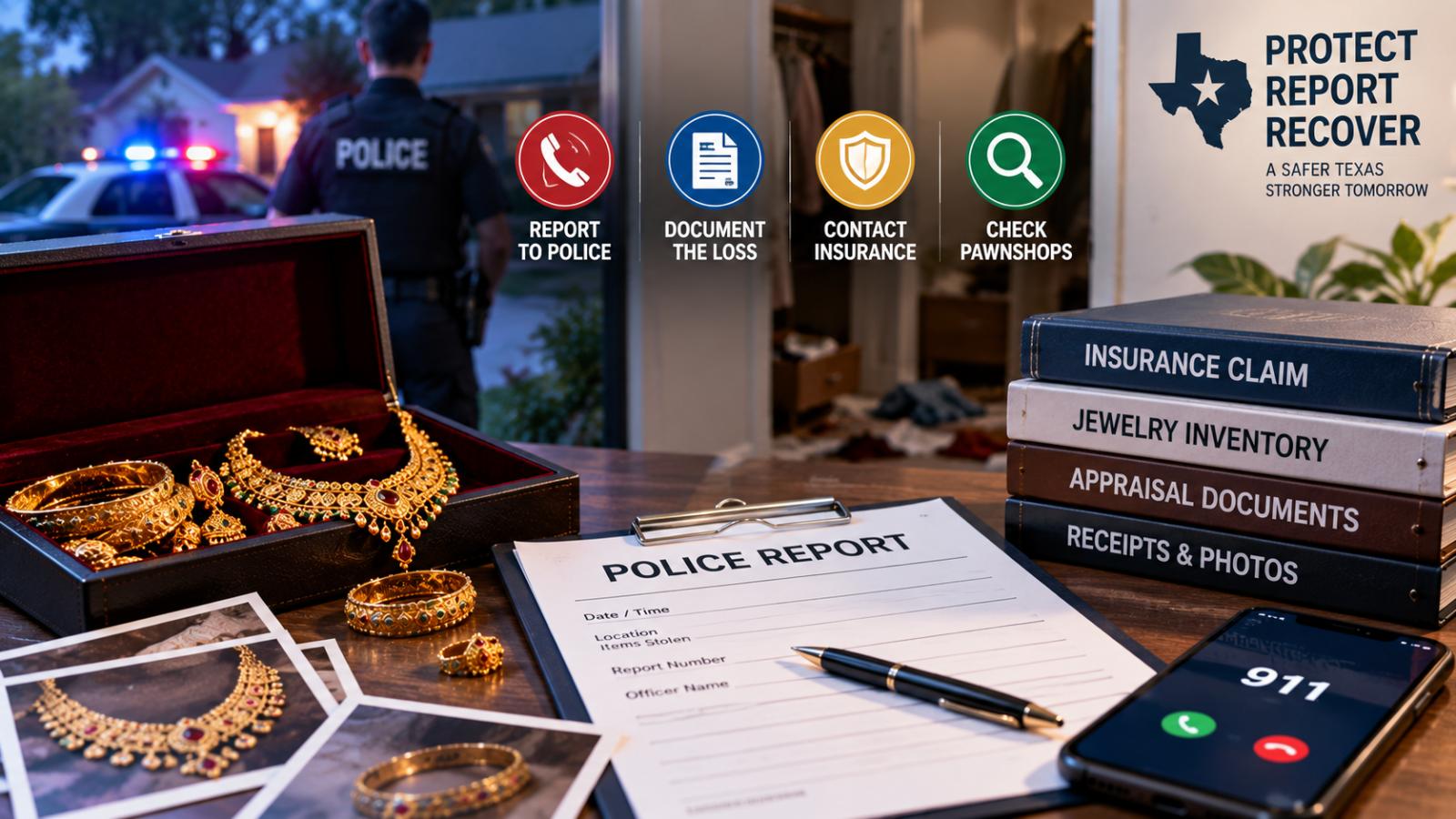
Report the jewelry theft to police
Call 911 if a crime is happening, a suspect remains at the scene or anyone is in immediate danger. For thefts discovered afterward, contact the appropriate local police department through its non-emergency or reporting system.
Reporting procedures vary by city. Austin, for example, allows certain theft and burglary reports online, while Houston requires direct police contact when a break-in occurred, evidence is present or suspect information is available.
Obtain the incident or offense-report number and keep it with your records.
Preserve evidence and document stolen gold
Avoid cleaning or rearranging areas affected by a burglary until police determine whether evidence needs to be processed.
Investigators can use information about entry points, items taken, possible suspects and evidence left at the scene during a burglary investigation.
Prepare a detailed list of missing jewelry, including photographs, purchase receipts, appraisals, weight, purity, distinctive designs, gemstones and identifying marks whenever available.
Contact your insurance company
Notify your homeowners or renters insurer promptly and ask what documentation is required for a theft claim.
Texas homeowners policies generally cover theft, but expensive jewelry can be subject to special coverage limits. The Texas Department of Insurance recommends additional coverage when valuable jewelry exceeds a policy's standard limits.
Families with valuable collections should understand whether homeowners insurance covers gold and Indian jewelry and whether additional scheduled coverage is needed.
Renters policies can also cover stolen belongings, although jewelry limits may apply depending on the policy.
Check Texas pawnshop procedures
Texas law specifically provides a way for burglary and theft victims to seek help if stolen property may have reached a pawnshop.
A consumer who has filed an offense report with local law enforcement may ask a pawnbroker to search pawnshop records. State law also requires pawnbrokers to assist consumers and law enforcement in locating and recovering stolen property.
People trying to recover or replace stolen valuables should also remain alert to Texas gold scams and suspicious offers involving precious metals.
Victims should provide the police report and a precise description of the missing jewelry rather than confronting anyone suspected of possessing the property.
Keep following the investigation
Save copies of the police report, insurance claim, photographs, appraisals and communications with investigators. If police recover property, proof of ownership may be required before it can be returned; Houston, for example, requests a report number and may require additional ownership documentation for recovered property.
For families holding valuable gold jewelry, detailed records prepared before a theft can make both identification and insurance claims considerably easier. Those holding investment-grade precious metals can also explore how the Texas Bullion Depository provides secure storage for approved gold and silver. After a loss, coordination between police, insurers and regulated resale channels offers the best chance of documenting and potentially recovering stolen property.