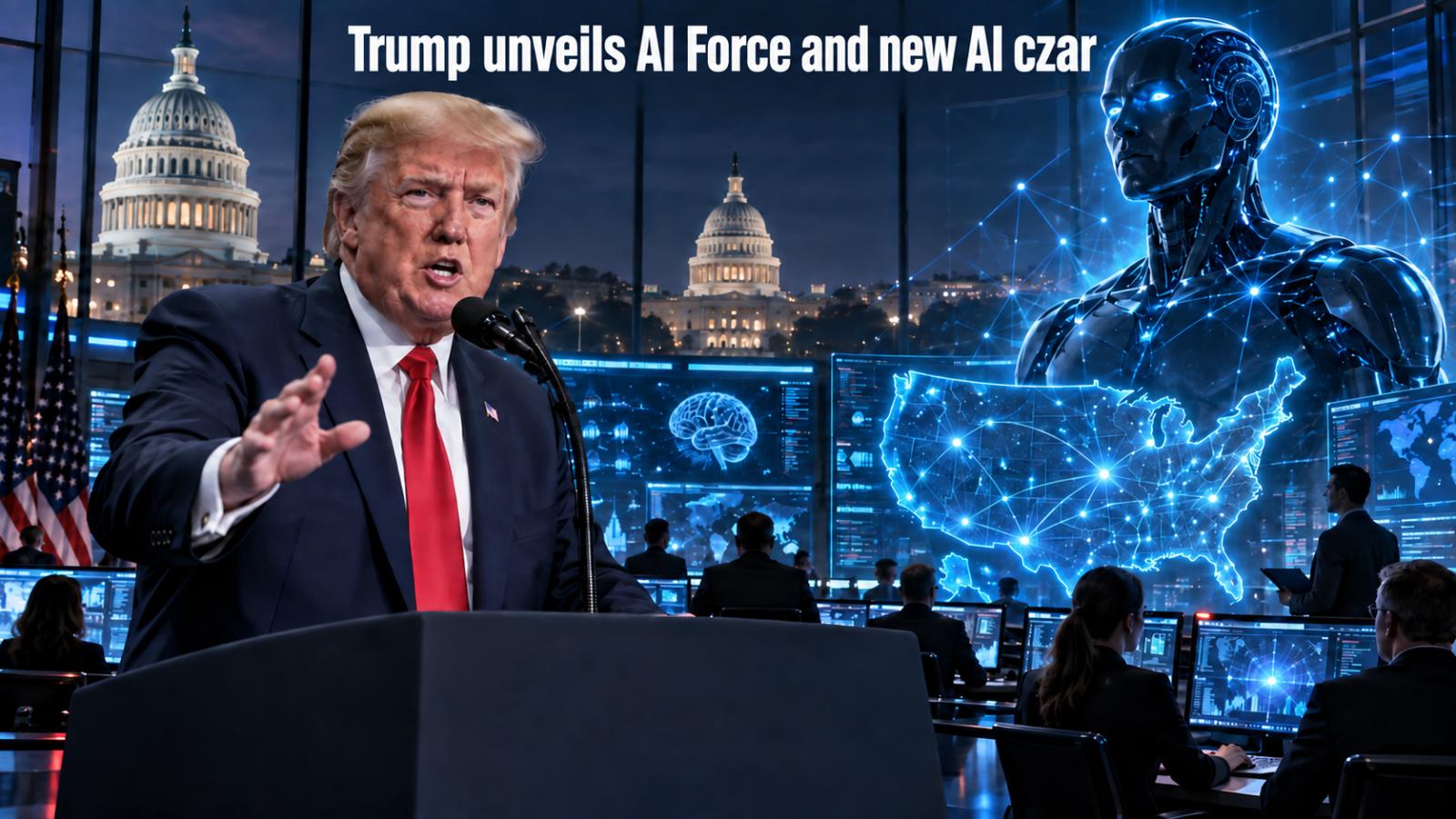
On September 19, 2026, President Donald Trump announced plans to create an “AI Force” and appoint an AI czar, backing industry growth as technology leaders and California officials demanded stronger safeguards.
Trump announces an AI Force
Trump unveiled the proposal on Truth Social on September 19, 2026. He said his administration would establish an “AI Force” and appoint an AI czar to oversee the AI sector, but provided few details about its powers or launch date. Trump compared the initiative with the creation of the US Space Force in 2019 and argued that AI is crucial to economic and strategic power. His administration, he said, would confront misuse without weakening innovation or US competitiveness.
President rejects an AI slowdown
In his September 19 statement, Trump criticised opponents of artificial intelligence and expanding data centres, portraying their warnings as politically motivated. He pledged that the United States would not “hinder or stifle” AI development but would support and monitor its growth. Trump also questioned whether “artificial intelligence” was the right name and suggested “Superior Intelligence” or “Extreme Intelligence.” His position favours investment and rapid development over federal restrictions.
Technology leaders warn of AI risks
Trump’s announcement followed growing warnings about advanced AI. In an essay published on September 12, 2026, Anthropic CEO Dario Amodei urged the industry to slow down so companies and governments could evaluate serious risks. Elon Musk supported stronger testing, including developers examining one another’s models before release. Former Anthropic researcher Jacob Coxon warned that highly capable systems could threaten humanity. Though disputed, such predictions have intensified calls for independent testing, transparency and emergency controls.
California explores an AI kill switch
On September 18, 2026, California Governor Gavin Newsom issued an executive order to accelerate safety checks and explore a “kill switch” for frontier AI systems. The plan calls for recurring evaluations, faster compliance reviews and formal reporting channels for security breaches. Newsom accused the federal government of failing to address the risks created by increasingly powerful models. The divide is clear: Trump wants to protect growth and US leadership, while California and safety advocates demand enforceable safeguards before the technology becomes harder to control.