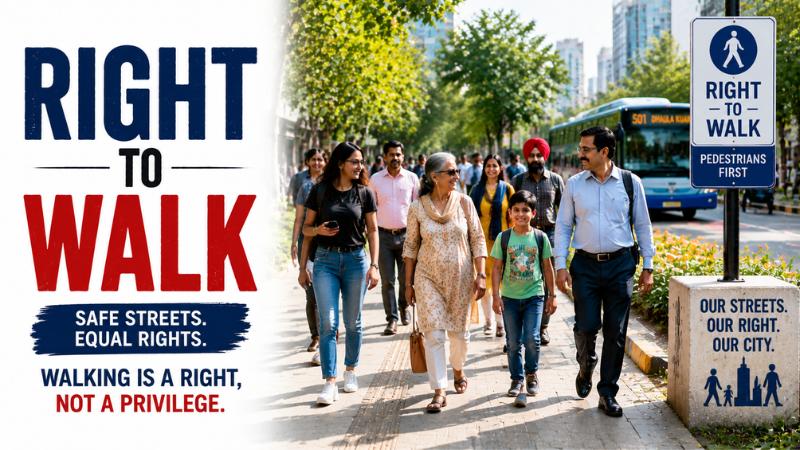
Supreme Court Says Right To Walk On Safe Footpaths Is A Fundamental Right
The Supreme Court has declared that walking on safe and clearly marked footpaths is a fundamental right, strengthening the legal protection available to pedestrians across India.
In a significant ruling, the court said public authorities have a duty to provide and maintain footpaths wherever roads exist. The judgment places pedestrian safety above the convenience of motorised vehicles and makes walking infrastructure a constitutional concern.
Supreme Court Backs Pedestrian Rights
A Bench of Justice PS Narasimha and Justice AS Chandurkar observed that the right to walk safely is protected under Articles 19 and 21 of the Constitution. The court said citizens should not be forced to risk their lives because of missing or poorly maintained footpaths.
The ruling makes it clear that roads cannot be designed only for vehicles. Pedestrians, including children, senior citizens and daily commuters, must also have safe public spaces to move without fear.
Public Authorities Given Clear Responsibility
The Supreme Court said Urban Development Authorities, Municipal Corporations, Municipalities, and Panchayats are responsible for creating and maintaining pedestrian infrastructure.
This means local bodies can be held accountable if they fail to provide a safe walking space along roads. Citizens may also seek legal remedies when authorities neglect pedestrian safety.
Court Says Cities Have Ignored Walkers
The court noted that Indian cities have long given more importance to motorised transport than to walkers. It said pedestrians are often pushed to the margins, even though walking is one of the most basic forms of movement.
The Bench described the lack of proper footpaths as a serious civic issue and said public roads should not be treated as spaces meant only for vehicles.
Case Linked To Child’s Death
The observations came during a case involving the death of a five-year-old child who was hit by a tanker while walking to school with his father. The court noted that the area had no footpath or pedestrian crossing.
The Supreme Court set aside the High Court’s reduced compensation order and enhanced the compensation for the child’s family to Rs 11.44 lakh.
Legal Framework For Pedestrian Safety Suggested
The court also pointed out that India does not have a dedicated legal framework for pedestrian rights. It recommended the creation of a regulatory body and suggested that laws may be framed to define pedestrian rights, duties, and enforcement systems.
A copy of the judgment will be sent to the concerned ministries and the Law Commission for further consideration.
Why The Ruling Matters
The judgment could have a major impact on urban planning and road safety in India. If implemented properly, it may push cities to build better footpaths, safer crossings, and more pedestrian-friendly roads.
For millions of people who walk to schools, offices, markets, and public transport points every day, the ruling sends a clear message: safe walking space is not a favour, but a constitutional right.