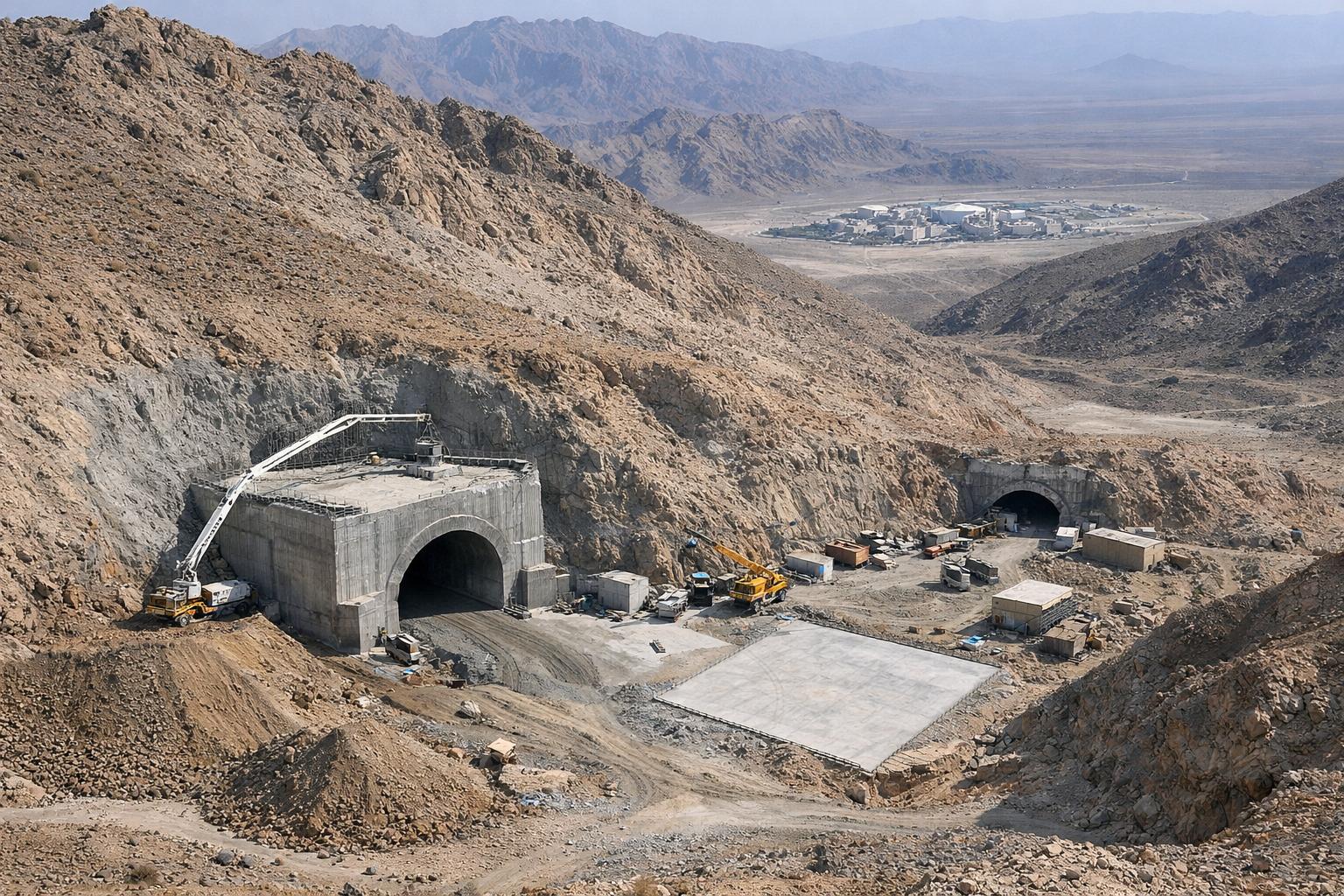
Fresh satellite imagery indicates that Iran is strengthening an underground complex near its main nuclear installation at Natanz, a development that analysts say could complicate diplomatic efforts and heighten regional security concerns. The activity has been observed at a mountainous site known as Pickaxe Mountain, located roughly 1.6 kilometres south of the uranium enrichment facility in central Iran, and appears to involve new concrete structures and expanded tunnel protections.
The construction comes at a time of renewed friction between Tehran and Washington. Former US president Donald Trump has repeatedly warned of possible military action if Iran does not reach an agreement over its nuclear programme, while Iranian officials have vowed to respond to any strike. The exchange of threats has added to fears of escalation across West Asia, where US forces have increased their presence and longstanding rivalries continue to shape the strategic landscape.
Images reviewed by analysts from the Institute for Science and International Security, a Washington-based think tank that tracks nuclear proliferation risks, show what appears to be fresh concrete poured over at least one tunnel entrance. Equipment consistent with a boom pump used for concrete delivery is visible at the site, suggesting active reinforcement work. Nearby, rock and soil appear to have been cleared and levelled, and additional concrete-reinforced structures have been erected close to the entrances.
Researchers who have monitored the area for several years say the scale of excavation and the amount of construction material suggest the site could support more than routine maintenance. The depth of the tunnels, estimated to be between 79 and 100 metres underground, may offer significant protection from aerial attacks and surveillance, potentially making the facility more resilient than other known installations. Such characteristics have drawn scrutiny from non-proliferation experts, who view hardened underground sites as capable of hosting sensitive operations such as centrifuge assembly or uranium enrichment.
Iran has previously said that Pickaxe Mountain could be used for manufacturing and assembling centrifuges, devices required for nuclear fuel production. Tehran maintains that its nuclear activities are intended solely for peaceful purposes, including energy generation and medical research, and has repeatedly denied pursuing a nuclear weapon. However, the limited access granted to international inspectors has raised questions among watchdog groups and foreign governments about transparency and compliance.
The site was not among those reportedly targeted during earlier US strikes on Iranian nuclear infrastructure, which officials described at the time as severely damaging key facilities. Analysts now suggest that any reconstruction of centrifuge capacity in protected locations like Pickaxe Mountain could allow Iran to restore or expand operations more quickly if other sites are disrupted.
International observers emphasize that the situation underscores the importance of oversight by the International Atomic Energy Agency. Experts argue that greater disclosure and inspections are essential to clarify the purpose of the new construction and to reduce the risk of miscalculation. Without verifiable information, they warn, suspicion could deepen and diplomatic efforts may face additional obstacles.
As tensions persist, the developments at Pickaxe Mountain have become another focal point in the broader debate over Iran’s nuclear ambitions, regional stability, and the fragile balance between deterrence and diplomacy.


 Joyful
0%
Joyful
0%
 Cool
0%
Cool
0%
 Thrilled
0%
Thrilled
0%
 Upset
0%
Upset
0%
 Unhappy
0%
Unhappy
0%