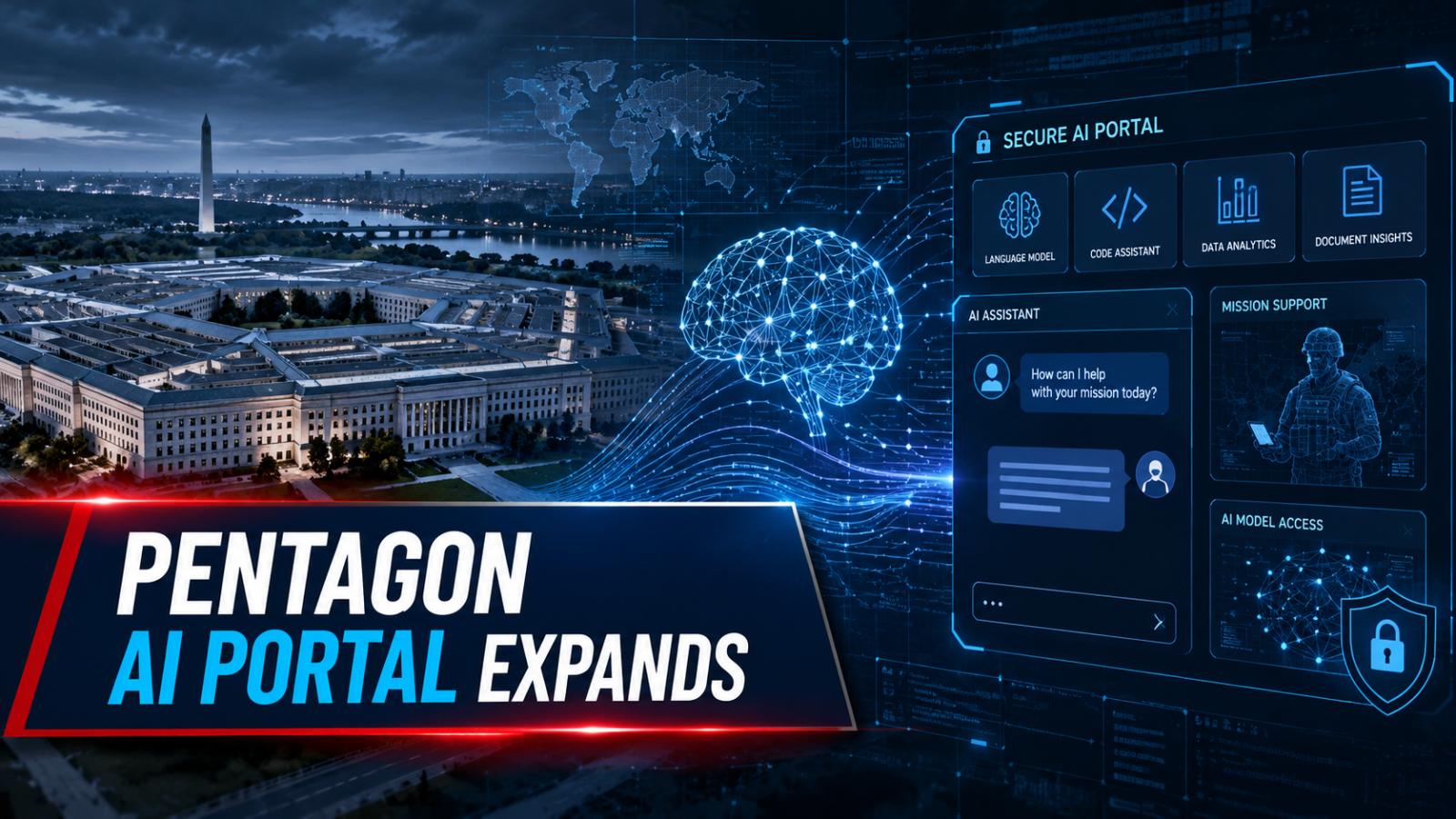
The Pentagon’s GenAI.mil platform has expanded access to commercial artificial intelligence across the US defence workforce, adding OpenAI’s ChatGPT Mil and Grok for Government alongside Google Gemini. More than 1.7 million users have already accessed the system, while Anthropic’s Claude remains absent following a high-profile dispute over military AI safeguards.
ChatGPT Mil and Grok Join GenAI.mil
GenAI.mil is designed as a secure portal where roughly three million US military and civilian defence personnel can use approved frontier AI models without relying on ordinary consumer services. The Pentagon says the platform allows personnel to work with Controlled Unclassified Information through systems accredited at Impact Level 5.
Google’s Gemini was available first. On August 31, the Pentagon added ChatGPT Mil and Grok for Government, giving users a broader choice of commercial models for tasks such as document analysis, research, logistics and other enterprise work. More than 1.7 million unique users have already been onboarded.
Anthropic Claude Remains Absent
Anthropic’s Claude is not currently part of GenAI.mil. The company’s disagreement with the Pentagon centred on restrictions it wanted to preserve around military use of its technology.
Anthropic sought safeguards preventing use of its models for mass domestic surveillance and fully autonomous weapons. Defence officials wanted contracts allowing models to be used for any lawful purpose, creating a fundamental disagreement over how much control an AI supplier should retain after deployment.
Pentagon Anthropic Court Fight
The dispute escalated when the Pentagon designated Anthropic a supply-chain risk, a move that threatened its ability to work with government agencies and defence contractors.
On August 27, US District Judge Rita Lin ruled that the designation was unlawful. The court found that the government had engaged in retaliation violating the First Amendment, denied Anthropic required due process and acted arbitrarily in applying the supply-chain risk label.
The ruling removed the blacklist, but it did not require the Pentagon to purchase Anthropic products. That distinction explains why Claude can remain outside GenAI.mil even after Anthropic prevailed in court.
Military AI Safeguards
The episode raises a broader question about AI safety policies in government deployments. OpenAI, Google and xAI all publish rules governing how their models may be used, but public information does not fully spell out every operational restriction attached to their GenAI.mil deployments.
OpenAI has said it supports bringing AI into national-security work with safeguards and confirmed that ChatGPT is being deployed through the Pentagon’s secure enterprise platform.
Data-security certification and permitted use are separate issues. Impact Level 5 addresses how sensitive information is handled; it does not by itself define whether a model may be used for targeting, weapons decisions or intelligence operations.
AI Defence Strategy
For the Pentagon, access to several frontier models reduces dependence on a single vendor and lets personnel choose different systems for different tasks. Defence officials have described Gemini as useful for search-oriented work and ChatGPT as strong for text-heavy tasks.
For AI companies, however, the Anthropic case illustrates the commercial cost of insisting on contractual limits that a major government customer will not accept. GenAI.mil is therefore more than a software rollout: it has become a test of how far AI laboratories are willing to defend their published safety principles when national-security contracts and millions of potential users are at stake.