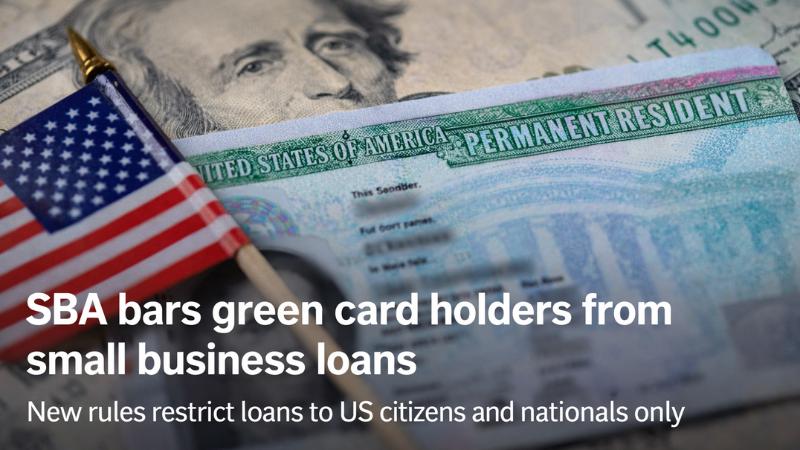
Green card holders will no longer be eligible for government-backed small business loans in the United States beginning March 1, 2026, following a policy change by the US Small Business Administration that tightens citizenship and residency requirements for borrowers. The revised rules limit access to key SBA lending programs exclusively to US citizens and nationals who maintain their principal residence within the country or its territories, effectively barring lawful permanent residents from participation.
According to an official policy notice issued in early February, the agency updated its Standard Operating Procedure 50 10 8, the framework that governs lender and development company loan programs. The revision rescinds earlier procedural guidance that permitted limited ownership by foreign nationals or certain residents living outside the United States. Under the new language, every direct and indirect owner of a small business applicant must meet the citizenship criteria.
The SBA said the updated rules require 100 percent of ownership interests in any applicant or borrowing entity to be held by eligible US citizens or nationals. As a result, even minority ownership by a legal permanent resident will disqualify a company from receiving SBA-backed financing. The policy applies broadly to applicants, operating companies, and entities tied to the loan structure, leaving little flexibility for mixed-ownership businesses.
The change is expected to affect a wide range of small and early-stage firms that rely on SBA loans for working capital, equipment purchases, and expansion. Many startups and family-owned enterprises depend on these lending programs because they offer lower interest rates and government guarantees that make financing more accessible. With the new restrictions in place, businesses that include green card holders among their owners may need to reconsider ownership arrangements or seek alternative sources of credit from private lenders.
Agency officials indicated that the revisions align loan eligibility standards with existing federal regulations and a recent executive directive emphasizing stricter residency compliance. The policy will take effect for all new applications submitted on or after the effective date. Existing and prospective borrowers are being advised to review their ownership structures carefully to ensure continued eligibility under the updated requirements.
The move marks a significant shift in how federal small business lending programs define qualification, narrowing access to public funds and reshaping the financing landscape for immigrant entrepreneurs. As the implementation date approaches, legal and financial advisers expect increased demand for guidance from affected business owners who must evaluate their options within the new framework.


 Joyful
0%
Joyful
0%
 Cool
0%
Cool
0%
 Thrilled
0%
Thrilled
0%
 Upset
0%
Upset
0%
 Unhappy
0%
Unhappy
0%