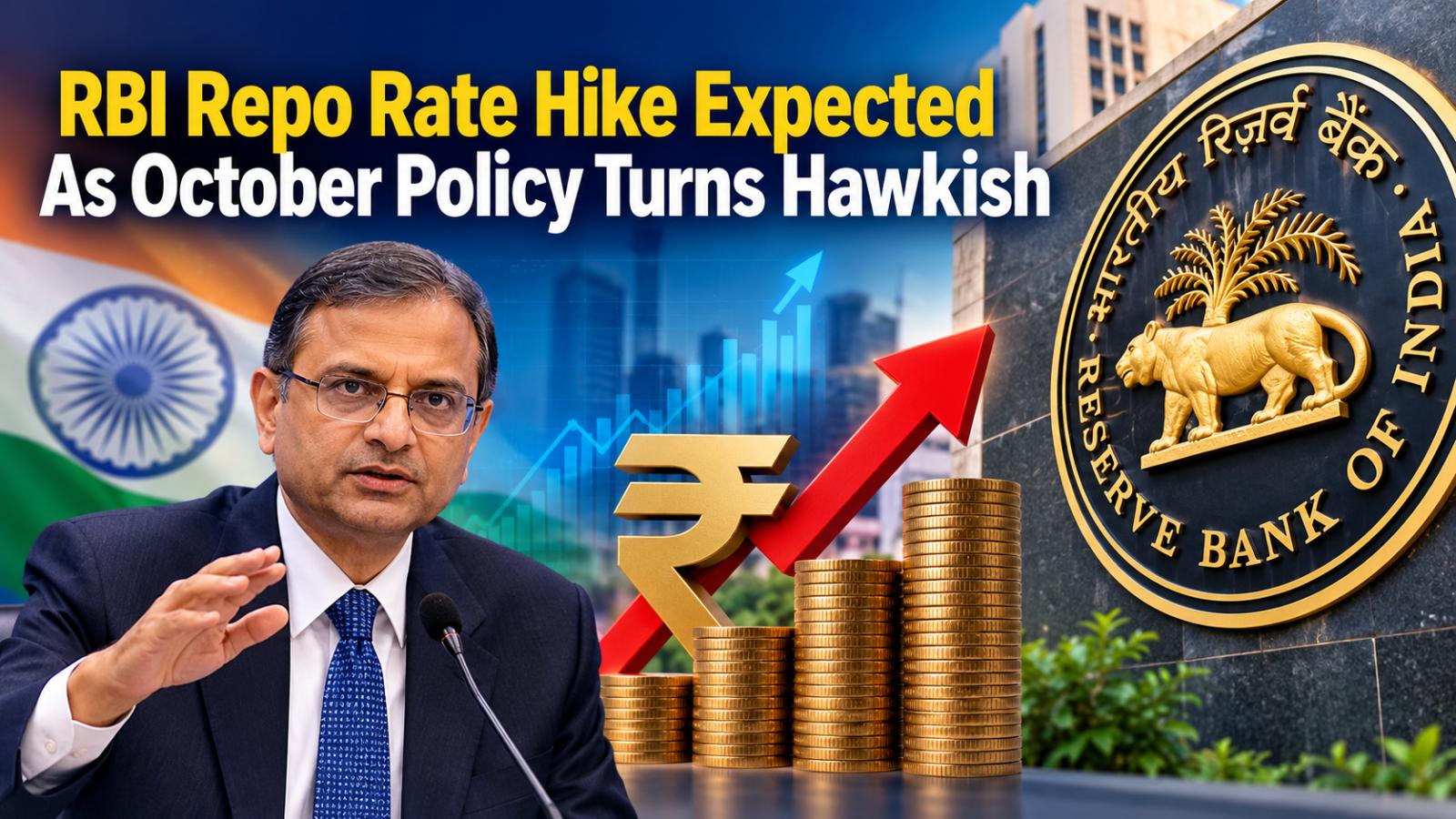
The Reserve Bank of India is set to announce its fourth bi-monthly monetary policy for FY27 on October 7, with financial markets closely watching whether the central bank will raise the repo rate for the first time since February 2023.
Economists expect the Monetary Policy Committee, led by RBI Governor Sanjay Malhotra, to consider a 25-basis-point increase that would take the benchmark repo rate to 5.50% from the current 5.25%.
The repo rate has remained at 5.25% for nearly 10 months after the RBI reduced rates by a cumulative 125 basis points during 2025, bringing the benchmark down from 6.50%.
This time, however, the economic environment looks different. Inflationary pressure, higher crude oil prices, rising global bond yields and a weaker rupee are creating challenges for policymakers. At the same time, major global central banks have become more cautious about inflation and interest rates, adding pressure on emerging economies such as India.
Markets have largely factored in the possibility of a 25-basis-point hike. The bigger question is whether the RBI will also change its policy stance and signal that additional rate increases could follow.
RBI MPC October policy faces rising inflation pressure
India’s inflation outlook has become a key concern for the central bank. Retail inflation has been running above the RBI’s 4% target, while wholesale price pressures have also remained elevated. A weaker rupee could add to these risks by making imported goods and commodities more expensive.
Higher crude oil prices are another challenge because India depends heavily on energy imports. A sustained increase in oil prices can raise transportation and manufacturing costs and eventually feed into consumer prices.
Economists broadly expect the RBI to take a cautious approach rather than move aggressively. A 25-basis-point hike would allow policymakers to respond to inflation without creating a sudden shock for borrowers, businesses and the wider economy.
Bond markets have already reacted to the possibility of higher interest rates. Short-term government bond and Treasury bill yields have risen in recent months, suggesting that investors have largely priced in a rate increase.
Attention is therefore shifting towards the RBI’s policy language. If the central bank moves away from a neutral stance towards a tighter position, investors may interpret it as a signal that October’s increase could be the beginning of a broader rate-hiking cycle.
RBI liquidity management and policy stance in focus
Liquidity management will also be an important part of the October policy. Despite inflation concerns, surplus liquidity in the banking system has kept overall financial conditions relatively comfortable.
The RBI could consider additional measures to absorb excess liquidity and ensure that any repo rate increase is transmitted effectively through the financial system. Open market operations and other liquidity-management tools could form part of that strategy.
For equity investors, a higher repo rate may create short-term pressure on interest-rate-sensitive sectors such as banking, automobiles and real estate. Higher borrowing costs can affect loan demand and business spending.
However, tighter monetary policy could also provide some support to the rupee and help reduce pressure from foreign investor outflows by improving India’s interest-rate differential with major global markets.
For bond investors, the RBI’s forward guidance may matter more than the expected 25-basis-point increase itself. Markets will closely examine Governor Sanjay Malhotra’s comments on inflation, economic growth, liquidity and the possibility of further rate hikes.
If the RBI raises rates on October 7, the move could mark an important turning point in India’s monetary policy cycle. The real signal for markets will be whether the central bank treats the hike as a limited response to current inflation risks or the start of a longer period of tighter monetary policy.