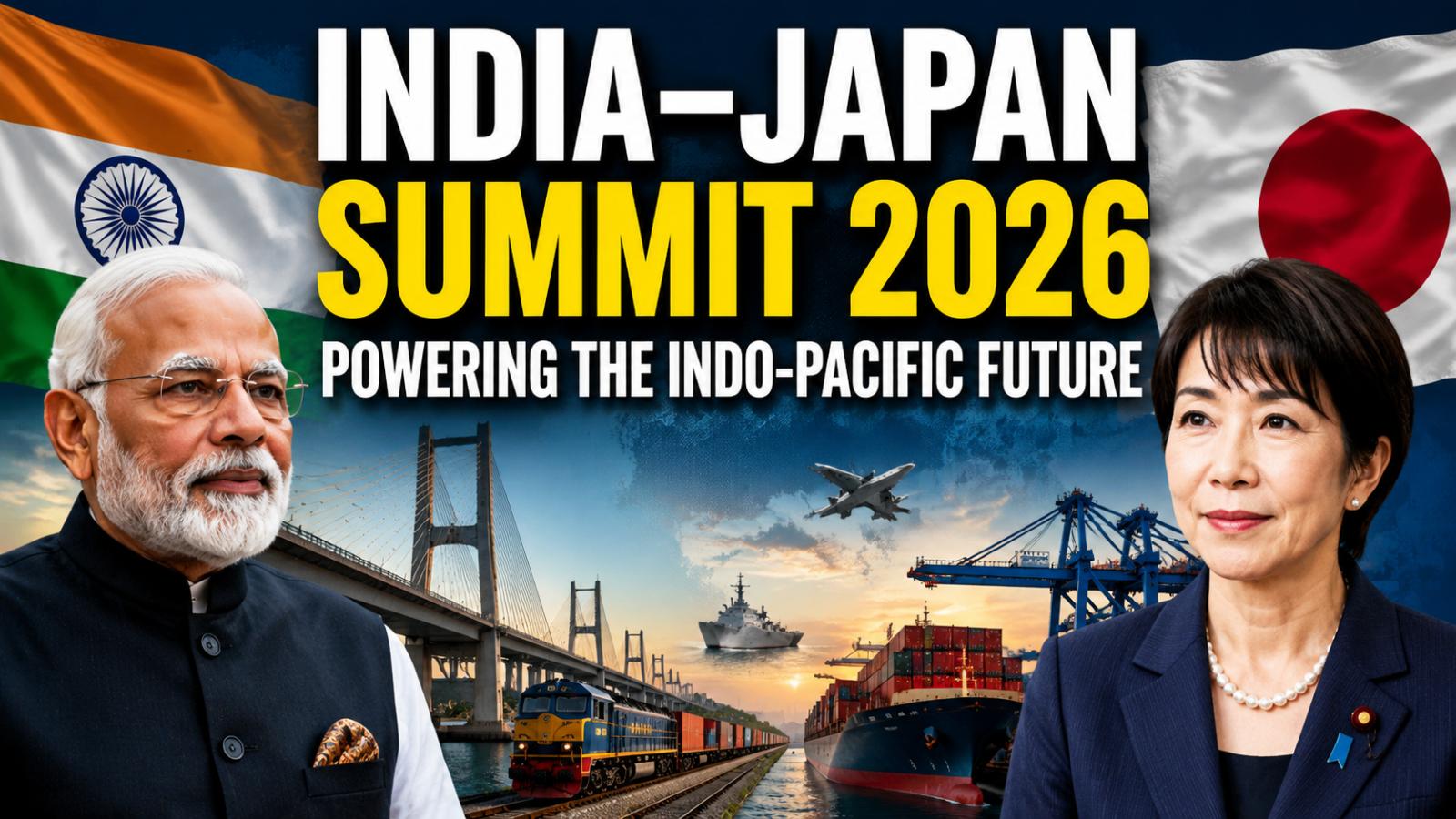
The latest round of strategic talks between India and Japan signals a shift from broad diplomatic alignment to project-driven cooperation. The visit by Japanese Prime Minister Sanae Takaichi marks a renewed focus on infrastructure delivery, supply chain redesign, and regional security coordination rather than symbolic assurances.
FOIP framework moves into implementation stage
The Free and Open Indo-Pacific vision is no longer being treated as a policy slogan. Both sides are now linking it to measurable outcomes such as maritime security coordination, logistics efficiency, and trade route diversification. The emphasis is on reducing vulnerabilities in existing sea lanes while building alternative economic pathways across Asia.
This approach also reflects a broader strategic response to shifting power dynamics in the Indo-Pacific, where economic routes and security concerns are increasingly intertwined.
Northeast India positioned as connectivity gateway
A major structural change in this partnership is the growing importance of India’s northeastern region as a trade corridor. Infrastructure such as the Dhubri–Phulbari bridge and the Matarbari port project are being viewed as integrated components of a longer supply chain extending toward Southeast Asia.
Rather than treating Northeast development as a domestic infrastructure agenda, both countries are aligning it with regional trade access. This could gradually reposition landlocked connectivity constraints into a transit advantage, especially for ASEAN-linked commerce.
Capital flows and industrial cooperation expand
Japan remains one of the largest sources of foreign direct investment for India, with long-term commitments aimed at expanding industrial capacity. Existing Japanese corporate presence in India already spans manufacturing, automotive, electronics, and services, but the new focus is shifting toward semiconductors, advanced manufacturing, and critical technology ecosystems.
The strategy is increasingly about supply chain resilience rather than cost-driven relocation, especially as global firms diversify away from concentrated production hubs.
Security coordination reflects regional pressure points
Defense cooperation between the two countries continues to deepen through multilateral exercises and intelligence sharing mechanisms. Maritime drills and joint training programs have become routine, reflecting a shared concern over regional stability in the Indo-Pacific.
Rising military activity across key sea lanes has pushed both sides to treat security cooperation as a structural necessity rather than a periodic engagement.
Strategic direction moving beyond diplomacy
The partnership is gradually evolving into a long-term economic and security architecture. Instead of isolated agreements, the current trajectory shows integrated planning across infrastructure, trade routing, and defense coordination.
The underlying shift is clear: India is becoming a central node in Japan’s Indo-Pacific strategy, while Japan is positioning itself as a key technology and capital partner in India’s growth roadmap.