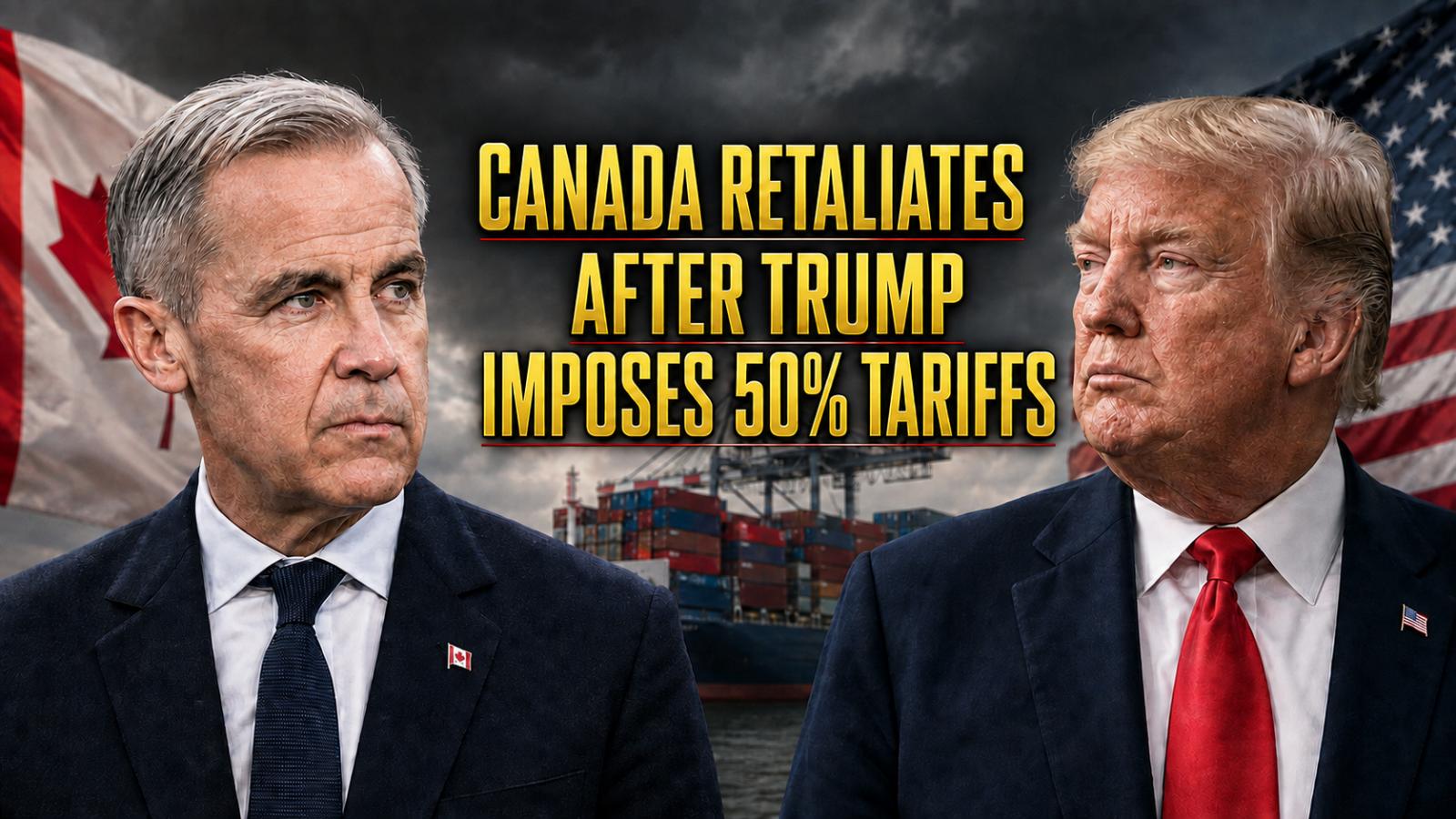
Canada retaliatory tariffs on US goods will begin September 8 after Trump’s 50% tariffs on Canada took effect. As Canada-US trade talks collapse, Mark Carney has promised a dollar-for-dollar response to protect Canadian industries and workers.
Canada-US trade talks collapse
Canadian Prime Minister Mark Carney has announced that Canada will impose retaliatory tariffs on American goods beginning September 8, escalating an already serious trade confrontation between the neighbouring countries.
The decision came after US President Donald Trump imposed 50% tariffs on nearly USD 20 billion worth of Canadian imports. The affected products reportedly include Canadian wine, dairy goods, cement, electronics and other consumer and industrial products.
Carney said Canada would respond “dollar for dollar” to defend its workers, businesses and economic interests. Ottawa’s planned countermeasures are expected to target American steel, dairy products, household appliances, agricultural machinery, electronics, pulp and paper, and other US-made goods.
The Canadian prime minister argued that Washington’s measures amounted to an economic attack on the country. His government had offered to remove existing counter-tariffs on American steel, aluminum and vehicles if the United States substantially reduced its own trade barriers.
However, negotiations ended without an agreement following more than a year of discussions and several days of last-minute meetings in Washington. Carney ordered the Canadian negotiating team to return to Ottawa, accusing the Trump administration of introducing unacceptable demands during the final stage of the talks.
According to Canada’s account, the revised American proposal offered fewer concessions for Canadian-made vehicles. It also sought conditions that could limit Canada’s ability to negotiate trade agreements with other countries and weaken protections related to sovereignty, language and culture.
US Trade Representative Jamieson Greer disputed Ottawa’s version of events. He said Washington had offered reductions covering lumber, steel and automobiles and argued that Canada had rejected a valuable opportunity. The United States has not indicated when formal negotiations might resume.
Trump’s 50% tariffs on Canada raise economic risks
The latest measures create uncertainty over the future of the United States-Mexico-Canada Agreement, the trade framework supporting deeply integrated supply chains across North America.
Canada is particularly exposed because more than 70% of its goods exports are shipped to the United States. International trade represents a significant share of the Canadian economy, while export-related industries support millions of jobs.
Ontario Premier Doug Ford backed Carney’s position and called for Canada to match every American tariff. Political and business leaders have also urged Ottawa to provide financial support for industries likely to suffer from declining exports and rising production costs.
The confrontation could affect manufacturers and consumers on both sides of the border. Companies that rely on cross-border materials may face higher costs, delayed shipments and difficulty planning future investments. Those additional expenses could eventually be passed on to households through higher retail prices.
Long-running disputes involving dairy market access, softwood lumber, steel and automobile production are also becoming harder to resolve. The tariff escalation may encourage Canada to develop alternative export markets, but replacing American demand would be difficult and could take several years.
Ottawa now faces a difficult balance: it must defend Canadian industries without imposing unnecessary costs on its own consumers. Retaliatory tariffs may increase pressure on Washington, but they can also raise prices for Canadian companies that depend on American machinery, components and raw materials.
Unless the two governments return to negotiations, the September 8 counter-tariffs could mark the start of a longer economic confrontation. The immediate dispute concerns tariffs, but its wider consequences could reshape trade, investment and political relations across North America.