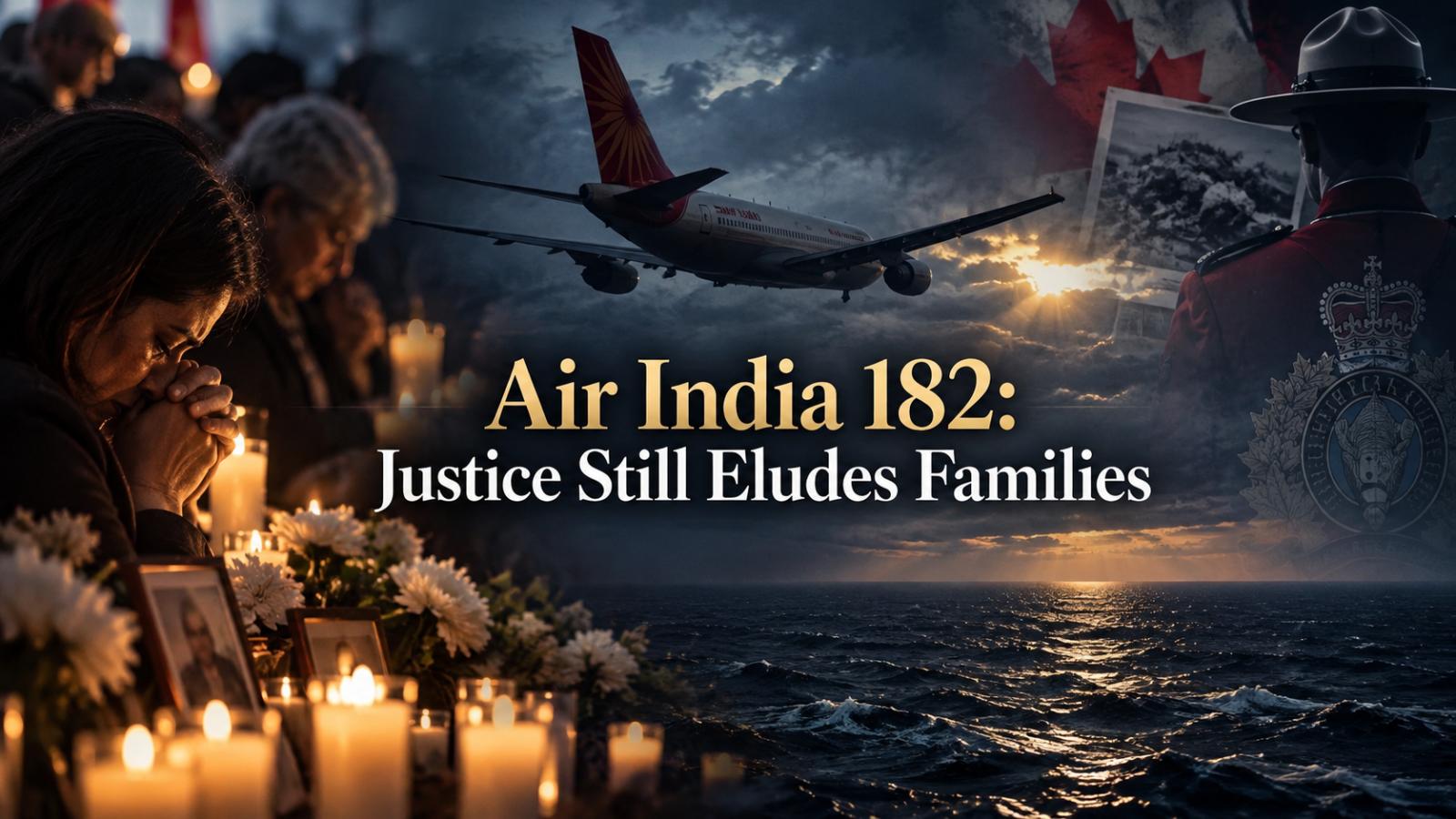
Forty-one years after the Air India Flight 182 bombing, families of the 329 victims are again confronting painful questions over justice. Canada’s RCMP says no suspects are currently under active consideration, although the investigation remains open, renewing frustration over one of the country’s deadliest terror attacks.
Air India 182 probe remains open after 41 years
More than four decades after Air India Flight 182 was destroyed by a bomb over the Atlantic, the Air India 182 probe has reached another painful stage. Canada's RCMP says there are currently no suspects or persons of interest under consideration, even as the case formally remains open and families of the 329 victims continue to seek answers.
The June 23, 1985 bombing remains the deadliest terrorist attack in Canadian history. Flight 182 was travelling from Canada toward India when a bomb exploded while the aircraft was off the coast of Ireland, killing everyone aboard. A second bomb linked to the plot exploded at Japan's Narita Airport the same day, killing two baggage handlers. The Canadian government has officially described Flight 182 as a defining national tragedy.
RCMP probe status leaves families searching for answers
RCMP representatives met relatives of victims in Toronto on September 12, 2026, to provide an update on the investigation. Police said investigators had examined an individual commonly referred to as “Mr. X,” but could not establish a definitive link between that person and the bombing.
The RCMP subsequently said no other suspects or persons of interest are currently under consideration. However, it stressed that the investigation has not been formally closed and that any credible new information will be examined.
For families who have spent 41 years waiting for accountability, the update has triggered renewed frustration. Several relatives have argued that an inactive investigation risks leaving major questions unanswered.
Victim families still await wider accountability
Only one person, Inderjit Singh Reyat, was convicted in connection with the bombing plot. Ripudaman Singh Malik and Ajaib Singh Bagri were acquitted in 2005. Talwinder Singh Parmar, identified by investigators as a key figure in the conspiracy, died in India in 1992.
The limited number of convictions has remained one of the most difficult aspects of the case for relatives. The latest RCMP update has therefore reopened a wider debate over whether Canadian authorities exhausted every realistic avenue for establishing responsibility.
1985 inquiry exposed major security failures
Canada's Commission of Inquiry into the bombing issued its final report in 2010 after examining intelligence, policing, aviation security and government coordination. The inquiry concluded that serious failures across Canada's security system contributed to the circumstances surrounding the attack and made extensive recommendations for reform.
The inquiry also examined weaknesses in aviation security and information-sharing between agencies. Its findings helped reshape how Canada viewed the bombing: not simply as an attack on an overseas airline, but as a Canadian terrorist tragedy involving profound institutional failures.
Extremist threat remains part of Canada-India debate
The Air India bombing continues to influence discussions about violent Khalistani extremism and Canada-India security relations. Canadian security assessments distinguish peaceful advocacy for Khalistan from individuals or networks linked to politically motivated violence.
Recent Canadian intelligence reporting has again identified violent Khalistani extremism as a national-security concern, while India has continued raising concerns about extremist activity directed at Indian interests from Canadian soil.